
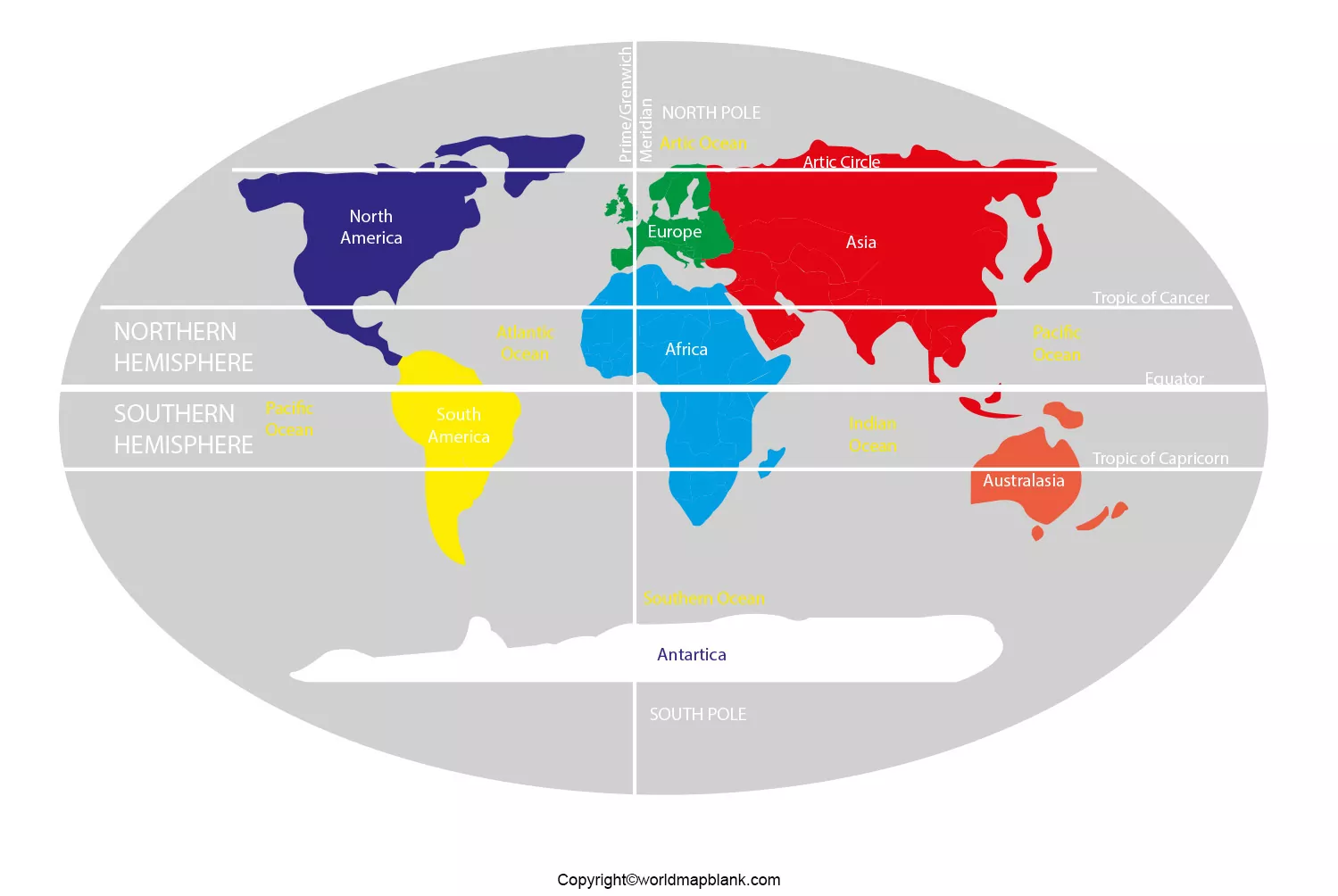

A world map with hemispheres helps you understand how Earth is divided into the Northern, Southern, Eastern, and Western Hemispheres. This printable world map with continents is useful for students, teachers, geography lessons, homework, and classroom activities.
Use the labeled maps below to identify the Equator, Prime Meridian, continents, and major geographical regions. You can also download the available PDF versions for printing and offline study.
- World coronavirus map
- World geographical map
- World Map Wallpaper
- World population map
- Accurate map of World
- Ancient World map
World Map with Hemispheres Labeled
A labeled world map with hemispheres makes it easier to understand Earth’s major geographical divisions. The Equator, located at 0° latitude, divides Earth into the Northern and Southern Hemispheres. The Prime Meridian, located at 0° longitude, provides the reference for measuring longitude east and west.
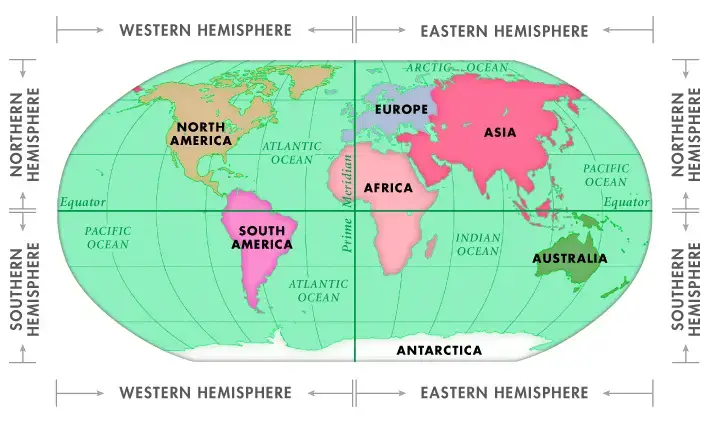
The Northern Hemisphere includes North America, Europe, most of Asia, the northern part of South America, and much of Africa. The Southern Hemisphere includes Australia, Antarctica, most of South America, the southern part of Africa, and some islands in Asia and Oceania.
The Eastern and Western Hemispheres are commonly illustrated using the Prime Meridian and the 180° meridian as reference lines. However, geographical descriptions can vary slightly depending on the convention used to define their boundaries.
World Map with Hemispheres and Continents
A world map with hemispheres and continents combines two important geographical concepts in one illustration. It helps readers compare the position of continents with the Equator and Prime Meridian.
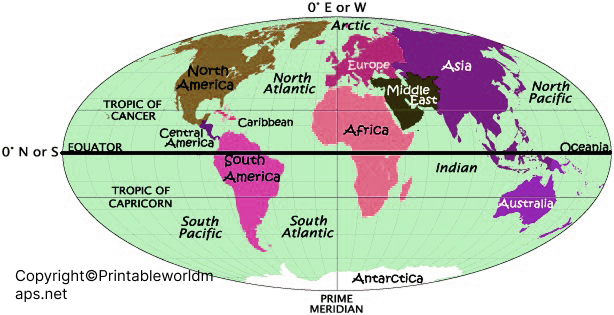
In the commonly taught seven-continent model, the continents are Asia, Africa, North America, South America, Antarctica, Europe, and Australia. Some educational systems use alternative continent models, including models that combine Europe and Asia as Eurasia.
The Equator crosses parts of South America, Africa, and Asia, as well as surrounding oceans. It is an important reference line for studying latitude and understanding the location of tropical regions.
The Prime Meridian passes through Europe and Africa before continuing south across the Atlantic Ocean toward Antarctica. Together with other longitude reference lines, it helps describe locations east and west around Earth.
Map of World with Hemispheres
A map of the world with hemispheres is useful for learning how latitude and longitude describe locations. The Northern and Southern Hemispheres are separated by the Equator, while the Eastern and Western Hemispheres are commonly represented using the Prime Meridian and the opposite meridian.

These divisions are useful for comparing continents, locating countries, and understanding global geography. Remember that a country or continent can extend across a reference line, meaning it may occupy more than one hemisphere.
For example, South America extends across the Equator, so parts of the continent lie in both the Northern and Southern Hemispheres. Africa also extends across the Equator and the Prime Meridian.
Hemispheres World Map
A hemispheres world map provides a visual overview of Earth’s major geographical regions. It can help students identify which continents are primarily in each hemisphere and understand why the Equator and Prime Meridian are important.
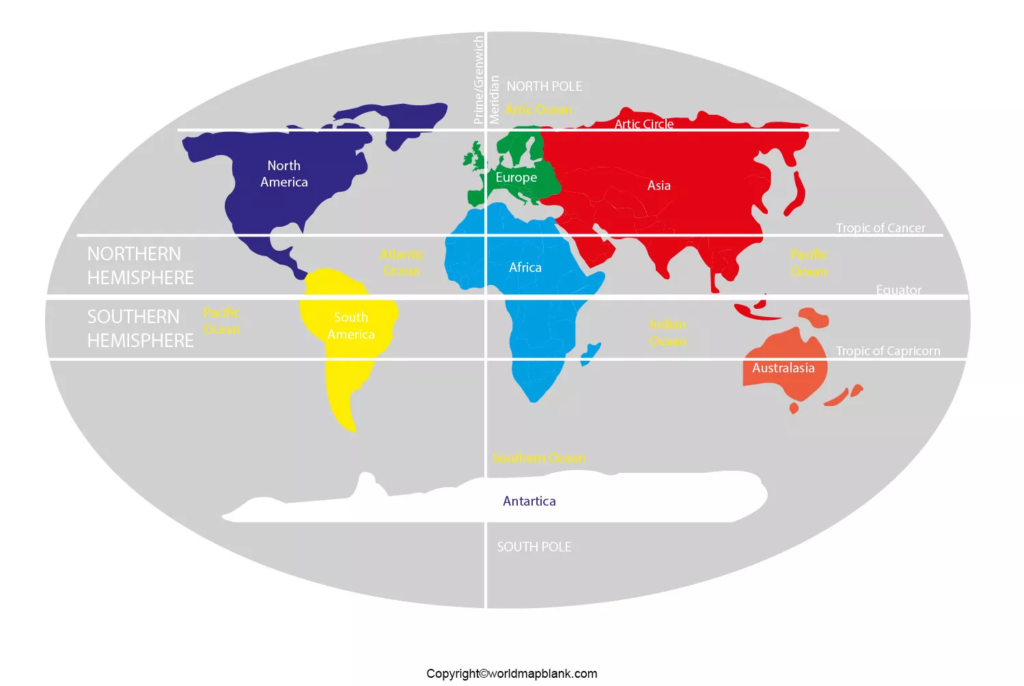
The Eastern Hemisphere contains most of Earth’s land area, including Asia, Australia, most of Europe, and much of Africa. The Western Hemisphere contains North America, most of South America, Greenland, and many Caribbean islands, along with portions of other regions.
The Northern Hemisphere contains most of Earth’s land area and a large share of its population. The Southern Hemisphere includes Australia, Antarctica, much of the Pacific and Indian Oceans, and substantial portions of the Atlantic Ocean.
These descriptions refer to broad geographical patterns rather than absolute divisions of entire continents or countries.
Understanding the Four Hemispheres of Earth
Earth can be divided into two equal halves in different ways. Four commonly studied hemispheres are the Northern, Southern, Eastern, and Western Hemispheres.
1. Northern Hemisphere
The Northern Hemisphere is the half of Earth north of the Equator. It includes North America, Europe, most of Asia, northern parts of South America, and much of Africa.
In the Northern Hemisphere, astronomical summer occurs around June to September, while astronomical winter occurs around December to March. The exact seasons and their dates vary by location and hemisphere.
2. Southern Hemisphere
The Southern Hemisphere is the half of Earth south of the Equator. It includes Antarctica, Australia, most of South America, southern parts of Africa, and many islands across the Pacific and Indian Oceans.
Its astronomical seasons are opposite to those in the Northern Hemisphere. Summer generally occurs around December to March, while winter occurs around June to September.
3. Eastern Hemisphere
The Eastern Hemisphere is commonly described as the half of Earth east of the Prime Meridian and west of the 180° meridian. It contains most of Asia, Australia, much of Europe, and large portions of Africa.
The exact boundary convention matters because the 180° meridian crosses some island regions. Some maps instead use the 20°W and 160°E meridians to define the hemispheres while keeping the Americas largely in the Western Hemisphere.
4. Western Hemisphere
The Western Hemisphere is commonly described as the half of Earth west of the Prime Meridian and east of the 180° meridian. It includes North America, most of South America, Greenland, Central America, and the Caribbean.
Parts of Europe and Africa also lie west of the Prime Meridian. Therefore, it is not accurate to assume that every part of Europe and Africa belongs to the Eastern Hemisphere.
What Are the Equator and Prime Meridian?
The Equator and Prime Meridian are reference lines used to describe positions on Earth.
The Equator: This imaginary circle lies at 0° latitude and divides Earth into the Northern and Southern Hemispheres. Latitude measures how far north or south a location is from the Equator.
The Prime Meridian: This reference line lies at 0° longitude and passes through Greenwich, England. Longitude measures how far east or west a location is from the Prime Meridian.
The 180° meridian lies approximately opposite the Prime Meridian and is associated with the International Date Line. The International Date Line does not follow the 180° meridian exactly everywhere because it bends around countries and island groups.
Interesting Facts About World Hemispheres
- Earth is divided into Northern and Southern Hemispheres by the Equator.
- The Prime Meridian is the international reference for 0° longitude.
- The Equator is a great circle and is approximately 40,075 kilometres long.
- The Northern and Southern Hemispheres experience opposite astronomical seasons.
- The Eastern Hemisphere contains most of Earth’s land area.
- The Southern Hemisphere contains Antarctica and Australia.
- The seven-continent model is widely used in schools, although other continent models exist.
How to Use a Printable World Map with Hemispheres
A printable hemisphere map can support geography lessons, school projects, revision, and classroom exercises.
- Download the PDF file linked above.
- Open the file in a PDF reader and check the page orientation.
- Print the map using a suitable paper size, such as A4 or Letter, if supported by the PDF.
- Locate the Equator and identify the Northern and Southern Hemispheres.
- Find the Prime Meridian and compare the Eastern and Western Hemispheres.
- Label the continents or mark selected countries to practise geographical identification.
For classroom activities, teachers can ask students to identify continents crossed by the Equator or compare the seasons in the two hemispheres.
Frequently Asked Questions
What are the four hemispheres of Earth?
The four commonly studied hemispheres are the Northern, Southern, Eastern, and Western Hemispheres. The Equator separates the Northern and Southern Hemispheres, while longitude reference lines define the Eastern and Western Hemispheres.
Where can I download a world map with hemispheres in PDF?
You can use the PDF download links in the sections above to access the available world maps. Check each file before printing to confirm that it contains the labels and geographical details you need.
Which continents are in the Northern Hemisphere?
North America and Europe are entirely north of the Equator in standard continental definitions. Asia, Africa, and South America extend across the Equator, while Australia and Antarctica are in the Southern Hemisphere.
Which continents are in the Southern Hemisphere?
Australia and Antarctica are entirely in the Southern Hemisphere. South America and Africa extend across the Equator, so only parts of those continents are south of it.
Does the Equator pass through any continents?
Yes. The Equator crosses South America, Africa, and Asia, including islands in the Indonesian region. It also crosses several oceans.
What is the difference between latitude and longitude?
Latitude measures a location’s angular distance north or south of the Equator. Longitude measures its angular distance east or west of the Prime Meridian.
Why are world hemisphere maps useful for students?
They help students understand global location, latitude, longitude, continental distribution, and the relationship between geographical reference lines and Earth’s major regions.
Can I print a world map with continents and hemispheres?
Yes. Download one of the linked PDF files and print it using the page settings supported by your PDF reader and printer. Check the map’s labels and scale before using it for detailed study.
Reference links
https://education.nationalgeographic.org/resource/hemisphere
https://education.nationalgeographic.org/resource/prime-meridian
https://education.nationalgeographic.org/resource/mapmaker-latitude-longitude
https://education.nationalgeographic.org/resource/longitude
https://education.nationalgeographic.org/resource/great-circle
https://science.nasa.gov/learn/basics-of-space-flight/chapter2-1

70 thoughts on “Printable World Map with Hemispheres and Continents in PDF”