

A Labeled Map of Albania helps you identify the country’s capital, major cities, administrative regions, neighboring countries, and surrounding seas. Located in southeastern Europe on the western side of the Balkan Peninsula, Albania is known for its Adriatic and Ionian coastlines, mountainous landscapes, and historic cities.
This collection includes labeled maps of Albania, maps showing its administrative divisions, city maps, and a map highlighting the capital, Tirana. You can use these maps for geography lessons, school assignments, travel planning, and general reference.
- World map with continents
- Physical world map
- Political world map
- Labeled map of Asia
- Labeled map of Africa
- Labeled map of Europe
- Labeled map of South America
- World time zone map
- Labeled map of World
- Blank map of world
- Labeled map of North America
- Blank map of Asia
- World map with oceans
- World map poster
Labeled Map of Albania
Albania covers approximately 28,748 square kilometers. It shares land borders with Montenegro to the north, Kosovo to the northeast, North Macedonia to the east, and Greece to the south and southeast. The Adriatic Sea lies along its western coast, while the Ionian Sea borders the southwestern coast.
Tirana is the capital and an important center of government, business, education, and culture. Other notable urban centers include Durrës, Shkodër, Vlorë, Elbasan, Korçë, and Fier.
Use the labeled map below to locate Albania and understand its position in southeastern Europe.
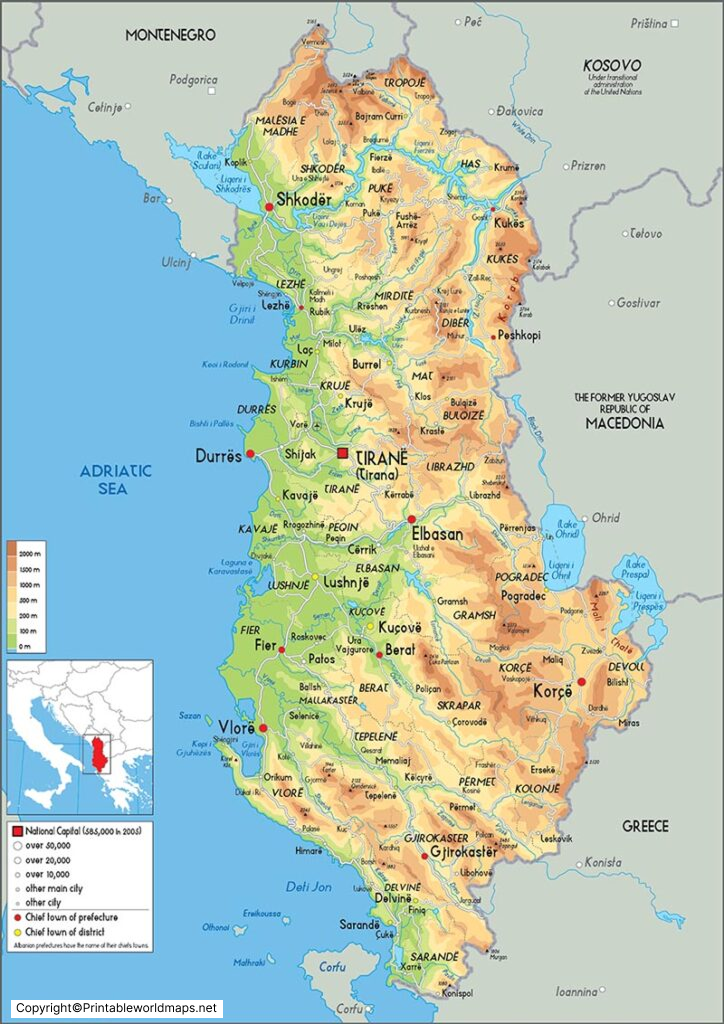
Labeled Map of Albania with States
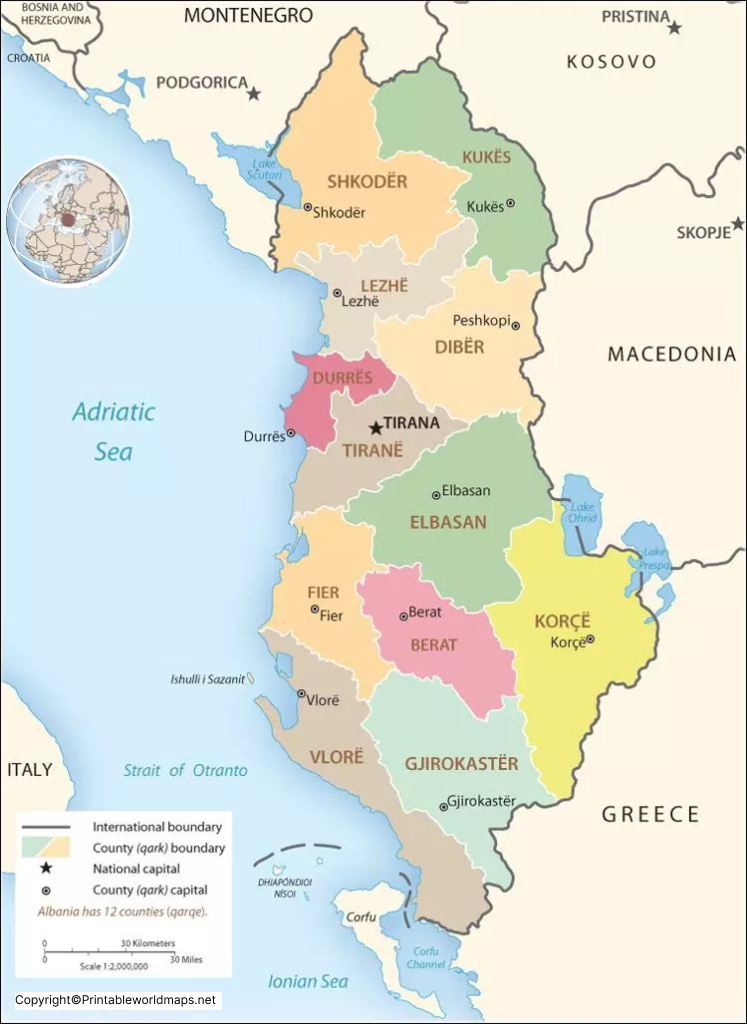
Albania is administratively divided into 12 prefectures (counties) and 61 municipalities. These are the appropriate modern administrative terms rather than states, which Albania does not have in the same sense as countries organized as federal states.
The 12 prefectures are:
- Berat
- Dibër
- Durrës
- Elbasan
- Fier
- Gjirokastër
- Korçë
- Kukës
- Lezhë
- Shkodër
- Tiranë
- Vlorë
A labeled administrative map can help you locate these prefectures and understand how Albania is organized. Municipalities are the first-level local government units, while prefectures form a higher administrative level.
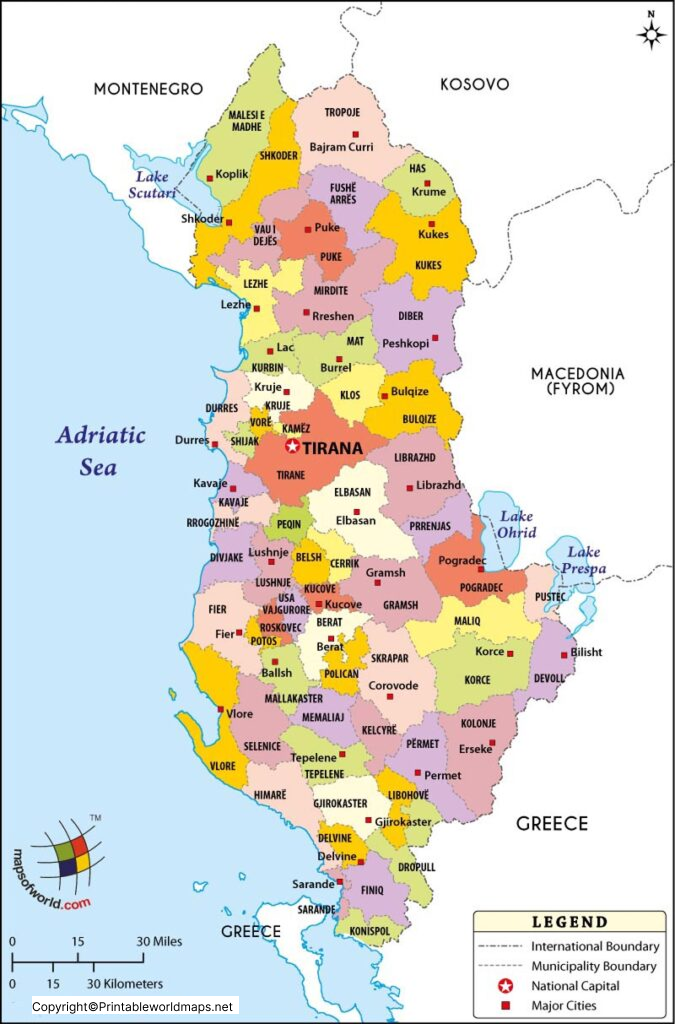
Labeled Map of Albania with Cities
A labeled city map helps readers identify Albania’s principal urban areas and understand their locations in relation to the country’s coast, mountains, and neighboring regions.
Some important cities and towns include:
- Tirana: The national capital and a major economic and cultural center.
- Durrës: A coastal city and an important port on the Adriatic Sea.
- Shkodër: A historic city in northwestern Albania, near Lake Shkodër.
- Vlorë: A coastal city near the meeting area of the Adriatic and Ionian seas.
- Elbasan: A city in central Albania with historical and industrial significance.
- Fier: An important regional center in southwestern Albania.
- Korçë: A city in southeastern Albania known for its cultural heritage.
- Berat: A historic city recognized for its distinctive Ottoman-era architecture.
- Gjirokastër: A historic southern city known for its traditional stone houses.
- Sarandë: A coastal destination in southern Albania.
The names and number of places shown on a map depend on its scale and publication date. For accurate geographic reference, check the spelling of place names and distinguish cities from villages and other settlements.

Labeled Albania with Capital
Tirana is the capital of Albania. It is located in the central part of the country, near Mount Dajti and approximately 30 kilometers from the Adriatic coast, according to Albania’s official tourism authority.
The city became Albania’s capital in 1920 and has developed into the country’s principal political, administrative, educational, and commercial center. Its location makes it a useful reference point when studying Albania’s road connections and regional geography.
A labeled map highlighting Tirana helps students and travelers distinguish the national capital from other important cities, including Durrës, Shkodër, Vlorë, and Elbasan.
Geography and Location of Albania
Albania lies in southeastern Europe and occupies part of the western Balkan Peninsula. Its landscape includes mountain ranges, inland valleys, plains, lakes, and a long coastline. The country is geographically diverse despite its relatively small area.
The Adriatic coast extends along western Albania, while the Ionian coast is found farther south. The northern and eastern parts of the country contain mountainous terrain, and the western lowlands include important agricultural and urban areas.
These geographic features influence settlement patterns, transportation routes, tourism, and economic activity. A physical map is useful for identifying terrain, rivers, and lakes, while a political or administrative map is better for locating borders, prefectures, and cities.
Important Facts About Albania
- Official name: Republic of Albania
- Capital: Tirana
- Region: Southeastern Europe
- Total area: Approximately 28,748 km²
- Official language: Albanian
- Currency: Albanian lek (ALL)
- Administrative divisions: 12 prefectures and 61 municipalities
- Neighboring countries: Montenegro, Kosovo, North Macedonia, and Greece
- Seas: Adriatic Sea and Ionian Sea
- Population reference: Albania’s 2023 population census recorded 2,402,113 residents. This is a census figure, not a current population estimate.
For updated population figures and administrative statistics, consult Albania’s Institute of Statistics (INSTAT).
How to Use a Labeled Map of Albania
A labeled map can support several types of learning and planning:
- Geography education: Locate Albania, its capital, neighboring countries, and surrounding seas.
- School projects: Use city and administrative maps to prepare presentations and assignments.
- Travel planning: Identify major cities and understand their approximate geographic positions before planning a route.
- Regional studies: Compare Albania’s coastline, mountains, plains, and neighboring Balkan countries.
- Map practice: Use a labeled map as a reference before testing your knowledge with a blank map.
For printing, open the PDF version and check the page orientation and print scaling. Choose a size that keeps city labels and boundary lines readable.
Frequently Asked Questions
1. What is the capital of Albania?
Tirana is the capital of Albania. It is located in the central part of the country and serves as its principal political and administrative center.
2. How many states does Albania have?
Albania does not have states in the usual federal-system sense. It is administratively divided into 12 prefectures and 61 municipalities.
3. What are the 12 prefectures of Albania?
The 12 prefectures are Berat, Dibër, Durrës, Elbasan, Fier, Gjirokastër, Korçë, Kukës, Lezhë, Shkodër, Tiranë, and Vlorë.
4. Which countries border Albania?
Albania shares land borders with Montenegro, Kosovo, North Macedonia, and Greece. The Adriatic and Ionian seas lie along its western and southwestern coasts.
5. Where can I download a labeled map of Albania?
You can download the printable PDF maps provided in this article, including maps of Albania, its cities, its administrative divisions, and its capital.
6. What is the area of Albania?
Albania covers approximately 28,748 square kilometers, according to official country-profile and statistical references.
7. Which are some of the major cities in Albania?
Major cities include Tirana, Durrës, Shkodër, Vlorë, Elbasan, Fier, Korçë, Berat, Gjirokastër, and Sarandë.
8. What is the population of Albania?
Albania’s 2023 population census recorded 2,402,113 residents. Population estimates can differ from census results because they use different dates and statistical methods. Consult INSTAT for the latest official estimate.
Conclusion
A labeled map of Albania is a useful reference for learning about the country’s capital, major cities, administrative divisions, neighboring countries, and physical geography. The printable maps above can help with schoolwork, geographic research, and travel preparation.
For reliable statistics and current administrative information, compare map labels with official Albanian government and statistical sources. This is especially important when using older maps that may reflect outdated place names or administrative classifications.
Reference links
https://www.instat.gov.al/en/themes/demography-and-social-indicators/population
https://akt.gov.al/en/cities/tirane
https://www.instat.gov.al/media/12917/regional-statistical-yearbook-2023__.pdf
