
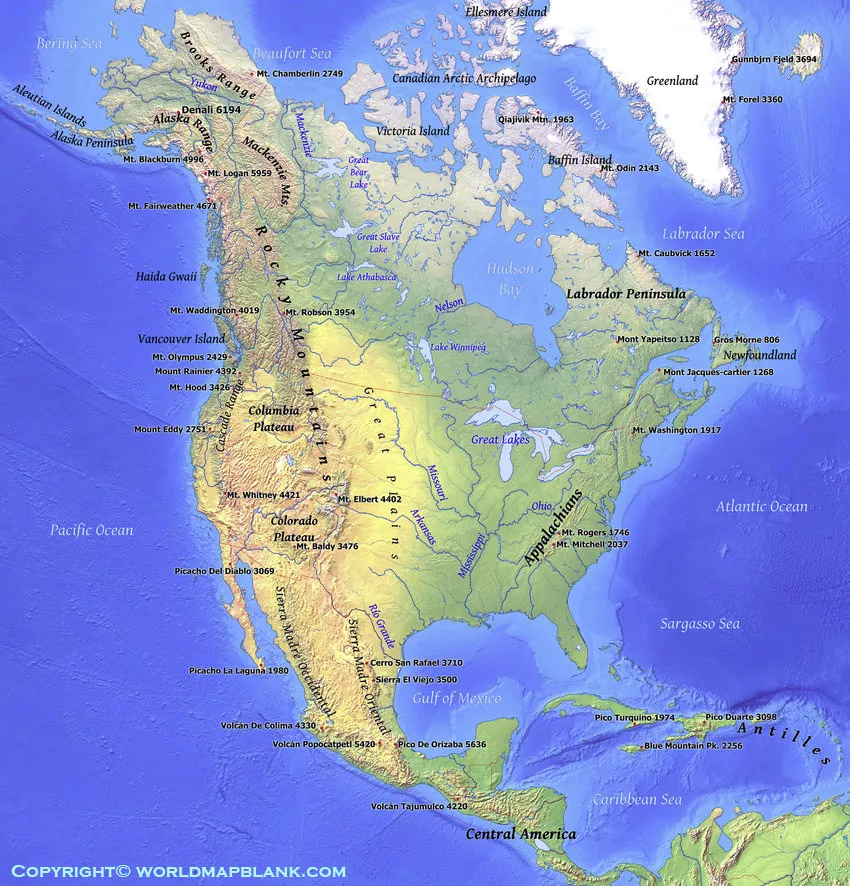

Explore the North America Mountains Map to identify the continent’s major mountain ranges, understand their locations, and learn important physical geography facts. This page includes printable mountain maps and PDF downloads for students, teachers, geography enthusiasts, and anyone studying North American landforms.
Use the maps below to explore mountain systems across Canada, the United States, Mexico, and other parts of the continent. You can view the images online or download the available PDF files for offline study, classroom activities, and geography projects.
- World coronavirus map
- World geographical map
- World Map Wallpaper
- World population map
- Accurate Map of the World
- Ancient World map
Map of North America Mountains
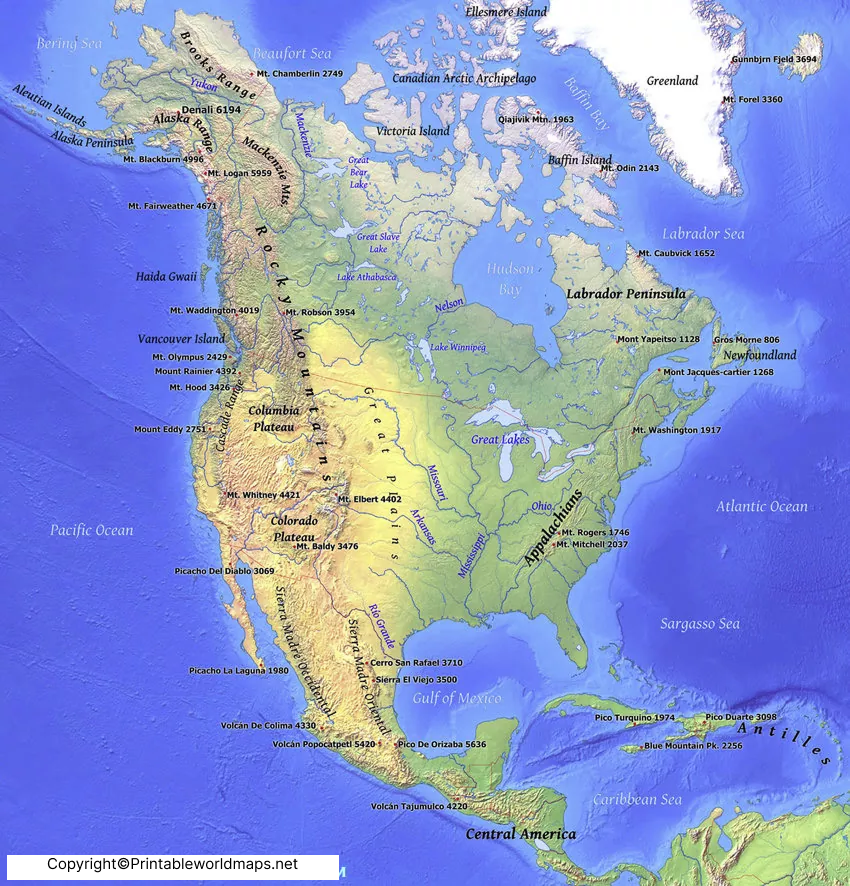
North America has a varied physical landscape that includes extensive mountain systems, plateaus, plains, valleys, and coastal regions. Its major mountain ranges are especially prominent in the western part of the continent, while the Appalachian Mountains extend along the east.
A physical mountain map helps readers understand where these ranges are located and how they relate to surrounding countries, states, provinces, and other geographical features.
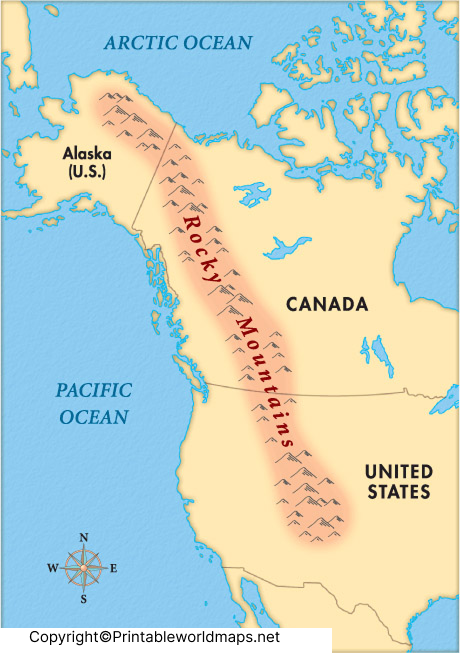
Map of North America Rocky Mountains
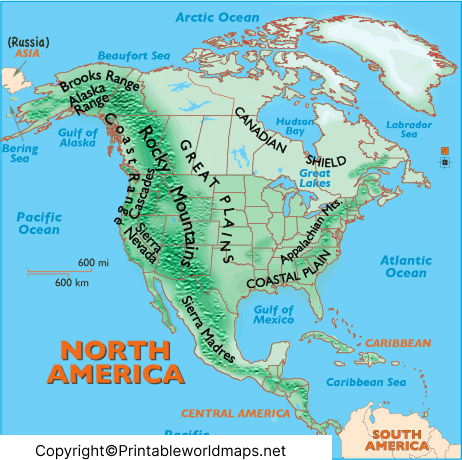
The Rocky Mountains are one of North America’s best-known mountain systems. They extend through western Canada and the United States, reaching south into New Mexico. The region contains many individual mountain ranges, high peaks, valleys, forests, and alpine environments.
The Rocky Mountains are important for understanding the continent’s physical geography, water resources, wildlife habitats, and outdoor recreation. A labeled mountain map can help students trace the range across national and regional boundaries.
North America Mountains Map
The North America Mountains Map provides a useful starting point for exploring the continent’s major mountain systems. Seven important ranges and mountain regions to learn about are the Rocky Mountains, Appalachian Mountains, Alaska Range, Sierra Nevada, Cascade Range, Brooks Range, and Sierra Madre Occidental.
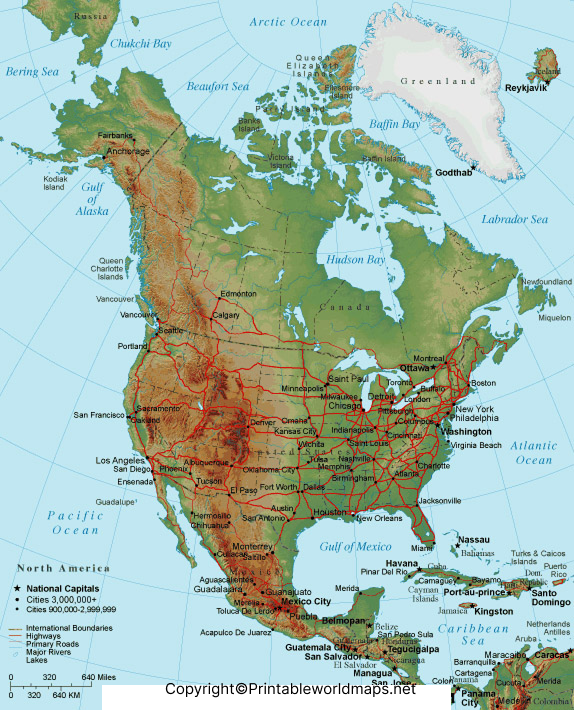
These mountain systems differ in elevation, geological history, climate, and landscape. Some contain high alpine peaks and glaciers, while others are characterized by forested slopes, volcanic landscapes, or older, heavily eroded mountains.
7 Major Mountain Ranges in North America
1. Rocky Mountains
The Rocky Mountains extend from western Canada through the western United States to New Mexico. They contain numerous individual ranges and are a major feature of the continent’s western interior.
2. Appalachian Mountains
The Appalachian Mountains stretch across eastern North America, from eastern Canada into the eastern United States. They are geologically older than many of the prominent high mountain systems in the west and have been extensively shaped by erosion.
3. Alaska Range
Located in southern Alaska, the Alaska Range contains Denali, the highest mountain in North America, with an official elevation of 20,310 feet (6,190 metres).
4. Sierra Nevada
The Sierra Nevada lies mainly in eastern California, with part of the range extending into Nevada. It is known for its granite landscapes, high peaks, deep valleys, and important mountain watersheds.
5. Cascade Range
The Cascade Range extends through western North America, including parts of British Columbia, Washington, Oregon, and northern California. It includes numerous volcanoes and is an important part of the region’s geological landscape.
6. Brooks Range
The Brooks Range stretches across northern Alaska. It forms a major mountainous region in the Arctic and includes remote landscapes with tundra, valleys, and wildlife habitats.
7. Sierra Madre Occidental
The Sierra Madre Occidental is a major mountain system in western Mexico. Its rugged terrain, deep canyons, forests, and high plateaus make it an important feature of Mexico’s physical geography.
The exact boundaries of mountain systems depend on the geographical classification being used. Use a detailed physical or geological map when you need precise boundaries rather than a general educational overview.
Map of North America Mountains Physical
A physical map emphasizes natural features such as mountains, plains, plateaus, rivers, lakes, and elevation differences. Depending on its design, a mountain map may use colors, shaded relief, labels, or contour lines to communicate the shape of the land.
These maps are useful for geography lessons, school assignments, revision, and introductory research. Before using a map for a detailed project, check its legend, scale, labels, and publication information.
The maps provided on this page can be viewed online, and the linked PDF files can be used for printing if the files are available. Print settings, image resolution, and the original page size can affect the final result.
How to Use a Printable North America Mountains Map
- Open the map image to inspect its labels and geographical coverage.
- Select the associated PDF link if you prefer a printable file.
- Check the map legend and identify the mountain ranges shown.
- Compare the ranges with a reliable physical or geological reference map.
- For classroom use, label the ranges, nearby countries, major peaks, and surrounding geographical features.
For the clearest printed result, select a suitable paper size and check the print preview before printing. If the map contains small labels, use a larger paper size where supported.
Interesting Facts About North American Mountains
- Highest peak: Denali, in Alaska, is the highest mountain in North America at 20,310 feet (6,190 metres) above sea level.
- Extensive mountain system: The Rocky Mountain region includes more than 100 individually named ranges, according to a U.S. Geological Survey reference.
- Different geological histories: North America’s mountain systems formed through different processes, including tectonic uplift, volcanic activity, and the collision or movement of crustal plates.
- Older eastern mountains: The Appalachian Mountains have a long geological history and have been substantially reshaped by erosion.
- Important water sources: Mountain snowpack and watersheds contribute to river systems and freshwater supplies in many regions.
- Varied ecosystems: North American mountains support habitats ranging from forests and alpine meadows to tundra and glacier environments.
These facts provide context for reading the map and understanding why mountain ranges are important to the continent’s landscape.
Why Are North America’s Mountain Ranges Important?
Mountain ranges influence regional climate, precipitation, river systems, biodiversity, and human activities. Higher elevations generally experience different temperatures and growing conditions from nearby lowlands, while mountains can affect how air masses and precipitation move across a region.
Mountains also support tourism, scientific research, outdoor recreation, and the conservation of natural habitats. Their geological features help scientists understand how the continent developed over millions of years.
A physical map is a useful first step, but a topographic or geological map may be more appropriate for advanced research involving elevation, rock formations, or tectonic history.
Frequently Asked Questions
1. What are the major mountain ranges in North America?
Major mountain systems include the Rocky Mountains, Appalachian Mountains, Alaska Range, Sierra Nevada, Cascade Range, Brooks Range, and Sierra Madre Occidental.
2. What is the highest mountain in North America?
Denali in Alaska is the highest mountain in North America. Its official elevation is 20,310 feet (6,190 metres) above sea level.
3. Where are the Rocky Mountains located?
The Rocky Mountains extend through western Canada and the United States, reaching south into New Mexico.
4. Can I download a North America Mountains Map PDF?
Yes. This page provides links to several PDF files associated with the mountain map images. Open the relevant PDF link to check its availability and download or print the file.
5. What is the difference between a physical map and a mountain map?
A physical map shows natural landforms and water features across a wider area. A mountain map focuses on mountain ranges, peaks, and related geographical features, although some maps combine both purposes.
6. Are the Appalachian Mountains in western North America?
No. The Appalachian Mountains are in eastern North America, extending from eastern Canada into the eastern United States.
7. How can students use a North America Mountains Map?
Students can locate mountain ranges, compare their positions, learn about major peaks, and study the relationship between mountains, rivers, climate, and surrounding regions.
8. What is the best map for studying mountain elevations?
A topographic map is generally more suitable for detailed elevation study because it may include contour lines, elevation points, and other terrain information. A general physical map is useful for learning the locations of major ranges.
Reference links
https://www.usgs.gov/publications/rocky-mountains
https://pubs.usgs.gov/of/1998/of98-140/
https://www.usgs.gov/news/national-news-release/new-elevation-nations-highest-peak
https://www.nps.gov/articles/rockies.htm
https://www.nps.gov/subjects/mountains/geology.htm
https://www.usgs.gov/geology-and-ecology-of-national-parks/geology-denali-national-park-and-preserve
