

A Printable Blank Map of Guinea is a useful resource for students, teachers, geography learners, and anyone who wants to study the location and shape of Guinea in West Africa. A blank outline map helps learners identify the country’s borders, locate neighboring countries, practice labeling important places, and understand its geographical position.
This page provides a Guinea outline map, a printable map, a transparent PNG map, and a practice worksheet in PDF format. You can use these resources for classroom activities, homework, geography revision, and personal study.
Guinea should not be confused with Equatorial Guinea or Guinea-Bissau, which are separate countries in Africa.
- Blank Map of Armenia
- World map with continents
- Physical world map
- Blank Map of Egypt
- Political world map
- Blank Map of Fiji
- World map poster
- World time zone map
- Blank Map of Ethiopia
- Labeled map of World
- Blank Map of Sudan
- Blank Map of Armenia
- Blank map of world
- Labeled map of Africa
- Blank Map of Finland
- Labeled map of Europe
- World map with oceans
- Blank Map of Azerbaijan
- Labeled map of south america
- Labeled map of North America
- Blank map of Asia
- Blank Map of France
Blank Map of Guinea – Outline
A blank map of Guinea shows the country’s general outline without requiring learners to rely on pre-labeled locations. It is suitable for geography lessons, map-coloring activities, quizzes, and classroom worksheets.
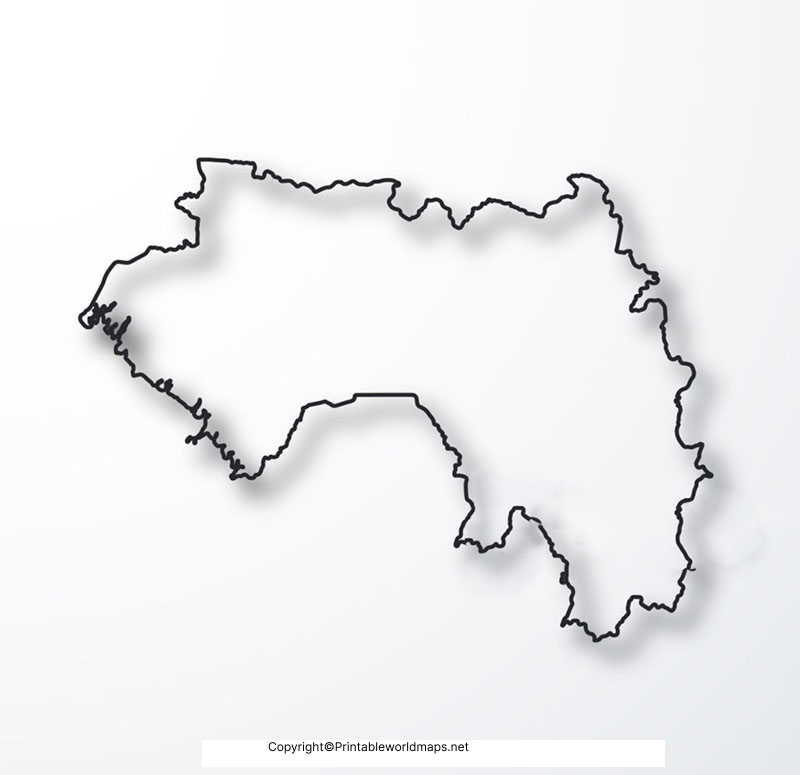
Students can print the outline and complete activities such as:
- Marking Guinea’s capital, Conakry.
- Labeling the six neighboring countries.
- Identifying the Atlantic coast.
- Marking major rivers and highland areas using a reliable reference map.
- Coloring the country’s different geographical regions.
Teachers can use multiple printed copies for individual assignments, group exercises, and geography assessments. For accurate classroom work, compare the outline with a current atlas or authoritative reference map before adding detailed borders or physical features.
Printable Map of Guinea
A printable map of Guinea is useful when you need a ready-to-use map instead of drawing the country’s outline yourself. Download the image or PDF, print it on paper, and use it for study, reference, or educational activities.
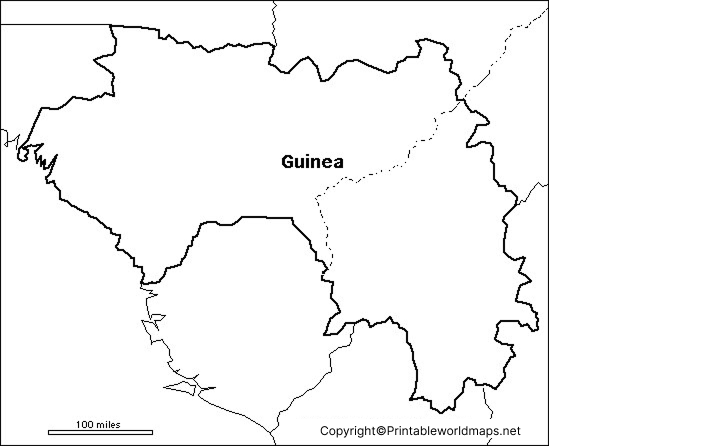
For a clear printout, choose a suitable paper size and check the print preview before printing. Select a fit-to-page option if the map extends beyond the printable area. If you need to write labels by hand, leave enough space around the map for notes.
Remember that a printable map is not necessarily a navigation map. For travel planning, precise coordinates, or official boundary information, consult an appropriate mapping authority.
Transparent PNG Guinea Map
A transparent PNG Guinea map can be helpful when preparing school presentations, geography projects, posters, and digital learning materials. PNG files can support transparent backgrounds, although the actual transparency depends on how the particular image was created and saved.
Before using the image in a presentation, check whether its background is genuinely transparent. You can place a transparent map over a colored background or combine it with labels, titles, and other educational graphics.
For professional reports or detailed geographic analysis, verify the map’s scale, boundaries, and source. A simple outline image may not include every geographical feature or administrative division.
Map of Guinea for Practice Worksheet
The Guinea map practice worksheet gives students an opportunity to test their knowledge through map-labeling exercises. Learners can complete the worksheet independently or use it as part of a classroom geography lesson.
Suggested activities for students
- Write the name of Guinea’s capital city.
- Label Guinea’s neighboring countries.
- Mark the Atlantic Ocean along the western coast.
- Locate the Fouta Djallon highlands using a reference map.
- Identify the general direction of the country’s coastal and inland regions.
- Compare the completed worksheet with a labeled map and correct any mistakes.
Teachers can adapt these exercises for different age groups by adding multiple-choice questions, timed quizzes, coloring tasks, or short written answers.
Guinea Geography Facts
Before labeling a blank map, it helps to understand a few basic facts about the country.
| Geographic detail | Information |
|---|---|
| Official country name | Republic of Guinea |
| Continent | Africa |
| Region | West Africa |
| Capital city | Conakry |
| Official language | French |
| Currency | Guinean franc (GNF) |
| Approximate total area | 245,857 square kilometers |
| Coastline | Atlantic Ocean |
| Neighboring countries | Guinea-Bissau, Senegal, Mali, Côte d’Ivoire, Liberia, and Sierra Leone |
These country details are consistent with reference information published by the United Nations and the World Factbook. Population figures vary by year and estimate, so check a current statistical source if you need a population figure for a school report.
Neighboring Countries of Guinea
Guinea shares land borders with six countries. Labeling them on a blank map is a useful way to understand Guinea’s position in West Africa.
- Guinea-Bissau: Located to the northwest.
- Senegal: Located to the north.
- Mali: Located to the north and northeast.
- Côte d’Ivoire: Located to the east and southeast.
- Liberia: Located to the south and southeast.
- Sierra Leone: Located to the southwest.
The Atlantic Ocean lies along Guinea’s western coastline. Students should use a labeled reference map to check the precise position and shape of each international border.
Major Geographical Features of Guinea
Guinea has a varied landscape that includes coastal plains, plateaus, highlands, and inland areas. These features make the country a useful subject for studying physical geography.
Coastal Guinea
The western part of the country borders the Atlantic Ocean. Its coastal environment includes low-lying areas and estuaries. Students can mark the coastline and identify Conakry on a labeled reference map.
Fouta Djallon Highlands
The Fouta Djallon highlands are located in central Guinea and are known for their elevated terrain. The region is important to the country’s physical geography and is associated with the headwaters of several West African river systems.
Upper Guinea
Upper Guinea includes extensive inland areas with savanna landscapes. It provides a useful example of how the landscape changes between the coast and the interior.
Forested Guinea
The southeastern part of Guinea includes forested highlands and mountainous areas. Mount Nimba, on the country’s southeastern border region, is among its notable high-elevation features.
These broad regional descriptions are intended for educational use. Refer to a physical map or geographical atlas when you need to identify specific rivers, mountain ranges, protected areas, or regional boundaries.
How to Use a Blank Map of Guinea
A blank Guinea map can be used for more than identifying the country’s shape. Try these practical learning activities:
- Geography practice: Label the capital, neighboring countries, coastline, and major physical features.
- Classroom tests: Ask students to complete a map without consulting their notes.
- Coloring exercises: Use different colors to distinguish coastal, highland, and inland areas.
- Research assignments: Ask learners to find information about Guinea’s climate, landforms, and neighboring countries.
- Presentation projects: Add verified labels and geographic facts to a digital map image.
- Revision worksheets: Repeat the exercise to improve recall of locations and directions.
For younger learners, start with the country’s outline and neighboring countries. More advanced students can add rivers, elevation zones, major settlements, and administrative regions.
Frequently Asked Questions
1. Where can I download a printable blank map of Guinea?
You can download the Guinea outline map from the PNG link in the section above or use the corresponding PDF link for printing. The worksheet PDF is also available for geography practice.
2. Is the Guinea outline map free to download?
The files are linked directly from this website’s media library. Check the website’s current terms of use before redistributing, republishing, or using them commercially.
3. What is the capital of Guinea?
The capital of Guinea is Conakry, a coastal city on the Atlantic Ocean.
Guinea borders Guinea-Bissau, Senegal, Mali, Côte d’Ivoire, Liberia, and Sierra Leone.
5. What is the difference between a PNG map and a PDF map?
A PNG is an image format suitable for digital projects, while a PDF is a document format that is convenient for printing and distributing worksheets. Actual image quality and transparency depend on the file.
6. Can students use a blank Guinea map for school assignments?
Yes. Students can use a blank map to practice labeling countries, marking the capital, identifying the coastline, and learning about the country’s physical geography. They should verify detailed labels against a reliable atlas.
7. Is Guinea the same country as Guinea-Bissau or Equatorial Guinea?
No. Guinea, Guinea-Bissau, and Equatorial Guinea are three separate African countries. Guinea is in West Africa and has Conakry as its capital.
8. What should I label on a blank map of Guinea?
Start with Conakry, the Atlantic Ocean, and the six neighboring countries. You can then add the Fouta Djallon highlands, major rivers, and other features using a reliable labeled map.
Reference links
https://data.un.org/legacy/en/iso/gn.html
https://theworldfactbook.org/country/guinea.html
https://unctadstat.unctad.org/CountryProfile/GeneralProfile/en-GB/324/index.html
