

The Labeled Map of Luxembourg helps you locate the country’s capital, major cities, administrative cantons, rivers, and neighboring countries. Luxembourg, officially known as the Grand Duchy of Luxembourg, is a small, landlocked country in Western Europe bordered by Belgium, France, and Germany.
Although Luxembourg is sometimes described as having states or provinces, its current administrative structure includes 12 cantons and 100 municipalities. A labeled map is useful for students, teachers, travelers, and anyone learning about European geography.
Explore the maps below to understand Luxembourg’s location, administrative divisions, capital city, and important towns.
- World map with continents
- Physical world map
- Political world map
- Labeled map of Asia
- Labeled map of Africa
- Labeled map of Europe
- Labeled map of South America
- World time zone map
- Labeled map of World
- Blank map of world
- Labeled map of North America
- Blank map of Asia
- World map with oceans
- World map poster
Labeled Map of Luxembourg
Luxembourg covers approximately 2,586 square kilometers. According to Luxembourg’s official statistics, its population reached 690,959 on 1 January 2026. The country is known for its international institutions, multilingual population, historic towns, and important role in European affairs.

Luxembourg shares its western and northern borders with Belgium, its southern border with France, and its eastern border with Germany. Its location makes it a useful subject for studying the political map of Europe.
The country’s landscape includes the hilly and forested Oesling region in the north and the Gutland region in the south. Major waterways include the Moselle, Sûre, and Our rivers. These rivers are important geographical features and help define parts of Luxembourg’s borders.
Labeled Map of Luxembourg with States
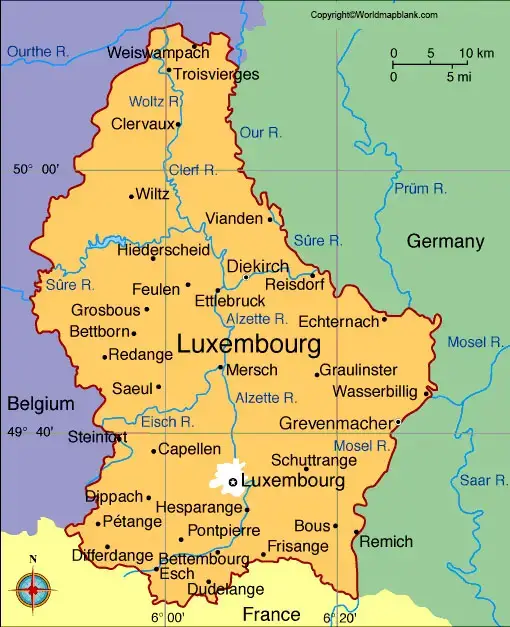
Luxembourg does not have states or provinces in the same sense as countries such as the United States or India. Its territory is divided into 12 cantons, which serve as geographical and administrative units. Municipalities provide local government services.
The 12 cantons of Luxembourg are:
- Capellen
- Clervaux
- Diekirch
- Echternach
- Esch-sur-Alzette
- Grevenmacher
- Luxembourg
- Mersch
- Redange-sur-Attert
- Remich
- Vianden
- Wiltz
Use a labeled administrative map to identify each canton and understand how the country is organized. For accuracy, map labels should distinguish cantons from municipalities and towns.
Labeled Map of Luxembourg with Cities
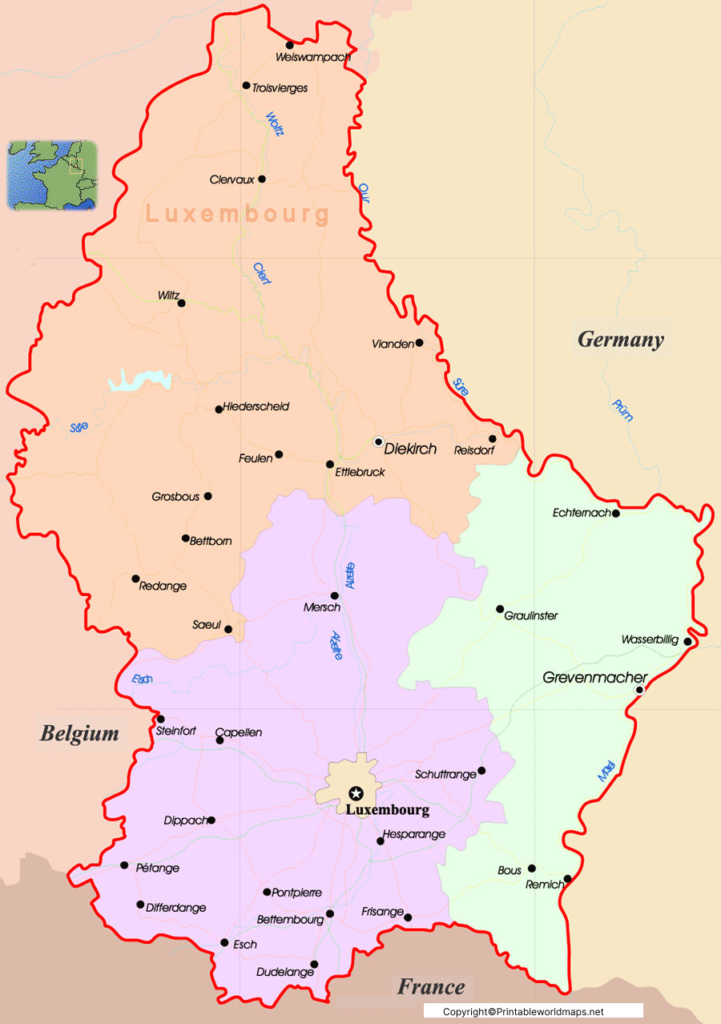
Luxembourg has several important towns and cities that serve as commercial, cultural, administrative, and regional centers. The country’s 12 municipalities that legally hold city status are:
- Luxembourg City
- Esch-sur-Alzette
- Differdange
- Dudelange
- Ettelbruck
- Diekirch
- Echternach
- Grevenmacher
- Remich
- Rumelange
- Vianden
- Wiltz
A labeled city map makes it easier to locate these places and understand their positions within the country. Esch-sur-Alzette is an important urban center in southern Luxembourg, while Echternach is known for its historical heritage and location near the German border.
When using the map for schoolwork or research, remember that a municipality, a town, and a canton are different geographical concepts.
Labeled Luxembourg Map with Capital
Luxembourg City is the capital of Luxembourg. It is located in the southern part of the country and serves as the seat of the national government. The city is an important financial, administrative, and European institutional center.
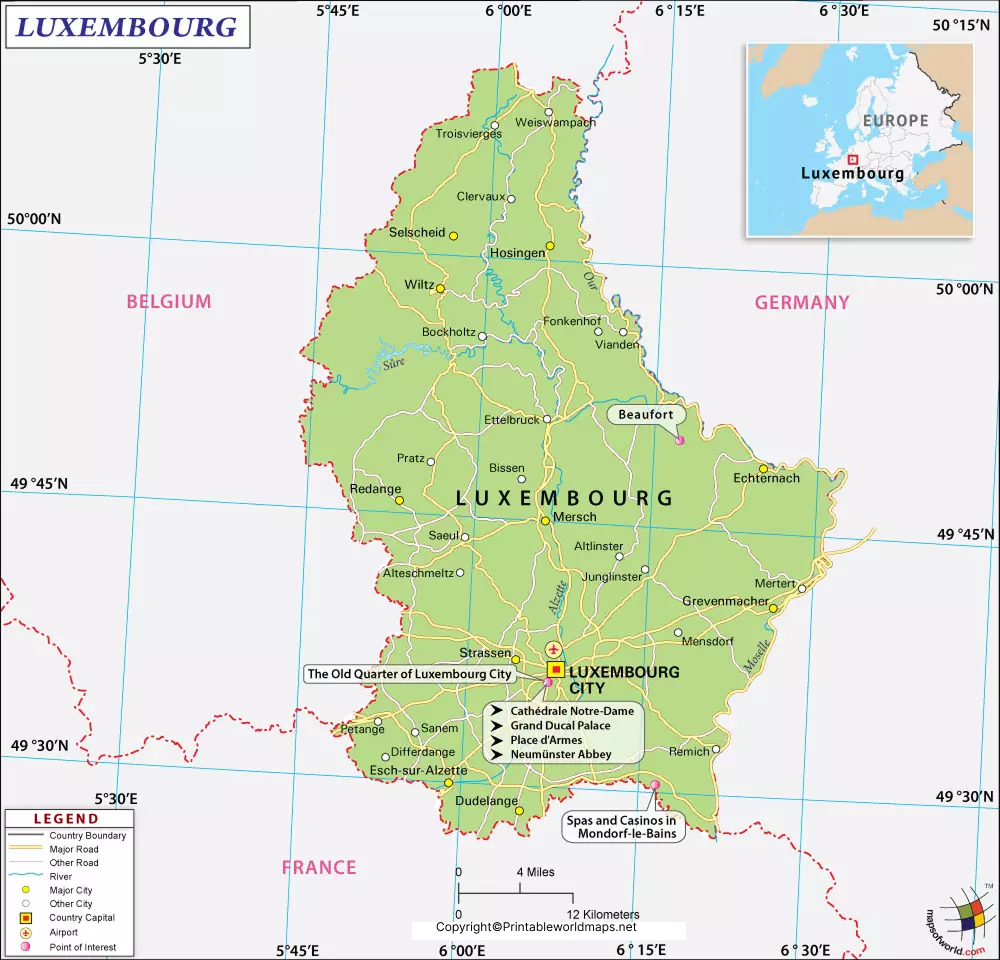
The historic center is situated around the valleys of the Alzette and Pétrusse rivers. Its steep cliffs, old quarters, and surviving fortifications reflect the city’s former strategic importance. The Old Quarters and Fortifications of Luxembourg City are recognized as a UNESCO World Heritage Site.
Notable landmarks include Notre-Dame Cathedral, the Grand Ducal Palace, the National Museum of History and Art, and Neumünster Abbey. The Mudam Luxembourg museum is another important destination for contemporary art.
A capital map helps readers distinguish Luxembourg City from the country of Luxembourg, which shares the same name. This distinction is especially useful when studying European capitals and political geography.
Geography of Luxembourg: Regions, Rivers and Borders
Luxembourg’s geography combines wooded hills, valleys, agricultural landscapes, and developed urban areas.
Oesling: Located in the north, Oesling forms part of the Ardennes uplands. The region is characterized by hills, forests, and river valleys.
Gutland: Covering much of the southern and central part of the country, Gutland includes agricultural land, settlements, and important urban areas.
Major rivers: The Moselle forms part of Luxembourg’s southeastern border with Germany. The Our and Sûre are also important rivers in the country’s eastern and northeastern geography.
Neighboring countries: Belgium lies to the west and north, Germany to the east, and France to the south.
These features make a physical map useful alongside a labeled political map. A political map shows borders and settlements, while a physical map emphasizes terrain, rivers, and other natural features.
Important Facts About Luxembourg
| Geographic fact | Information |
|---|---|
| Official name | Grand Duchy of Luxembourg |
| Capital | Luxembourg City |
| Region | Western Europe |
| Landlocked or coastal | Landlocked |
| Neighboring countries | Belgium, France, Germany |
| Area | Approximately 2,586 km² |
| Population | 690,959 on 1 January 2026 |
| Administrative cantons | 12 |
| Municipalities | 100 |
| Major rivers | Moselle, Sûre, Our |
| Currency | Euro (€) |
| Government | Parliamentary constitutional monarchy |
Population figures can change each year, so the date is included to make this information easier to verify. The area and administrative figures are based on official Luxembourg and European Union information.
How to Use a Printable Map of Luxembourg
A printable map can help with classroom activities, geography assignments, travel planning, and general reference.
- For students: Identify Luxembourg’s capital, neighboring countries, major rivers, and cantons.
- For teachers: Use a labeled map to explain European political geography and administrative divisions.
- For travelers: Locate Luxembourg City and other towns before planning a visit.
- For map practice: Compare a labeled map with a blank map to test your knowledge of place names.
For clearer printing, select a PDF version when available. Check that small place labels remain readable at the intended paper size. If you use a map in a presentation or publication, confirm its reuse permissions and retain any required attribution.
Frequently Asked Questions About Luxembourg Maps
1. What is the capital of Luxembourg?
Luxembourg City is the capital of the Grand Duchy of Luxembourg. It is the seat of the national government and an important European financial and institutional center.
2. How many states does Luxembourg have?
Luxembourg does not have states in its standard administrative structure. The country is divided into 12 cantons and 100 municipalities.
3. What are the 12 cantons of Luxembourg?
The cantons are Capellen, Clervaux, Diekirch, Echternach, Esch-sur-Alzette, Grevenmacher, Luxembourg, Mersch, Redange-sur-Attert, Remich, Vianden, and Wiltz.
4. Which countries border Luxembourg?
Luxembourg shares land borders with Belgium, France, and Germany.
5. What are the major cities in Luxembourg?
Luxembourg City, Esch-sur-Alzette, Differdange, Dudelange, and Ettelbruck are among its important urban centers. The country has 12 municipalities with official city status.
6. What is the area of Luxembourg?
Luxembourg covers approximately 2,586 square kilometers, making it one of Europe’s smaller countries.
7. What is the population of Luxembourg?
Luxembourg had 690,959 residents on 1 January 2026, according to the country’s official statistics. Population figures should always be checked against the latest available release.
8. Which rivers are shown on a map of Luxembourg?
Important rivers include the Moselle, Sûre, and Our. The Moselle forms part of the border with Germany, and the Sûre and Our are significant features of the country’s river system.
9. Can I download a printable map of Luxembourg?
Yes. The map links in this article provide PDF versions of the labeled country, administrative divisions, cities, and capital maps. Check each file before printing to ensure the labels are suitable for your needs.
10. Why is Luxembourg City historically important?
Luxembourg City developed around a strategic fortified site. Its historic old quarters and fortifications are recognized by UNESCO for their historical and architectural significance.
Reference links
https://luxembourg.public.lu/en/society-and-culture/territoire-et-climat/territoire.html
https://statistiques.public.lu/en/actualites/2026/stn15-population-2026.html
https://luxembourg.public.lu/en/society-and-culture/population/demographics.html
https://whc.unesco.org/en/list/699
https://european-union.europa.eu/principles-countries-history/eu-countries/luxembourg_en
