

The Labeled Map of Armenia helps you identify the country’s location, international boundaries, ten provinces, capital city, and important urban centers. Armenia is a landlocked country in the South Caucasus region, situated in the Armenian Highlands between Eastern Europe and Western Asia. Its total area is approximately 29,743 square kilometers, according to the Government of Armenia.
Armenia shares international borders with Georgia to the north, Azerbaijan to the east, Iran to the south, and Turkey to the west. The country has a mountainous landscape, elevated plateaus, valleys, rivers, and Lake Sevan, one of its most prominent geographical features.
Use the labeled maps below to locate Armenia’s administrative regions, identify its capital and major cities, and study the country’s physical and political geography. Printable PDF versions are useful for classroom assignments, geography projects, presentations, and personal reference.
For additional geography resources, explore these related maps:
- World map with continents
- Physical world map
- Political world map
- Labeled map of Asia
- Labeled map of Africa
- Labeled map of Europe
- Labeled map of South America
- World time zone map
- Labeled map of World
- Blank map of world
- Labeled map of North America
- Blank map of Asia
- World map with oceans
- World map poster
Labeled Map of Armenia
The labeled map of Armenia shows the country’s position in the South Caucasus and helps readers understand its neighboring countries, major geographical features, and location within the wider region.
Armenia covers approximately 29,743 square kilometers. The Government of Armenia reports an average elevation of around 1,800 meters above sea level, reflecting the country’s mountainous terrain. Mount Aragats, at approximately 4,090 meters, is the highest mountain in Armenia.
The Aras (Araks) River forms parts of Armenia’s southern border, while the Debed River drains areas in the north. Lake Sevan, located in the eastern part of the country, is an important freshwater lake.
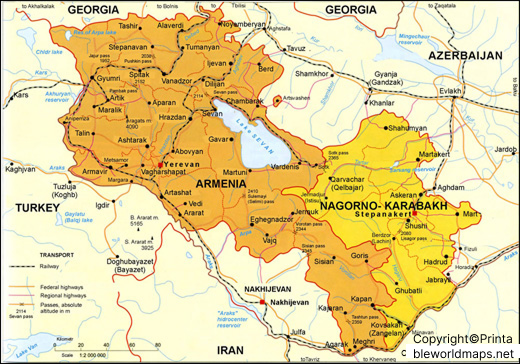
This map is useful for locating Armenia, identifying its neighboring countries, and learning the basic features of its geography.
Labeled Map of Armenia with States
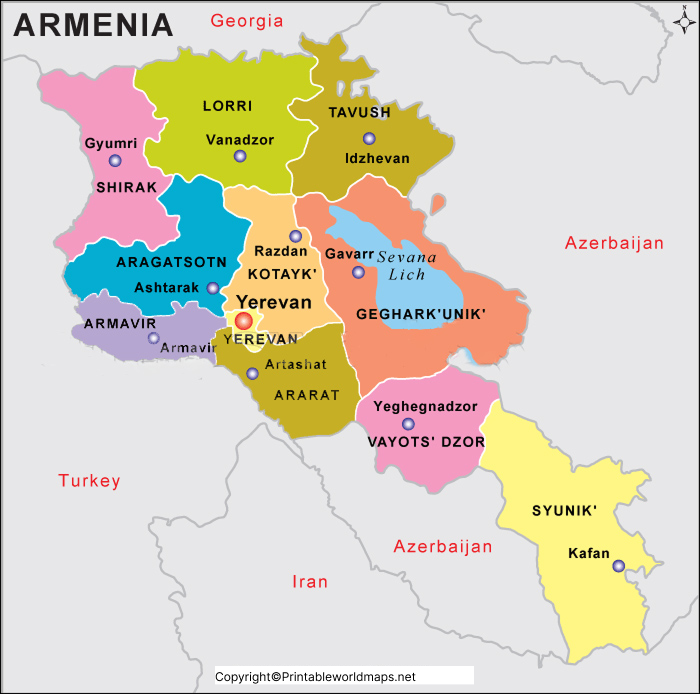
Armenia is administratively divided into ten provinces, known locally as marzes, and the capital city of Yerevan, which has a separate administrative status. Therefore, Armenia has ten provinces plus Yerevan rather than eleven provinces.
The ten provinces are Aragatsotn, Ararat, Armavir, Gegharkunik, Kotayk, Lori, Shirak, Syunik, Tavush, and Vayots Dzor.
A province map helps students understand the country’s administrative organization and identify the location of regional centers. The word “states” is sometimes used informally in map searches, but “provinces” or “regions” is the more accurate description of Armenia’s administrative divisions.
Labeled Map of Armenia with Cities
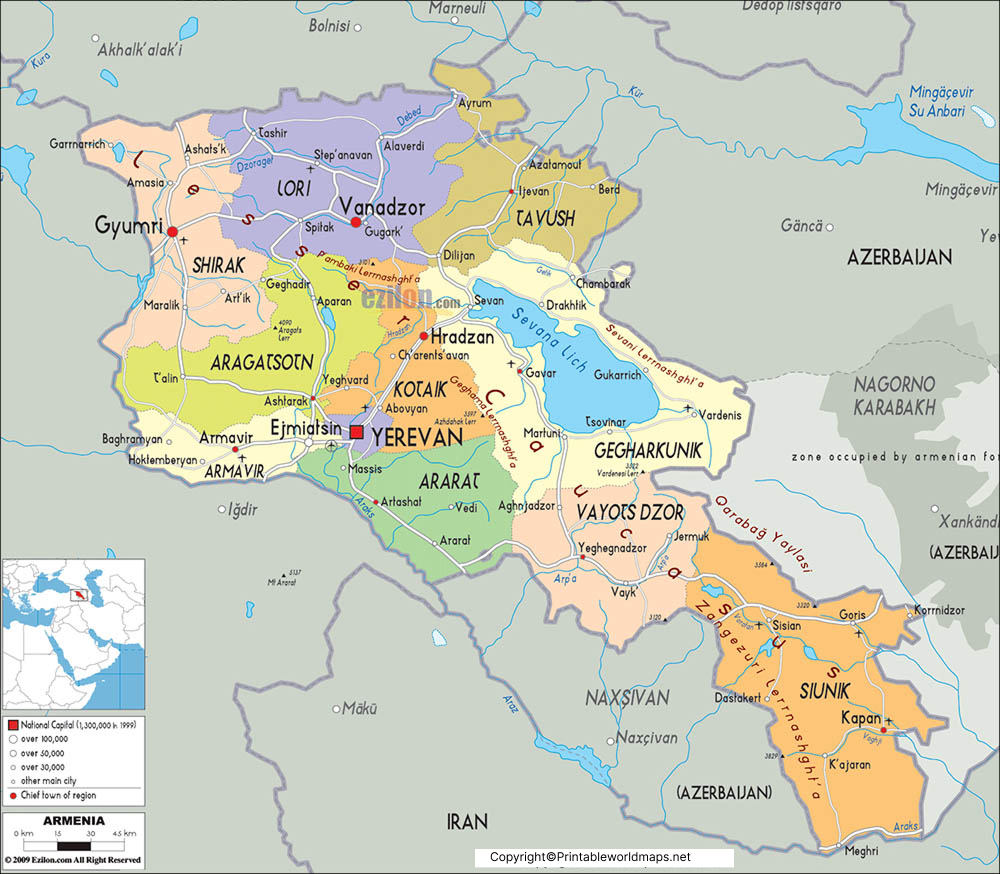
A labeled map of Armenia with cities helps readers locate major urban centers, understand their regional positions, and plan geography lessons or educational activities.
Some important cities and urban centers include:
- Yerevan: The national capital and a major cultural, economic, and administrative center.
- Gyumri: A major city in Shirak Province and an important cultural center.
- Vanadzor: The administrative center of Lori Province.
- Vagharshapat (Etchmiadzin): A historic city in Armavir Province with important religious heritage.
- Hrazdan: The administrative center of Kotayk Province.
- Kapan: The administrative center of Syunik Province.
- Gavar: The administrative center of Gegharkunik Province.
- Ijevan: The administrative center of Tavush Province.
- Yeghegnadzor: The administrative center of Vayots Dzor Province.
- Artashat: The administrative center of Ararat Province.
- Armavir: The administrative center of Armavir Province.
- Ashtarak: The administrative center of Aragatsotn Province.
These locations provide a useful starting point for studying Armenia’s settlement patterns and regional geography. Note that city classifications and administrative boundaries may change, so consult official sources when using the map for formal research.
Labeled Armenia with Capital
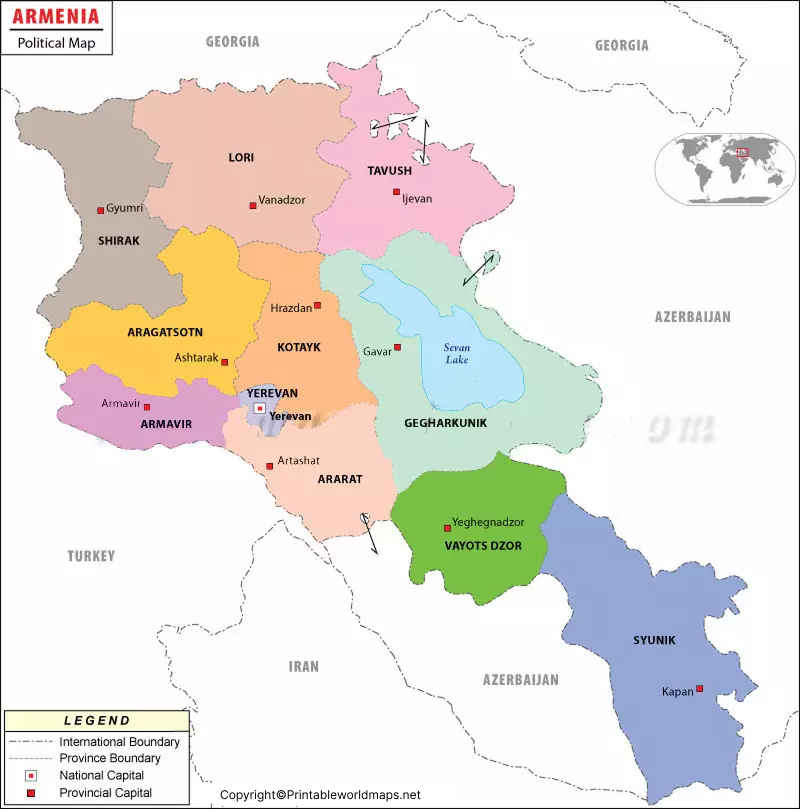
Yerevan is the capital and largest city of Armenia. It is located in the northeastern part of the Ararat Plain, along both sides of the Hrazdan River. The city serves as a center for national government, commerce, education, transportation, and culture.
Yerevan has a long history. The ancient fortress of Erebuni was founded in 782 BCE by King Argishti I of Urartu. Its archaeological remains are an important part of the city’s historical heritage.
In 2012, Yerevan was designated a UNESCO World Book Capital. The program highlighted reading, publishing, literacy, and cultural activities, coinciding with the 500th anniversary of Armenian printing.
Yerevan is also divided into 12 administrative districts, including Kentron, Erebuni, Arabkir, Avan, and Shengavit. These districts are subdivisions of the capital, not additional provinces of Armenia.
Important Facts About Armenia
The following facts provide additional context for readers using the maps:
- Official name: Republic of Armenia.
- Capital: Yerevan.
- Region: South Caucasus, between Eastern Europe and Western Asia.
- Total area: Approximately 29,743 square kilometers.
- Administrative divisions: Ten provinces and the capital city of Yerevan.
- Highest mountain: Mount Aragats, approximately 4,090 meters.
- Major lake: Lake Sevan.
- Official language: Armenian.
- Currency: Armenian dram (AMD).
- Independence: Armenia declared independence in 1991; September 21 is celebrated as Independence Day.
The World Bank estimated Armenia’s population at 3,033,500 in 2024. Population figures change over time, so use the latest available official statistics when an exact current figure is required.
How to Use and Print These Armenia Maps
You can use these maps for schoolwork, geography quizzes, presentations, travel research, and general reference.
- Choose the map that matches your purpose: country location, provinces, cities, or capital.
- Open the PNG image to view it online or save it to your device.
- Select the corresponding PDF link when you need a document for printing.
- For best results, check the PDF page size and choose “Fit to page” in your printer settings.
- For classroom activities, use a labeled version as a reference and a blank map for students to complete independently.
Map labels, boundaries, and administrative information should be checked against authoritative sources when accuracy is important. A general reference map is not a substitute for official surveying, navigation, or legal boundary documentation.
Frequently Asked Questions About Armenia Maps
1. What is the capital of Armenia?
Yerevan is the capital and largest city of Armenia. It is the country’s principal administrative, cultural, and economic center.
2. How many provinces does Armenia have?
Armenia has ten provinces, known as marzes, plus Yerevan, which has a separate administrative status.
3. Which countries border Armenia?
Armenia shares international borders with Georgia, Azerbaijan, Iran, and Turkey.
4. What is the largest city in Armenia?
Yerevan is Armenia’s largest city and its national capital.
5. What is the highest mountain in Armenia?
Mount Aragats is the highest mountain in Armenia, reaching approximately 4,090 meters above sea level.
6. Can I download a printable map of Armenia?
Yes. The PNG and PDF links in this article provide map versions for viewing, saving, and printing. Check each PDF before printing to confirm its page size and readability.
7. What is the difference between an Armenia political map and a physical map?
A political map emphasizes national boundaries, provinces, cities, and administrative centers. A physical map emphasizes natural features such as mountains, rivers, lakes, and elevation.
8. Is Yerevan a province of Armenia?
Yerevan has a separate administrative status and is not one of the ten provinces. It is governed under the legal framework for the capital city.
9. What is the area of Armenia?
Armenia covers approximately 29,743 square kilometers, according to the Government of Armenia.
10. Why is a labeled map of Armenia useful?
A labeled map helps readers identify the country’s location, neighboring countries, administrative regions, cities, and capital. It is useful for students, teachers, geography enthusiasts, and general reference.
Reference links
https://www.gov.am/en/geography/
https://gov.am/en/general-information-1
https://www.gov.am/en/demographics/demographics/
https://data.worldbank.org/country/AM
https://www.unesco.org/en/world-book-capital/yerevan
