

The Labeled Map of Kenya helps you identify the country’s location in East Africa, its capital city, major urban centres, administrative boundaries, and important geographical features. Whether you are studying geography, planning a trip, or looking for a printable reference, these maps make it easier to understand Kenya’s political and physical landscape.
Kenya borders Tanzania to the south, Uganda to the west, South Sudan to the northwest, Ethiopia to the north, and Somalia to the northeast. The Indian Ocean lies along its southeastern coastline. Nairobi is the national capital and the country’s largest city.
Kenya covers approximately 580,367 square kilometres, according to the Government of Kenya’s regional information page. Its landscapes include coastal plains, highlands, savannas, mountains, and the Great Rift Valley.
Use the maps below to explore Kenya’s location, counties, major cities, and capital. Printable PDF versions are also provided where available.
- World map with continents
- Physical world map
- Political world map
- Labeled map of Asia
- Labeled map of Africa
- Labeled map of Europe
- Labeled map of South America
- World time zone map
- Labeled map of World
- Blank map of world
- Labeled map of North America
- Blank map of Asia
- World map with oceans
- World map poster
Labeled Map of Kenya
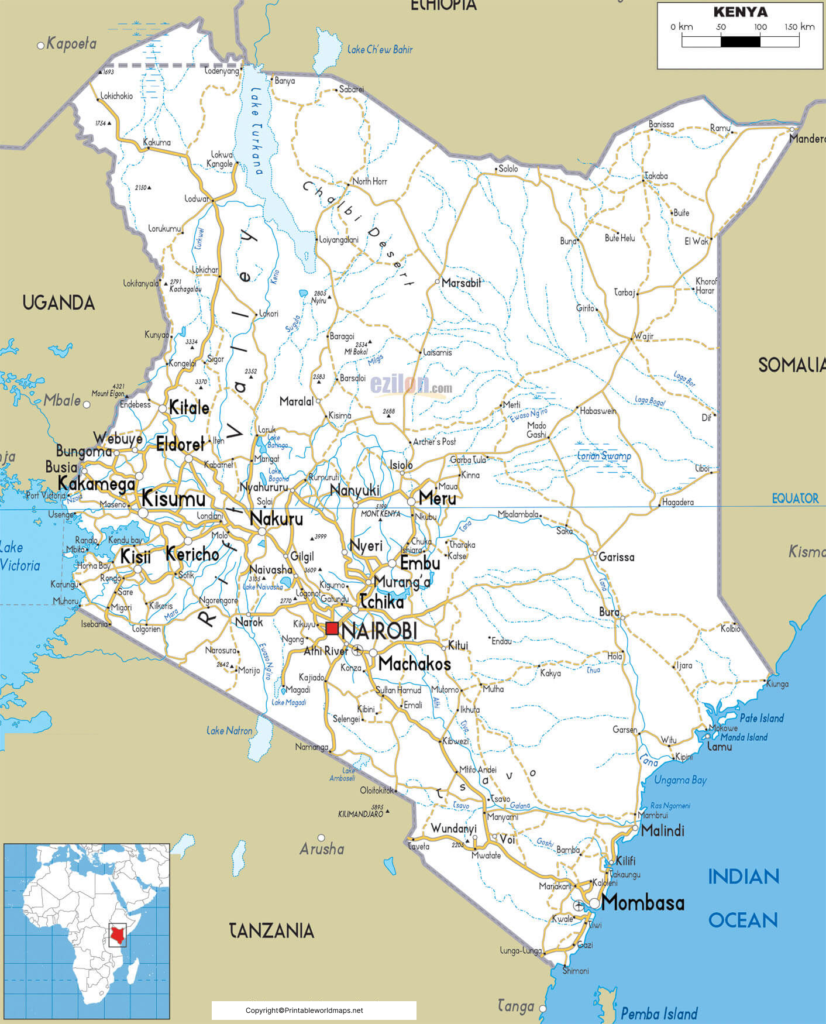
A general labeled map identifies Kenya’s position in Africa and helps readers locate major geographical features and neighbouring countries. Depending on the map’s detail, it may also show selected towns, rivers, lakes, mountain areas, and the Indian Ocean coastline.
Kenya’s geographical diversity is especially notable around the Great Rift Valley, the central highlands, Lake Victoria in the west, and the coastal region in the southeast. These features help explain the country’s varied climate, settlement patterns, and economic activities.
Labeled Map of Kenya with States
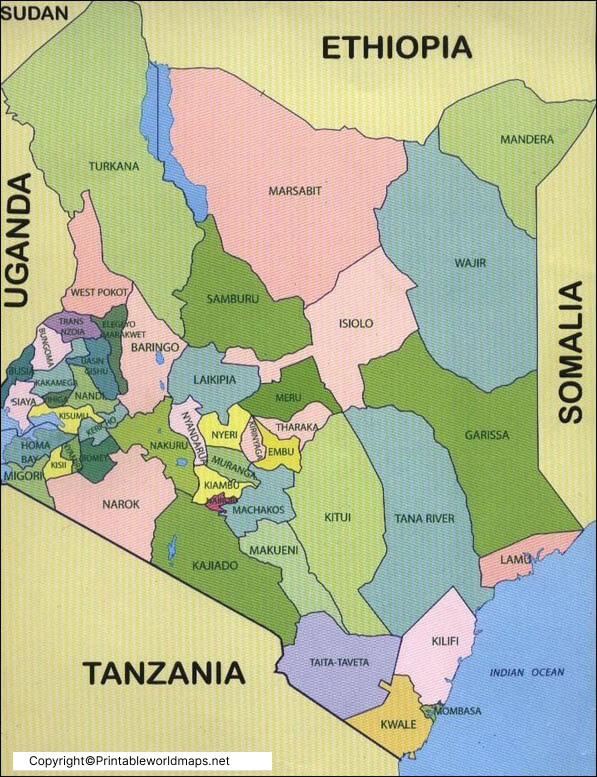
Kenya was historically divided into eight provinces: Central, Coast, Eastern, Nairobi, North Eastern, Nyanza, Rift Valley, and Western. However, the Constitution of Kenya, 2010 established 47 counties as the units of devolved government.
For an accurate modern administrative map, counties should be used instead of states or the former provincial divisions. Each county has its own county government and plays a role in delivering local services.
Examples of Kenya’s 47 counties include Nairobi City, Mombasa, Kiambu, Nakuru, Kisumu, Uasin Gishu, Turkana, Garissa, Kilifi, and Machakos.
The county system is important for understanding local administration, electoral boundaries, public services, and regional development. When choosing a map for current educational or research purposes, check whether it displays the 47 counties rather than only the former provinces.
For official administrative information, consult the Kenya State Department for Devolution.
Labeled Kenya Map with Cities
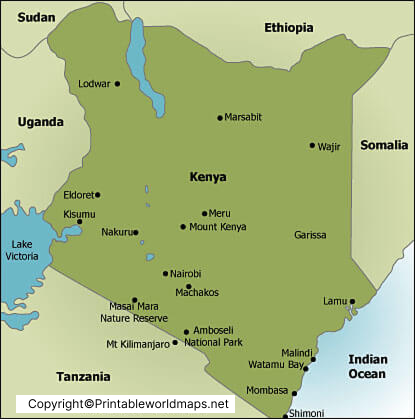
A labeled city map helps readers locate Kenya’s major urban centres and understand their positions relative to the coast, highlands, lakes, and neighbouring countries.
Important cities and urban centres include:
- Nairobi: Kenya’s capital and a major centre for government, finance, technology, transport, and commerce.
- Mombasa: A coastal city and an important seaport on the Indian Ocean.
- Kisumu: A major city on the northeastern shore of Lake Victoria.
- Nakuru: An important urban and commercial centre in the Rift Valley region.
- Eldoret: A significant urban centre in western Kenya, associated with agriculture, commerce, and distance running.
- Malindi: A coastal town known for tourism, marine attractions, and its historical connections to Indian Ocean trade.
These places serve different regional purposes, from administration and industry to transport, tourism, and agriculture. Their locations can be identified more easily on a detailed city map.
Keep in mind that city status, municipal boundaries, and population rankings can change. A map showing cities and towns should therefore be read alongside current official administrative and census information.
Labeled Kenya Map with Capital
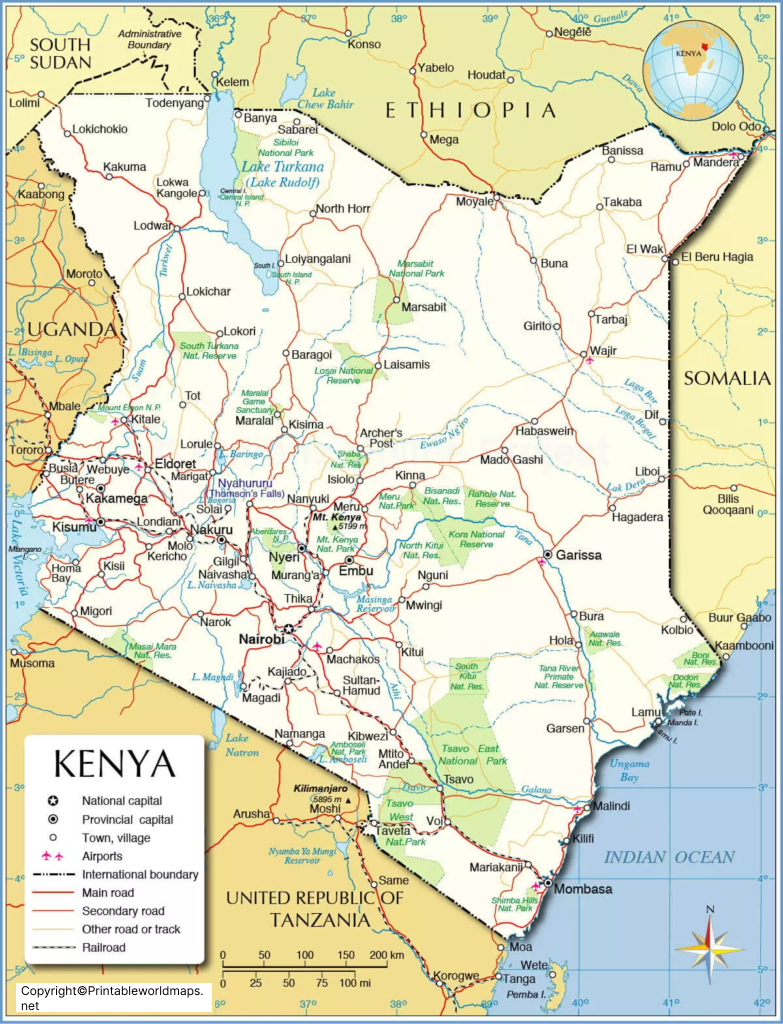
Nairobi is the capital of Kenya. It is situated in the country’s south-central highlands and serves as the main centre of national government, business, transport, and international diplomacy.
Nairobi is also known for Nairobi National Park, a protected wildlife area located close to the urban centre. The park provides a distinctive example of the relationship between a growing city and its surrounding natural environment.
The city is an important transport hub, with road, rail, and air connections linking Kenya to other parts of East Africa and international destinations. Its economic activities include financial services, manufacturing, technology, trade, and tourism.
A capital-focused map is useful for students learning African geography, travellers planning routes, and readers who want to understand where Kenya’s national administration is based.
Kenya Geography: Location, Borders and Landforms
Kenya lies across the Equator in East Africa. Its position connects the African interior with the Indian Ocean and places it near several neighbouring countries.
The country’s major geographical features include:
- Great Rift Valley: A prominent geological feature extending through Kenya, with escarpments, volcanic landscapes, and lakes.
- Central Highlands: Elevated areas that include the region around Mount Kenya and important agricultural zones.
- Lake Victoria: Africa’s largest lake by surface area, bordering Kenya, Uganda, and Tanzania.
- Indian Ocean Coast: A coastal zone with beaches, ports, coral reefs, and historical trading settlements.
- Northern and Eastern Drylands: Extensive arid and semi-arid areas with varied pastoral and wildlife landscapes.
Kenya’s principal river systems include the Tana River and the Ewaso Ng’iro, among others. The Tana is an important river for water supply, agriculture, and hydroelectric power. The country also shares Lake Victoria and several transboundary water systems with neighbouring countries.
These physical features are useful reference points when reading a physical map of Kenya. They also help explain differences in rainfall, vegetation, settlement, transport, and land use across the country.
Important Facts About Kenya
| Fact | Information |
|---|---|
| Official name | Republic of Kenya |
| Continent | Africa |
| Region | East Africa |
| Capital city | Nairobi |
| Administrative divisions | 47 counties |
| Approximate area | 580,367 sq km |
| Official languages | English and Kiswahili |
| Currency | Kenyan shilling (KES) |
| Independence Day | 12 December |
| Coastline | Indian Ocean |
Area figures and administrative details should be checked against the relevant official source when preparing maps for academic, professional, or statistical use.
Kenya’s population has also grown significantly over time. According to the Kenya National Bureau of Statistics, the 2019 population and housing census recorded 47,564,296 people. For newer estimates and population projections, use the latest official statistical publications rather than treating the 2019 census figure as the current population.
How to Use a Printable Map of Kenya
A printable map can be useful for classroom activities, geography assignments, travel preparation, and general reference.
- Choose the right map: Use a political or county map to identify administrative boundaries, a city map to locate urban centres, or a physical map to study landforms and water features.
- Check the labels: Confirm that place names and county boundaries are readable at the intended print size.
- Download the PDF: Use the PDF version when available for printing and classroom distribution.
- Verify current information: Compare administrative details with official Kenyan government sources if accuracy is important.
- Use a suitable scale: A country-level map is helpful for understanding overall location, while a more detailed regional map is better for local navigation.
For best results, print the map at a size that keeps labels legible. A high-resolution image or PDF is generally more suitable than a small thumbnail.
Frequently Asked Questions About the Labeled Map of Kenya
1. What is the capital of Kenya?
Nairobi is the capital and largest city of Kenya. It is the country’s principal centre of national government, commerce, and international diplomacy.
2. How many states does Kenya have?
Kenya does not use states as its current primary administrative divisions. It has 47 counties established under the Constitution of Kenya, 2010. The country was historically divided into eight provinces.
3. What are the major cities of Kenya?
Important cities and urban centres include Nairobi, Mombasa, Kisumu, Nakuru, and Eldoret. Malindi is another notable coastal urban centre.
4. Which countries border Kenya?
Kenya borders Tanzania, Uganda, South Sudan, Ethiopia, and Somalia. The Indian Ocean lies to its southeast.
5. Where can I download a printable map of Kenya?
You can download the PNG and PDF versions provided in the map sections above. Choose the general labeled map, county or administrative map, cities map, or capital map according to your needs.
6. What are Kenya’s main geographical features?
Kenya includes the Great Rift Valley, central highlands, Mount Kenya, Lake Victoria’s eastern shoreline, savannas, northern drylands, and the Indian Ocean coast.
7. What languages are spoken officially in Kenya?
English and Kiswahili are Kenya’s official languages. Kiswahili is also the national language.
8. Where can I find official population data for Kenya?
The Kenya National Bureau of Statistics publishes national census reports, county-level population data, and other official statistics. Its 2019 census remains a useful benchmark, while newer estimates should be checked in its latest publications.
Reference links
https://www.eac.go.ke/about-kenya/
https://www.devolution.go.ke/county-information/
https://www.knbs.or.ke/2019-kenya-population-and-housing-census-results/
https://www.mod.go.ke/the-constitution-of-kenya-2010-online/
