

The Labeled Map of Mali helps you identify the country’s capital, major cities, administrative regions, neighboring countries, and important rivers. Mali is a landlocked country in West Africa, extending from the Sahara Desert in the north to the Sahel and savanna landscapes in the south.
This guide includes a labeled country map, an administrative map, a map highlighting major cities, and a map showing the capital, Bamako. You can also use the printable PDF versions for geography lessons, classroom activities, research, and map-based projects.
- World map with continents
- Physical world map
- Political world map
- Labeled map of Asia
- Labeled map of Africa
- Labeled map of Europe
- Labeled map of South America
- World time zone map
- Labeled map of world
- Blank map of world
- Labeled map of North America
- Blank map of Asia
- World map with oceans
- World map poster
Labeled Map of Mali

A labeled map of Mali helps readers understand the country’s location in West Africa and identify its international borders, important settlements, and physical features. Depending on the map edition, labels may include cities, rivers, roads, and administrative boundaries.
Mali covers approximately 1.24 million square kilometers and shares land borders with Algeria, Niger, Burkina Faso, Côte d’Ivoire, Guinea, Senegal, and Mauritania. Because the country has no coastline, its geography and transport connections are strongly influenced by its inland location.
The Niger River is one of Mali’s most important geographic features. It supports agriculture, fishing, settlements, and transport across parts of the country. The Senegal River and its tributaries are also significant to western Mali.
Labeled Map of Mali with States and Regions

Mali’s administrative divisions have changed over time. Under the territorial reorganization enacted in March 2023, the country has 19 regions and the District of Bamako. The new structure also includes administrative levels such as cercles, arrondissements, and communes.
The 19 regions are:
- Bandiagara
- Bougouni
- Dioïla
- Douentza
- Gao
- Kayes
- Kidal
- Kita
- Koutiala
- Koulikoro
- Ménaka
- Mopti
- Nara
- Nioro
- San
- Ségou
- Sikasso
- Taoudénit
- Tombouctou
Bamako is administered separately as the capital district. Older maps may show the previous arrangement of eight regions and the District of Bamako. Therefore, check the publication date and administrative boundaries before using a map for official or academic work.
Labeled Map of Mali with Cities
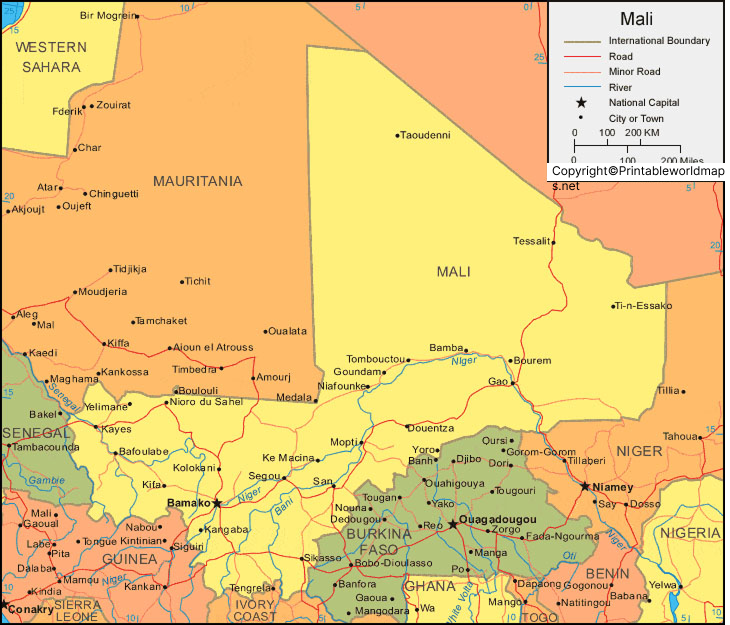
A labeled city map makes it easier to locate major urban centers and understand their positions relative to rivers, roads, and neighboring regions.
Important cities and towns shown on maps of Mali may include:
- Bamako: The national capital and a major administrative, commercial, and transport center.
- Sikasso: A major city in southern Mali, in an important agricultural area.
- Ségou: A city on the Niger River, known for its regional and historical importance.
- Mopti: A city near the confluence of the Niger and Bani rivers.
- Gao: A major settlement in eastern Mali, associated with the Niger River and the history of the Songhai Empire.
- Kayes: A city in western Mali near the Senegal River.
- Tombouctou (Timbuktu): A historic city known for its role in trans-Saharan trade, scholarship, and Islamic learning.
- Koutiala: An important city in the agricultural south of the country.
City population figures should be checked against a specific census or statistical source. Figures from different years may refer to a city proper, an administrative district, or a wider urban area, so they should not be compared without checking their definitions.
Labeled Mali Map with Capital

Bamako is the capital of Mali. It is located in the southwestern part of the country along the Niger River and serves as the principal center of national government, business, education, and transport.
The Niger River is a defining feature of Bamako’s landscape. The city has expanded along both sides of the river, which also supports economic activity and provides an important geographic reference for understanding the surrounding region.
Notable landmarks and institutions in Bamako include the National Museum of Mali, the National Zoo, and the Grand Mosque area. The city is also an important center for universities, markets, and cultural activities.
When reading a capital map, look for the symbol used to distinguish the national capital from other cities. Also check whether the map displays administrative boundaries, major roads, rivers, or nearby settlements, as these features can help with orientation.
Mali’s Geography and Neighboring Countries
Mali lies in the interior of West Africa and has no direct access to the sea. Its seven neighboring countries are Algeria to the north, Niger to the east, Burkina Faso to the southeast, Côte d’Ivoire to the south, Guinea to the southwest, and Senegal and Mauritania to the west.
The country contains three broad natural zones:
- Saharan zone: The arid northern region, where desert landscapes dominate.
- Sahelian zone: The transitional belt across central Mali, with semi-arid conditions.
- Sudanian zone: The relatively wetter south, where savanna landscapes and agriculture are more prominent.
These zones help explain differences in settlement patterns, vegetation, rainfall, and land use across the country.
Important Rivers and Physical Features of Mali
The Niger River and Senegal River are two of Mali’s major waterways. The Niger flows through the country and supports communities, farming, fishing, and transport. Its inland delta forms an important wetland and agricultural region.
Other notable physical features include the Sahara Desert in the north, the Bandiagara Escarpment in the central region, and Hombori Tondo, the country’s highest point at approximately 1,155 meters above sea level.
When studying a physical map, distinguish rivers and lakes from political boundaries. Physical features explain the landscape, while administrative boundaries show how the country is divided for governance.
Seven Essential Facts About Mali
- Capital: Bamako is the national capital.
- Location: Mali is a landlocked country in West Africa.
- Area: The country covers approximately 1.24 million square kilometers.
- Neighbors: Mali shares land borders with seven countries.
- Administrative structure: The updated structure includes 19 regions and the District of Bamako.
- Major rivers: The Niger and Senegal rivers are important waterways.
- Highest point: Hombori Tondo rises to approximately 1,155 meters.
These facts provide a useful introduction to Mali’s location, political geography, and physical environment.
How to Use a Printable Map of Mali
A printable map can support geography lessons, school assignments, presentations, and personal research. Choose the map that best fits your purpose:
- Labeled country map: Identify Mali and its neighboring countries.
- Administrative map: Study regions and administrative boundaries.
- City map: Locate major urban centers and settlements.
- Capital map: Find Bamako and understand its position within the country.
- Physical map: Study rivers, elevation, desert areas, and other natural features.
For the clearest printout, select a PDF when available and check the page orientation and print scaling before printing. If you use a map in a report or classroom presentation, include its source and publication date.
Map accuracy note: Administrative boundaries and place names can change. The map images linked above were published in 2023 or earlier, while Mali’s administrative reorganization was enacted in March 2023. Verify the boundaries and labels against an official, updated administrative map before using them for official, legal, or professional purposes.
Frequently Asked Questions About the Labeled Map of Mali
What is the capital of Mali?
Bamako is the capital of Mali. It lies in the southwestern part of the country along the Niger River and is the country’s main center of government and commerce.
How many regions does Mali have?
Mali’s updated administrative structure includes 19 regions and the District of Bamako. Older maps may show the previous structure, so check the date and source of an administrative map.
Which countries border Mali?
Mali shares land borders with Algeria, Niger, Burkina Faso, Côte d’Ivoire, Guinea, Senegal, and Mauritania.
Which river is the most important on a map of Mali?
The Niger River is one of the country’s most important waterways. The Senegal River is also a major river, particularly in western Mali.
Can I download a printable map of Mali?
Yes. The map links in this article include PNG images and PDF versions. Open the relevant PDF link to view or print the map.
Where is Bamako located in Mali?
Bamako is in southwestern Mali, along the Niger River. It is the national capital and a major administrative and commercial center.
Why do some maps of Mali show only eight regions?
Some older maps use a previous administrative arrangement. Mali’s territorial reorganization, enacted in March 2023, established a structure with 19 regions and the District of Bamako. Older maps should be dated clearly to avoid confusion.
What is the difference between a political map and a physical map of Mali?
A political map emphasizes borders, regions, cities, and administrative divisions. A physical map focuses on natural features such as rivers, mountains, elevation, and desert landscapes.
Reference links
2. https://gouvernement.ml/category/actions-du-gouvernement/
3. https://www.worldbank.org/ext/en/country/mali
