

The Azerbaijan labeled map helps you locate the country’s capital, major cities, administrative districts, neighboring countries, and coastline along the Caspian Sea. Azerbaijan, officially known as the Republic of Azerbaijan, is situated in the South Caucasus region, at the crossroads of Eastern Europe and Western Asia.
Baku is the capital and largest city of Azerbaijan. The country shares land borders with Russia, Georgia, Armenia, Iran, and Turkey through the Nakhchivan exclave. It covers approximately 86,600 square kilometers (33,436 square miles), according to commonly cited geographic figures.
On this page, you can explore a labeled map of Azerbaijan, view its administrative divisions, identify important cities, and access printable map files in PDF format for educational and reference purposes.
- World map with continents
- Physical world map
- Political world map
- Labeled map of Asia
- Labeled map of Africa
- Labeled map of Europe
- Labeled map of South America
- World time zone map
- Labeled map of World
- Blank map of world
- Labeled map of North America
- Blank map of Asia
- World map with oceans
- World map poster
Labeled Map of Azerbaijan
The labeled map of Azerbaijan identifies the country’s location, capital, major settlements, and geographical features. Azerbaijan lies west of the Caspian Sea and includes both a mainland territory and the Nakhchivan Autonomous Republic, which is separated from the mainland by Armenian territory.
Azerbaijan became independent from the Soviet Union in 1991. Its official language is Azerbaijani, and its currency is the Azerbaijani manat (AZN).
The country’s landscape includes the Greater Caucasus Mountains in the north, lowlands and plains around the Kura and Aras river systems, and coastal areas along the Caspian Sea. These features make a labeled map useful for understanding Azerbaijan’s physical geography as well as its political location.
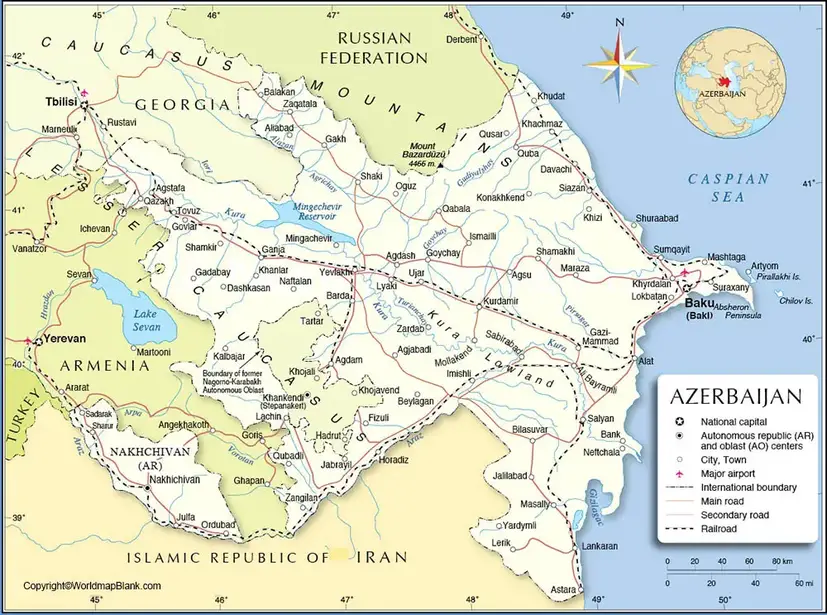
Labeled Map of Azerbaijan with States
Azerbaijan does not have states in the same administrative sense as India or the United States. Instead, the country is divided into administrative districts, cities, and autonomous territory. The exact number of administrative units can vary depending on the classification and year of the official source.
The Nakhchivan Autonomous Republic has a distinct autonomous status within Azerbaijan. Baku and several other cities also have special administrative arrangements. Therefore, a map described as an “Azerbaijan map with states” is more accurately understood as a map showing administrative divisions.
When studying an administrative map, look for district boundaries, city names, and the location of Nakhchivan. These details help readers understand how the country is organized and how its settlements are distributed.

Labeled Map of Azerbaijan with Cities
The labeled map of Azerbaijan with cities helps readers locate major urban centers and understand their positions relative to Baku, the Caspian Sea, and neighboring regions.
Important cities include:
- Baku: The capital, largest city, and a major economic and cultural center.
- Ganja: A major city in western Azerbaijan with a long historical heritage.
- Sumqayit: An industrial city on the Caspian Sea coast, northwest of Baku.
- Mingachevir: A city associated with the Kura River and the Mingachevir Reservoir.
- Lankaran: A city in the south of the country, near the Caspian Sea and the border with Iran.
- Shaki (Sheki): A historic city in northwestern Azerbaijan known for its cultural heritage.
The cities shown on a map can vary according to its scale. A country-level map usually highlights major cities, while a detailed administrative map may include smaller settlements and district centers.

Labeled Azerbaijan with Capital
Baku is the capital of Azerbaijan. It is located on the Absheron Peninsula along the western shore of the Caspian Sea and serves as the country’s principal political, commercial, and cultural center.
Baku is known for its historic Old City, a UNESCO World Heritage Site that includes the Maiden Tower and the Palace of the Shirvanshahs. Modern landmarks include the Flame Towers and the Heydar Aliyev Center, designed by architect Zaha Hadid.
The city’s location has contributed to its importance in trade, transport, and the energy industry. Azerbaijan has significant petroleum and natural gas resources, and Baku has played an important role in the development of the country’s oil industry.
On a capital-city map, look for Baku on the eastern side of Azerbaijan, beside the Caspian Sea. Its location also helps explain the concentration of transport links, businesses, and cultural attractions around the capital.

Neighboring Countries of Azerbaijan
Azerbaijan shares land borders with five countries when the Nakhchivan Autonomous Republic is included:
- Russia: To the north.
- Georgia: To the northwest.
- Armenia: To the west of mainland Azerbaijan and around Nakhchivan.
- Iran: To the south.
- Turkey: Along a short border with Nakhchivan in the northwest.
The Caspian Sea lies to the east. It is an inland body of water rather than an ocean, so Azerbaijan does not have a coastline on an open ocean.
A labeled political map is particularly helpful for identifying these borders and understanding Azerbaijan’s strategic position between the Caucasus, Iran, Russia, and the Caspian region.
Physical Geography of Azerbaijan
Azerbaijan has varied physical features, including mountain ranges, river valleys, plains, and semi-arid lowlands. The Greater Caucasus Mountains extend across the north, while the Lesser Caucasus occupies parts of the west and southwest.
The Kura River is one of the country’s most important rivers. The Aras River forms sections of Azerbaijan’s southern border. Both river systems are significant geographical features that can be identified on a physical map.
The country’s climate varies by elevation and location. Lowland areas can experience hot summers and relatively dry conditions, while mountainous areas are generally cooler and may receive substantial snowfall.
A physical map complements a political map by showing relief, rivers, and landforms rather than administrative boundaries alone.
Interesting Facts About Azerbaijan
- Capital city: Baku is the capital and largest city of Azerbaijan.
- Geographical location: Azerbaijan lies in the South Caucasus, between Eastern Europe and Western Asia.
- Area: The country covers approximately 86,600 square kilometers.
- Caspian coastline: Azerbaijan has a coastline along the Caspian Sea, the world’s largest inland body of water.
- Official language: Azerbaijani is the official language.
- Currency: The Azerbaijani manat is the national currency.
- Independence: Azerbaijan restored its independence in 1991 following the dissolution of the Soviet Union.
These facts provide useful context when reading a labeled map and learning about Azerbaijan’s location, cities, and national geography.
How to Use and Print the Azerbaijan Map
Choose a map based on the information you need:
- Political map: Useful for identifying the country, neighboring countries, and boundaries.
- Administrative map: Helpful for studying districts, cities, and autonomous territory.
- Cities map: Best for locating Baku and other major urban centers.
- Capital map: Useful for identifying Baku and its position on the Caspian coast.
- Physical map: Suitable for learning about mountains, rivers, plains, and elevation.
To print a PDF map, open the relevant file, check its page orientation and scale, and select a paper size that keeps the labels legible. For school assignments and presentations, verify that small city names and boundary labels remain readable after printing.
Frequently Asked Questions
What is the capital of Azerbaijan?
Baku is the capital and largest city of Azerbaijan. It is located on the Absheron Peninsula along the Caspian Sea.
Where is Azerbaijan located?
Azerbaijan is in the South Caucasus region, at the crossroads of Eastern Europe and Western Asia. The Caspian Sea lies to its east.
Which countries border Azerbaijan?
Azerbaijan shares land borders with Russia, Georgia, Armenia, and Iran on or around its mainland territory. The Nakhchivan exclave also borders Turkey, Armenia, and Iran.
Does Azerbaijan have states or provinces?
Azerbaijan does not use states in the same way as India or the United States. Its administrative divisions include districts, cities, and the Nakhchivan Autonomous Republic.
What are the major cities of Azerbaijan?
Major cities include Baku, Ganja, Sumqayit, Mingachevir, and Lankaran. Shaki is also an important historic city.
What is the official language of Azerbaijan?
Azerbaijani is the official language of the country.
What is the currency of Azerbaijan?
The official currency is the Azerbaijani manat (AZN).
Can I download a printable map of Azerbaijan?
Yes. The map links on this page provide PDF versions of the labeled map, administrative map, cities map, and capital map. Check the file before printing to confirm that it contains the labels you need.
Reference links
https://www.stat.gov.az/source/demoqraphy/?lang=en
https://president.az/en/pages/view/azerbaijan/population
https://stat.gov.az/menu/6/statistical_yearbooks/source/demoqraphy_2026.pdf
