
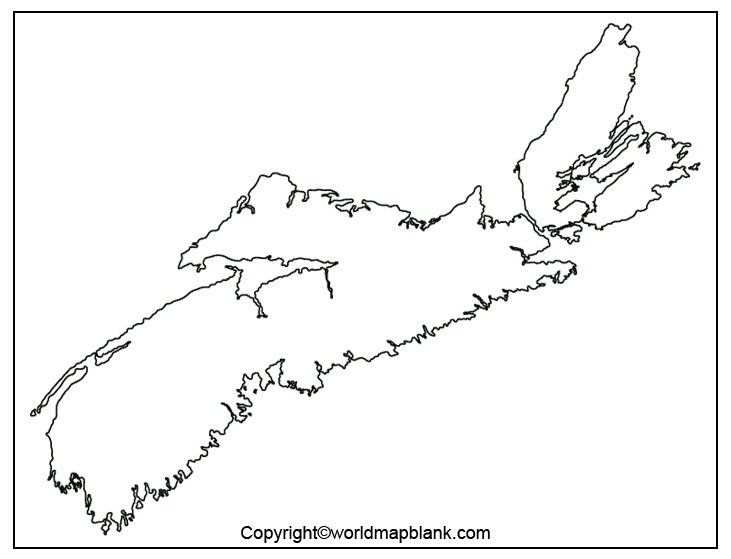

Explore Canada’s Atlantic coast with a blank map of Nova Scotia for geography lessons, school assignments, classroom activities, and personal study. This page provides printable map resources in PNG and PDF formats, including an outline map, a general printable map, a practice worksheet, and a transparent map image.
Nova Scotia is one of Canada’s four Atlantic provinces. Its capital city is Halifax, and the province includes mainland Nova Scotia, Cape Breton Island, and several smaller islands. A blank outline map can help students understand the province’s shape, identify important locations, and practise basic map-labeling skills.
Choose the map format that suits your activity, download the file, and print it for personal study or classroom practice.
- World Map with Continents
- Labeled Map of South America
- Labeled Map of Africa
- Political World Map
- Blank Map of World
- World Map with oceans
- World Map Poster
- Labeled Map of Europe
- Labeled Map of Africa
- Blank Map of Asia
- World Time Zone Map
- Labeled Map of World
- Physical World Map
Blank Map of Nova Scotia – Outline
A blank map of Nova Scotia is useful for learning the province’s geographical shape and coastal boundaries. An outline map provides a starting point for identifying locations and practising map-reading skills.

You can use the outline to practise drawing or labeling geographical features. Depending on the details shown in the selected image, you may also use a separate reference map to identify coastlines, nearby bodies of water, and important settlements.
For accurate geographical reference, compare your worksheet with the official provincial maps published by Natural Resources Canada.
Printable Map of Nova Scotia
A printable map of Nova Scotia is a convenient resource for students, teachers, homeschoolers, and anyone studying Canadian geography. Printed maps can be annotated, highlighted, or included in school projects.

Before printing, open the image or PDF and check its labels and geographical details. Select a suitable paper size and use the print preview to avoid cutting off the map’s edges.
For school assignments, you can add the province’s capital, major communities, surrounding water bodies, and other features when these are relevant to the lesson.
Blank Map of Nova Scotia for Practice Worksheet
A blank map of Nova Scotia can turn geography study into an interactive exercise. Instead of simply reading place names, learners can recall locations and add labels independently.

How to Use the Nova Scotia Map Worksheet
- Locate Nova Scotia on a map of Canada.
- Mark Halifax, the provincial capital.
- Identify mainland Nova Scotia and Cape Breton Island.
- Label selected surrounding waters, such as the Atlantic Ocean, Bay of Fundy, and Northumberland Strait.
- Compare your answers with a reliable reference map.
- Correct any mistakes and repeat the exercise to improve recall.
Teachers can use this activity for classroom assessments, revision exercises, and geography homework. Parents and independent learners can also use it to practise identifying provincial features.
Transparent PNG Nova Scotia Map
A transparent PNG map can be useful when creating presentations, educational worksheets, posters, and digital learning materials. Unlike an image with a solid background, a genuinely transparent PNG can be placed over a coloured background or another design element.

PNG is an image format that can preserve transparency, but not every PNG file has a transparent background. Check the image before using it in a design project. A PDF version may be more convenient when preparing a document for printing.
For research that requires detailed geological information, elevation, or officially documented geographical features, consult specialized maps from Natural Resources Canada or the Government of Nova Scotia.
Geography of Nova Scotia: Important Facts
Nova Scotia is located in eastern Canada along the Atlantic coast. Its geography is strongly influenced by its extensive coastline, coastal inlets, islands, and surrounding waters.
Here are some useful facts to explore with your map:
- Capital city: Halifax.
- Region: Atlantic Canada.
- Major land areas: Mainland Nova Scotia and Cape Breton Island.
- Nearby waters: Atlantic Ocean, Bay of Fundy, Northumberland Strait, and Gulf of St. Lawrence.
- Notable route: The Cabot Trail, a scenic route on Cape Breton Island.
- Geography activities: Map labeling, coastal-feature identification, provincial location practice, and comparisons with neighbouring Atlantic provinces.
These facts provide context for interpreting the map. A blank outline does not necessarily display cities, roads, elevation, or geological features, so use a labeled reference map when you need those details.
How to Print a Blank Map of Nova Scotia
Follow these steps to prepare your map for use:
- Choose the PNG image for quick viewing or the PDF for document printing.
- Open the downloaded file on your computer or mobile device.
- Select the print option and check the page preview.
- Choose a suitable paper size, such as A4 or Letter, depending on your printer.
- Use the fit-to-page option if necessary to keep the entire map visible.
- Print in black and white for labeling exercises or in colour when the map’s colours provide useful information.
For a classroom worksheet, leave enough space around the map for labels and written answers. If the map is being used in a report or presentation, include a source attribution where required by the map’s licence or usage terms.
Official Nova Scotia Map References
For reliable geographical information, compare printable worksheets with official reference material. Natural Resources Canada provides provincial maps, including political maps and outline maps with and without geographical labels.
The Government of Nova Scotia also provides geological maps, GIS data, and other specialized mapping resources.
These sources are particularly useful when you need to verify provincial boundaries, place names, geological details, or other information that may not appear on a basic outline map.
Frequently Asked Questions
1. Where can I download a blank map of Nova Scotia?
You can download the outline map and practice worksheet provided on this page in PNG and PDF formats. Choose the file that best suits your study, teaching, or printing needs.
2. Is the Nova Scotia blank map available as a PDF?
Yes. PDF versions are linked in the outline map, printable map, practice worksheet, and transparent map sections above.
3. What is a blank map of Nova Scotia used for?
It can be used for school assignments, geography revision, classroom quizzes, map-labeling activities, presentations, and independent learning.
4. What is the capital of Nova Scotia?
Halifax is the capital city of Nova Scotia. You can mark its location on a blank map as a basic geography exercise.
5. Which island is part of Nova Scotia?
Cape Breton Island is part of Nova Scotia. It is located northeast of the mainland and is connected to it by the Canso Causeway.
6. Which bodies of water surround Nova Scotia?
Nova Scotia is associated with the Atlantic Ocean, Bay of Fundy, Northumberland Strait, and Gulf of St. Lawrence. The precise water bodies shown will depend on the map’s scale and level of detail.
7. How do I print a Nova Scotia outline map?
Download the PNG or PDF, open it, and select Print. Use the print preview and fit-to-page settings to ensure the map fits on your paper.
8. Where can I find an official Nova Scotia reference map?
Natural Resources Canada publishes provincial reference maps, including an outline map showing Nova Scotia’s boundary, coastline, major lakes, and rivers. See the official reference links below.
Conclusion
A printable blank map of Nova Scotia is a practical resource for studying Canadian geography, completing classroom activities, and practising map labeling. Use the outline map for basic exercises, the worksheet for revision, and the transparent PNG for suitable digital projects.
For additional accuracy, compare the downloaded map with official geographical resources from Natural Resources Canada and the Government of Nova Scotia. This will help you distinguish a basic outline from a detailed political, physical, or geological map.
Reference links
https://natural-resources.canada.ca/maps-tools-publications/maps/atlas-canada/reference-maps
https://open.canada.ca/data/en/dataset/87f670d9-19a2-5917-98df-b677fd4a07db
https://novascotia.ca/natr/meb/maps
https://novascotia.ca/natr/meb/geoscience-online/geoscience_about.asp
