

A labeled map of Iceland helps you identify the country’s capital, major cities, geographical regions, and important coastal settlements. Located in the North Atlantic Ocean, Iceland is known for its volcanoes, glaciers, waterfalls, geothermal areas, and dramatic landscapes.
Iceland covers approximately 103,000 square kilometers and has Reykjavík as its capital. Unlike the United States, Iceland is not divided into states. Instead, it has regions, municipalities, towns, and other local administrative divisions.
This guide includes a labeled map of Iceland, maps showing its regions and cities, a capital map, and printable PDF versions for educational, geographical, and travel-planning purposes.
- World map with continents
- Physical world map
- Political world map
- Labeled map of Asia
- Labeled map of Africa
- Labeled map of Europe
- Labeled map of South America
- World time zone map
- Labeled map of world
- Blank map of world
- Labeled map of North America
- Blank map of Asia
- World map with oceans
- World map poster
Labeled Map of Iceland
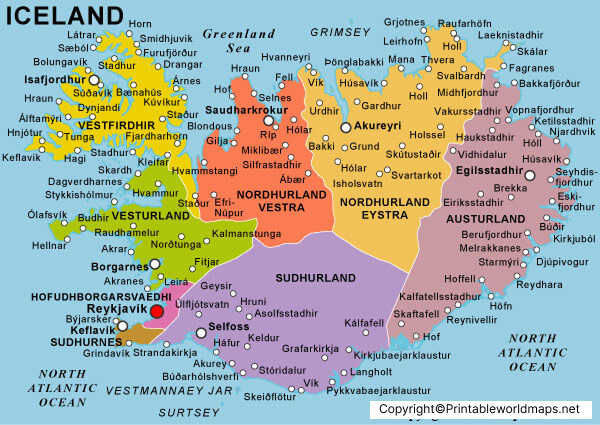
A labeled map provides an overview of Iceland’s position in the North Atlantic and helps readers understand the country’s overall shape, coastline, and geographical location.
Iceland lies close to the Arctic Circle, although most of the country is south of it. The island sits on the Mid-Atlantic Ridge, where the North American and Eurasian tectonic plates are moving apart. This geological setting contributes to Iceland’s volcanic activity, earthquakes, hot springs, and geothermal landscapes.
The country also contains extensive glaciers, including Vatnajökull, the largest ice cap in Iceland. Combining a labeled map with a physical map makes it easier to identify mountains, glaciers, volcanic areas, and coastal settlements.
Labeled Map of Iceland with States
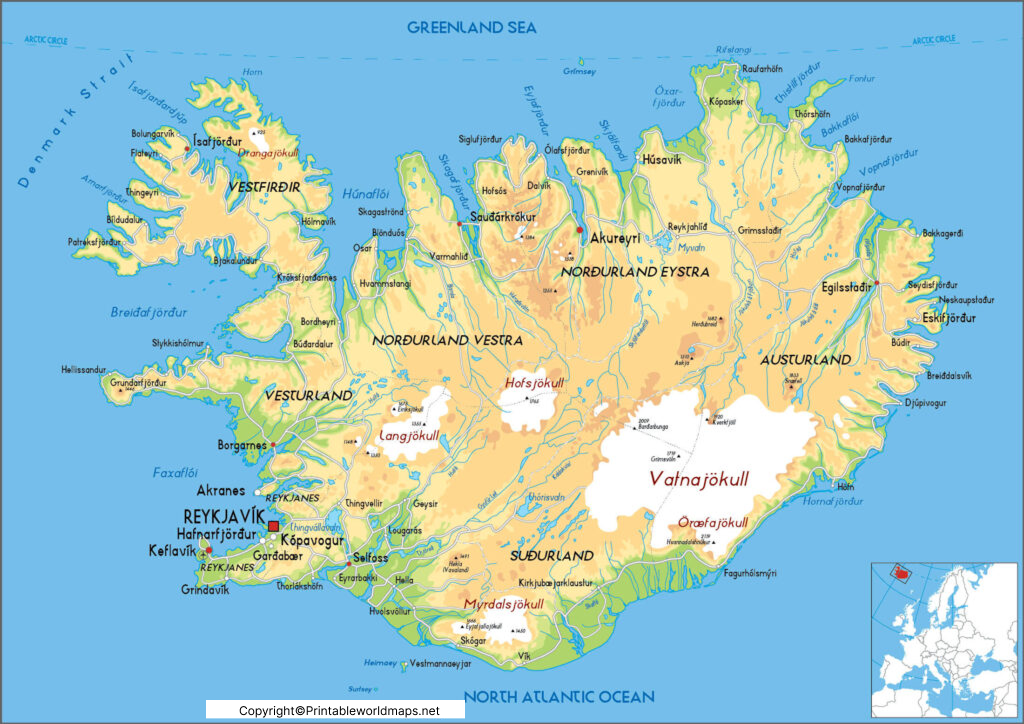
Iceland does not have states in the same sense as countries such as the United States or India. For geographical reference, the country is commonly organized into eight statistical regions:
- Capital Region
- Southern Peninsula
- West
- Westfjords
- Northwest
- Northeast
- East
- South
These regions are useful for understanding population distribution, local geography, and the location of towns and natural attractions. Tourism resources may group the country into seven broader travel regions, so the number of regions can vary according to the classification being used.
Iceland’s municipalities are separate local administrative units. Therefore, a map labeled with regions should not be described as a state map without explaining this distinction.
Most of Iceland’s population lives near the coast, particularly in and around the Capital Region. The interior highlands are sparsely populated and contain large areas of volcanic terrain, glaciers, and protected wilderness.
Labeled Map of Iceland with Cities
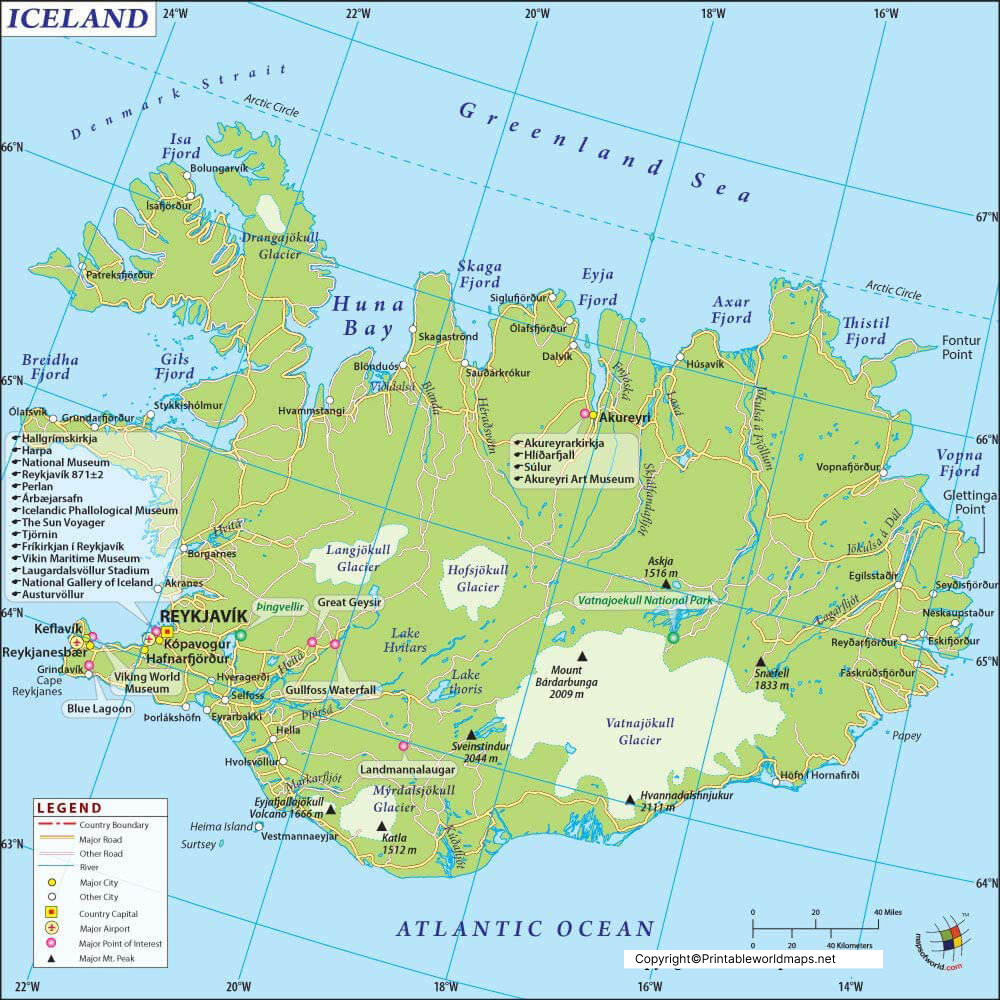
A labeled map of Iceland with cities helps readers locate major population centers and smaller settlements throughout the country. Reykjavík is the capital and largest city, while Akureyri is an important urban center in northern Iceland.
Other well-known towns and settlements include Kópavogur, Hafnarfjörður, Selfoss, Ísafjörður, Húsavík, Vík í Mýrdal, and Seyðisfjörður.
These places serve different purposes. Reykjavík is the country’s principal cultural and economic center, Akureyri is an important northern service center, and Húsavík is known for whale-watching tourism. Vík í Mýrdal is a useful reference point for exploring the South Coast.
When using a city map, remember that Iceland’s towns, urban settlements, and municipalities are not interchangeable administrative categories. A map may display a town name even when the surrounding municipality includes additional settlements or rural areas.
Labeled Iceland Map with Capital
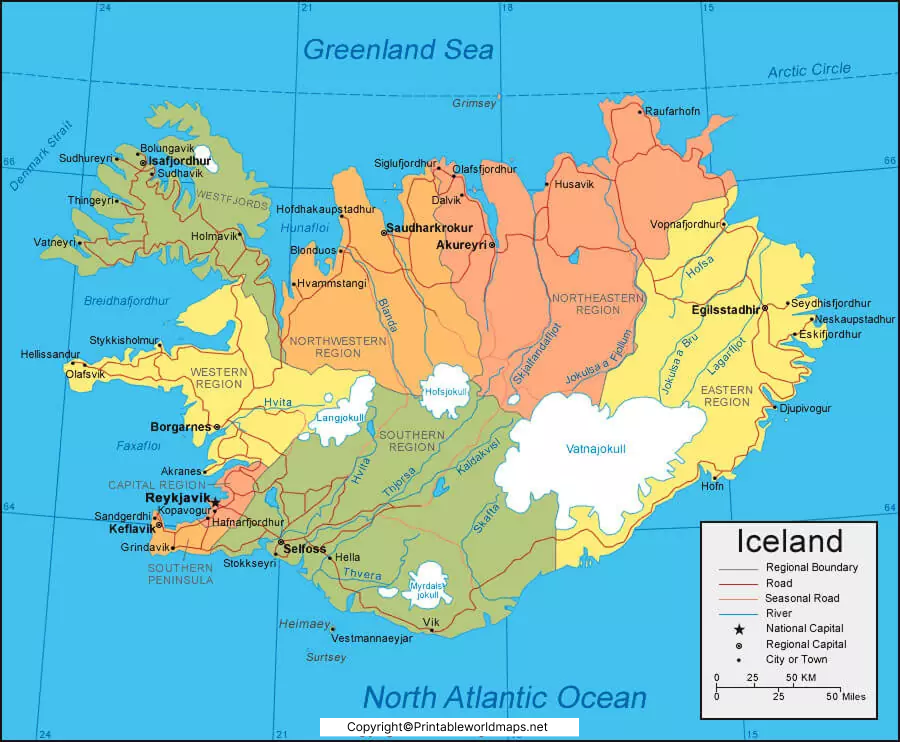
Reykjavík is the capital of Iceland. It is located in southwestern Iceland on the coast of Faxaflói Bay and serves as the country’s principal center for government, culture, education, and business.
The wider Capital Region includes several neighboring municipalities, such as Kópavogur, Hafnarfjörður, Garðabær, and Mosfellsbær. This wider urban area is distinct from Reykjavík municipality itself.
Reykjavík is also known for its museums, architecture, waterfront, cultural venues, and access to geothermal attractions. The National Museum of Iceland and the Reykjavík area offer opportunities to learn about the country’s history, settlement, and cultural development.
Geothermal energy is important in Iceland. It is used for district heating and other applications, while electricity is also generated from renewable sources, including hydropower and geothermal energy.
A capital map is particularly useful for students learning about Iceland’s political geography and travelers planning routes from Reykjavík to other parts of the island.
Geography and Important Facts About Iceland
The following facts provide useful context when reading a labeled map of Iceland.
| Geographic fact | Information |
|---|---|
| Country | Iceland |
| Capital | Reykjavík |
| Region of the world | Northern Europe |
| Ocean | North Atlantic Ocean |
| Approximate land area | 103,000 square kilometers |
| Currency | Icelandic króna (ISK) |
| Main geographical features | Volcanoes, glaciers, mountains, coastlines, and geothermal areas |
| Highest peak | Hvannadalshnúkur |
| Largest ice cap | Vatnajökull |
Iceland’s population changes over time, so use a dated official statistical release rather than an undated population estimate. Statistics Iceland reported 394,324 residents on January 1, 2026. This figure refers to the whole country, not just Reykjavík or the Capital Region.
Official population data is available from Statistics Iceland.
Why Is Iceland’s Geography Unique?
Iceland’s location on the Mid-Atlantic Ridge creates a distinctive geological environment. Volcanic systems, lava fields, hot springs, and geothermal areas can be found across the island. Glaciers and ice caps also shape its landscapes.
The climate is influenced by the surrounding North Atlantic, and conditions can change quickly. Coastal areas and the interior highlands can experience very different weather, so geographical maps are useful for understanding distances and terrain, while current weather and road maps are essential for travel planning.
How to Use a Printable Iceland Map
A printable map can be useful for school assignments, geography lessons, travel preparation, and general reference.
- For students: Identify Reykjavík, other major towns, the surrounding ocean, and Iceland’s main geographical regions.
- For teachers: Use a labeled map to explain the country’s location, settlements, and physical geography.
- For travelers: Use a city map to understand the relative positions of settlements before checking road distances and current conditions.
- For map practice: Compare the labeled map with a blank outline map to test geographical knowledge.
Before printing, check the PDF page dimensions and image resolution. A high-resolution PDF is generally preferable when labels need to remain legible on a larger sheet of paper.
Frequently Asked Questions About the Labeled Map of Iceland
1. What is the capital of Iceland?
Reykjavík is the capital and largest city of Iceland. It is located in the southwestern part of the country.
2. Does Iceland have states?
No. Iceland does not have states like the United States. It is divided into municipalities and can also be grouped into geographical or statistical regions.
3. How many regions does Iceland have?
Iceland is commonly divided into eight statistical regions. Tourism resources may use seven broader geographical regions, depending on their classification.
4. Which are the major cities and towns in Iceland?
Important urban centers and settlements include Reykjavík, Kópavogur, Hafnarfjörður, Akureyri, Selfoss, Ísafjörður, Húsavík, and Seyðisfjörður. Their size and administrative status vary.
5. Where is Iceland located?
Iceland is an island country in the North Atlantic Ocean, between Greenland and mainland Europe. It is generally classified as part of Northern Europe.
6. What is the approximate area of Iceland?
Iceland has a land area of approximately 103,000 square kilometers.
7. Can I download a labeled map of Iceland in PDF format?
Yes. The PDF links provided in this article allow you to access the available labeled map, regions map, cities map, and capital map.
8. What is the largest glacier in Iceland?
Vatnajökull is Iceland’s largest ice cap. It covers a substantial area in the southeastern part of the country.
9. What is the highest point in Iceland?
Hvannadalshnúkur, on the Öræfajökull volcano beneath the Vatnajökull ice cap, is generally recognized as Iceland’s highest peak.
10. Why is Reykjavík important?
Reykjavík is Iceland’s capital and a major center for government, business, education, culture, and tourism. It is also a common starting point for trips around the country.
Reference links
https://www.statice.is/statistics/population/inhabitants/
https://www.census.is/utgafur/frettasafn/mannfjoldi/mannfjoldi-1-januar-2026/
https://www.statice.is/statistics/population/inhabitants/municipalities-and-urban-nuclei/
https://www.visiticeland.com/the-regions/
https://www.visiticeland.com/article/weather-and-climate/
https://reykjavik.is/en/maps-for-public-use
https://unstats.un.org/UNSDWebsite/publications/pocketbook/world-stats-pocketbook-2025.pdf
