
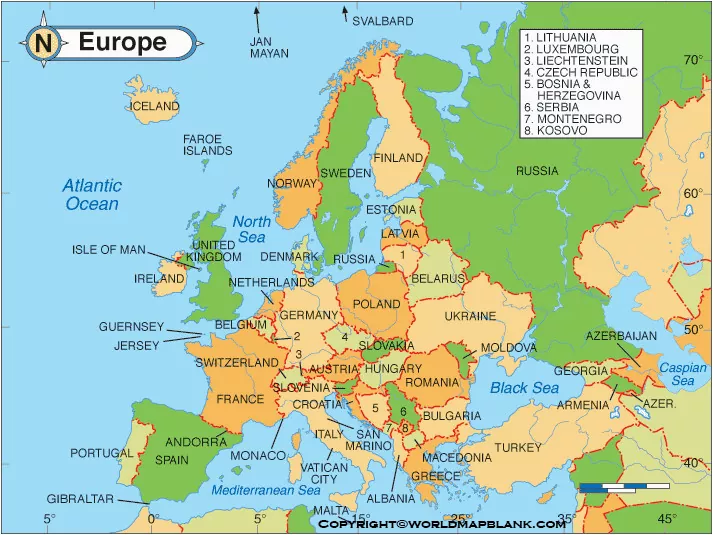

Explore the Europe Physical Map to study the continent’s major mountains, rivers, plains, lakes, seas, islands, peninsulas, and other natural features. These printable Europe physical maps are useful for students, teachers, geography projects, homeschool lessons, and anyone who wants a clear visual reference of Europe’s physical geography.
You can view the maps online, download printable PDF versions, and use labeled or physical map formats for classroom and personal study.
Europe Physical Map
Europe is the western part of the Eurasian landmass and is generally recognized as the second-smallest continent by land area, after Oceania. Its physical geography is highly varied, ranging from Arctic landscapes and Scandinavian fjords to broad plains, major mountain systems, Mediterranean coastlines, and numerous islands.
A Europe Physical Map helps identify these natural features without focusing primarily on political borders. It can show mountain ranges, rivers, lakes, plains, coastlines, seas, islands, and other geographic formations.

Key Physical Geography of Europe
Some of the most important physical features shown on a Europe physical map include:
- Alps – One of Europe’s best-known mountain systems, extending across several countries.
- Carpathian Mountains – A major mountain arc in Central and Eastern Europe.
- Pyrenees – A mountain range forming much of the natural boundary between Spain and France.
- Ural Mountains – Commonly used as part of the conventional geographic boundary between Europe and Asia.
- North European Plain – A broad lowland region extending across much of northern Europe.
- Volga River – The longest river in Europe and one of the continent’s major drainage systems.
- Danube River – One of Europe’s most important rivers, flowing through Central and Southeastern Europe.
- Mediterranean Sea – A major body of water bordering southern Europe.
- Black Sea – Located southeast of Europe and connected with the Mediterranean through the Bosporus, Sea of Marmara, and Dardanelles.
- Caspian Sea – A large inland body of water located east of the Caucasus region.
National Geographic divides Europe’s physical geography into four broad regions: the Western Uplands, North European Plain, Central Uplands, and Alpine Mountains.
Printable Europe Physical Map
A Printable Europe Physical Map provides a convenient way to study the continent’s natural landscape on paper or digitally. Students can use the map for geography assignments, classroom activities, revision, labeling exercises, and map-reading practice.
Europe has a highly varied coastline and includes many prominent peninsulas and islands. Important peninsulas include the Iberian, Italian, Balkan, Scandinavian, and Jutland peninsulas.
The continent is bordered by the Arctic Ocean to the north, the Atlantic Ocean to the west, and the Mediterranean, Black, and Caspian seas toward the south and southeast.
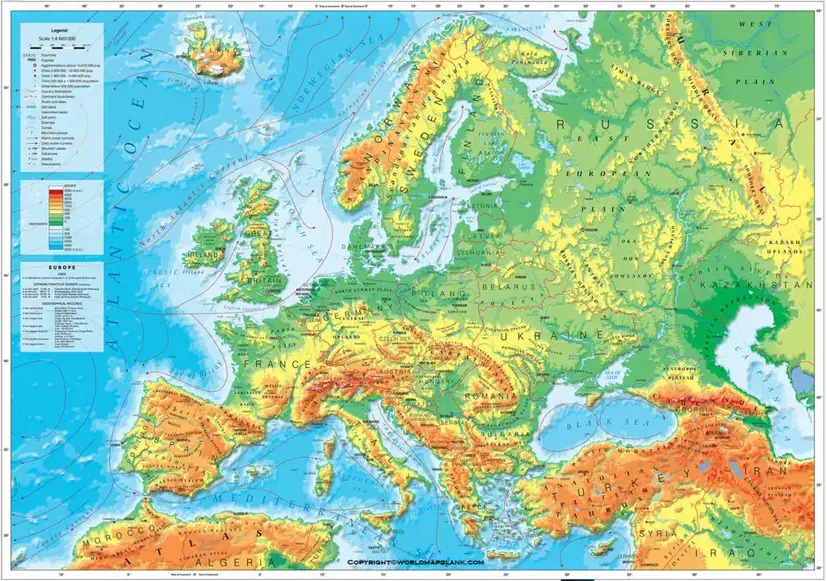
Map of Europe Physical
The Map of Europe Physical is designed to highlight the continent’s natural geography. Unlike a political map, which primarily emphasizes national boundaries and cities, a physical map focuses on landforms and bodies of water.

Depending on the map style, you can use it to identify:
- Major mountain ranges
- Rivers and river valleys
- Lakes
- Plains and lowlands
- Highlands and plateaus
- Seas and surrounding oceans
- Islands and peninsulas
- Important physical regions
Europe’s physical landscape changes significantly from north to south. Northern areas include glaciated landscapes and fjords, while the central part contains extensive plains and uplands. Southern Europe includes several major mountain ranges and the Mediterranean region.
Map of Europe Physical Labeled
The Map of Europe Physical Labeled is useful when you want to identify geographic features directly on the map. A labeled physical map can make geography lessons easier because students can connect names with the location and shape of each feature.
For example, students can locate the Alps, Carpathians, Pyrenees, North European Plain, Volga River, Danube River, Mediterranean Sea, Black Sea, and other important features.
The Pyrenees form a prominent natural barrier between Spain and France, while physical features such as the Alps have also influenced the geography and historical movement of people across Europe.

Major Mountains on a Europe Physical Map
Mountains are among the most recognizable features of Europe’s physical geography.
The Alps form a major mountain system across south-central Europe. Other important ranges include the Pyrenees, Carpathians, Apennines, Dinaric Alps, Balkan Mountains, Scandinavian Mountains, and Caucasus Mountains.
According to National Geographic, Mount Elbrus in Russia reaches 5,642 meters (18,510 feet) and is commonly identified as Europe’s highest peak.
A physical map makes it easier to compare the location of these mountain systems with nearby plains, rivers, and seas.
Major Rivers of Europe
Rivers are another important part of Europe’s physical geography. They have influenced agriculture, transportation, settlement, trade, and the development of cities.
Important European rivers include:
| River | Geographic importance |
|---|---|
| Volga | Europe’s longest river |
| Danube | Major river of Central and Southeastern Europe |
| Rhine | Important river system of Western and Central Europe |
| Dnieper | Major river flowing through Eastern Europe |
| Don | Important river of European Russia |
| Elbe | Major river flowing through Central Europe |
| Vistula | Major river of Poland |
| Loire | The longest river entirely in France |
The North European Plain contains several important navigable rivers, including the Rhine, Weser, Elbe, Oder, and Vistula.
Major Seas and Water Bodies of Europe
Europe’s location between several major bodies of water contributes strongly to its physical geography.
The major water bodies associated with Europe include:
- Arctic Ocean
- Atlantic Ocean
- Mediterranean Sea
- Black Sea
- Baltic Sea
- North Sea
- Norwegian Sea
- Caspian Sea
Europe’s long and irregular coastline also contributes to its large number of bays, gulfs, islands, and peninsulas. National Geographic describes Europe as a “peninsula of peninsulas” because of this distinctive geography.
Major Physical Regions of Europe
For easier study, Europe’s landscape can be understood through several broad physical regions.
Western Uplands
The Western Uplands include areas influenced strongly by ancient rock formations and glaciation. Parts of Scandinavia, Iceland, Scotland, Ireland, and other western areas contain rugged uplands, lakes, and fjords.
North European Plain
The North European Plain is an extensive lowland region stretching from western Europe toward Russia. Its relatively flat terrain and river systems have supported agriculture, transportation, and settlement for centuries.
Central Uplands
The Central Uplands include several elevated and wooded regions across Central Europe. Examples include the Black Forest, Ardennes, Vosges, and other upland areas.
Alpine Mountains
The Alpine region includes some of Europe’s most prominent mountain systems, including the Alps, Pyrenees, Apennines, Carpathians, and other ranges. These mountains create major variations in elevation, climate, vegetation, and drainage.
Why Use a Europe Physical Map?
A physical map can make geography easier to understand because it allows learners to see relationships between different natural features.
A Europe Physical Map can be useful for:
- Geography students
- Teachers and educators
- School assignments
- Homeschool lessons
- Geography quizzes
- Map-labeling activities
- Travel and geographic reference
- Research projects
- Classroom presentations
- General geography learning
Instead of memorizing individual names separately, learners can use the map to understand where mountains, rivers, plains, and seas occur in relation to one another.
Interesting Facts About Europe’s Physical Geography
Here are some useful facts to remember:
- Europe is the second-smallest continent by land area, after Oceania.
- Europe is commonly described as the western peninsula of Eurasia.
- The North European Plain is one of the continent’s major lowland regions.
- The Volga is Europe’s longest river.
- Mount Elbrus, at 5,642 meters, is commonly identified as Europe’s highest peak.
- Europe contains many major peninsulas, including the Iberian, Italian, Balkan, Scandinavian, and Jutland peninsulas.
- Glaciation has helped shape many northern European landscapes, including fjords and lakes.
How to Use a Printable Europe Physical Map
For the best learning results, try these simple activities:
1. Identify the mountain ranges
Locate the Alps, Pyrenees, Carpathians, Apennines, and Scandinavian Mountains.
2. Trace major rivers
Follow the Volga, Danube, Rhine, Dnieper, and other major rivers from their source toward their drainage areas.
3. Identify surrounding water bodies
Locate the Arctic Ocean, Atlantic Ocean, Mediterranean Sea, Black Sea, Baltic Sea, and North Sea.
4. Compare landforms
Look at how mountain ranges contrast with Europe’s major plains and lowlands.
5. Practice labeling
Print a map and ask students to label major mountains, rivers, seas, islands, and peninsulas.
Printable Europe Physical Map for Students and Teachers
This collection is particularly useful for geography lessons because the maps can be viewed digitally or printed for classroom activities.
Teachers can use the maps for:
- Geography worksheets
- Map quizzes
- Classroom displays
- Homework
- Revision activities
- Physical geography projects
Students can also use the PDF versions as quick reference material when preparing assignments or studying for geography examinations.
Frequently Asked Questions About Europe Physical Map
What is a Europe Physical Map?
A Europe Physical Map shows the continent’s natural geographic features, including mountains, rivers, lakes, plains, seas, islands, and other landforms.
What does a physical map of Europe show?
A physical map of Europe primarily shows natural features such as mountain ranges, rivers, lakes, plains, highlands, coastlines, and surrounding bodies of water.
What is the highest mountain in Europe?
Mount Elbrus in Russia is commonly identified as Europe’s highest peak, with an elevation of 5,642 meters (18,510 feet).
What is the longest river in Europe?
The Volga is the longest river in Europe. It flows through European Russia and drains into the Caspian Sea.
What are the major mountain ranges in Europe?
Major mountain systems include the Alps, Pyrenees, Carpathians, Apennines, Dinaric Alps, Balkan Mountains, Scandinavian Mountains, and Caucasus Mountains.
What are the major physical regions of Europe?
National Geographic identifies four broad physical regions: Western Uplands, North European Plain, Central Uplands, and Alpine Mountains.
Is Europe part of Eurasia?
Yes. Geographically, Europe forms the western portion of the larger Eurasian landmass. The boundary between Europe and Asia is conventionally defined using features including the Ural Mountains, Ural River, Caspian Sea, Caucasus region, and waterways toward the Black Sea, although boundary definitions can vary.
Can I print the Europe Physical Map?
Yes. The maps provided on this page can be viewed online and selected versions are available as PDF files for printing and educational use.
What is the difference between a Europe physical map and political map?
A physical map focuses on natural features such as mountains, rivers, and plains. A political map focuses on countries, borders, capitals, and other political divisions.
Reference Links
https://education.nationalgeographic.org/resource/europe-physical-geography
https://education.nationalgeographic.org/resource/europe-human-geography
https://unstats.un.org/unsd/demographic-social/products/dyb/dyb_2024
More Free Printable Maps to Download
We provide a high number of other printable maps of the world, continents and single countries for download. Please find below a link collection to more maps as downloadable PDF files which you might be interested in. You could also find your desired map with our search feature at the top of the page.

1 thought on “Printable Europe Physical Map | Map of Europe Physical”