

The Austrian Empire Map shows the historical territories governed by the Habsburg monarchy from 1804 to 1867. Located in Central Europe, the empire brought together diverse peoples, languages, cultures, and historic provinces under Habsburg rule. Its political and geographical boundaries changed over time because of wars, territorial exchanges, and administrative reforms.
A labeled historical map helps readers identify important regions, major cities, neighboring territories, and the location of Vienna, the imperial capital. It is also useful for students, teachers, history enthusiasts, and researchers studying the political development of Central Europe.
Labeled Map of Austrian Empire
The Austrian Empire was proclaimed in 1804 by Francis II, who became Emperor Francis I of Austria. The proclamation strengthened the Habsburg ruler’s imperial title during the Napoleonic Wars. The Holy Roman Empire was dissolved in 1806, making the Austrian Empire a distinct political entity.
Vienna served as the principal political and administrative center. Other important urban centers included Prague, Graz, and Trieste, although their administrative roles differed across historical periods.
The empire’s territory included numerous crown lands and historic regions. Its borders changed during the nineteenth century, particularly following the Congress of Vienna in 1814–1815 and the Austro-Prussian War of 1866.
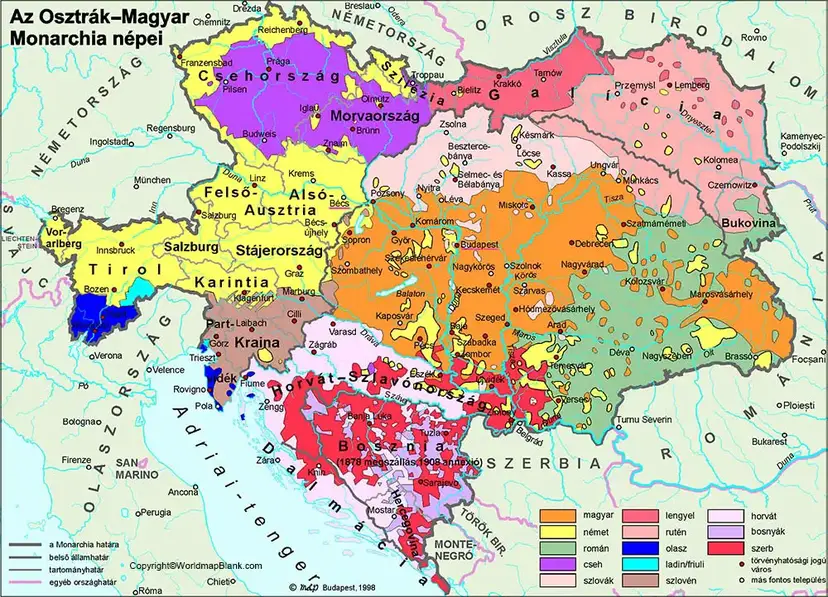
Labeled Map of Austrian Empire with States
The Austrian Empire was not a modern federal country divided into states in the contemporary sense. Its territory consisted of kingdoms, duchies, archduchies, and other lands under Habsburg rule. These territories had different historical traditions and administrative arrangements.
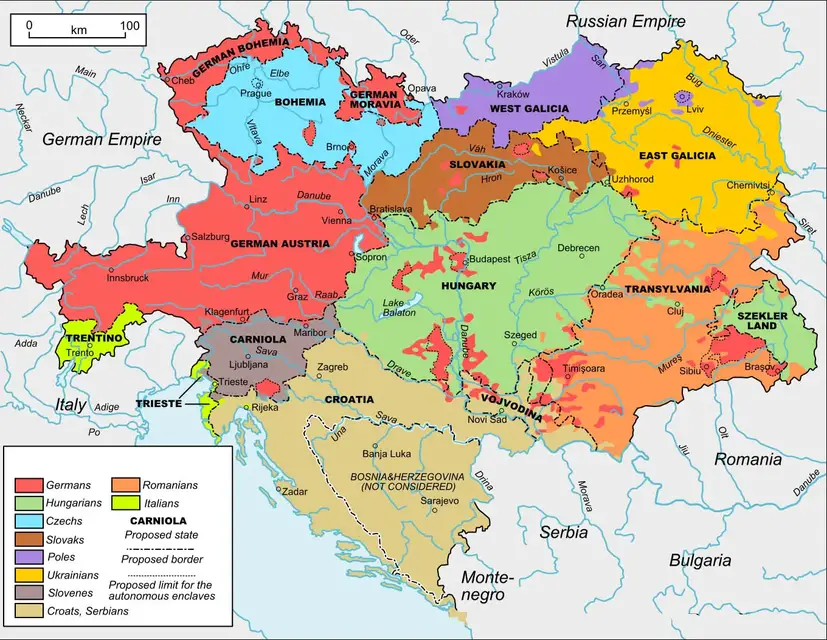
Important historical regions included:
- Archduchy of Austria: The dynastic heartland surrounding Vienna.
- Kingdom of Bohemia: A historic crown land associated with Prague.
- Margraviate of Moravia: A region associated with Brno.
- Kingdom of Galicia and Lodomeria: A large territory in the northeast, including areas of present-day Poland and Ukraine.
- Kingdom of Hungary: A major territory within the Habsburg monarchy.
- Kingdom of Lombardy–Venetia: An Italian territory that formed part of the empire during part of its history.
- Kingdom of Croatia-Slavonia: A historic region whose constitutional relationship with Hungary changed over time.
- Kingdom of Dalmatia: An Adriatic region under Habsburg administration.
The exact territories represented on a map depend on the year selected. For example, a map from 1815 will not show precisely the same borders as one from 1855 or 1866.
Labeled Map of Austrian Empire with Cities
A labeled Austrian Empire map with cities makes it easier to understand the political, commercial, and cultural geography of nineteenth-century Central Europe.
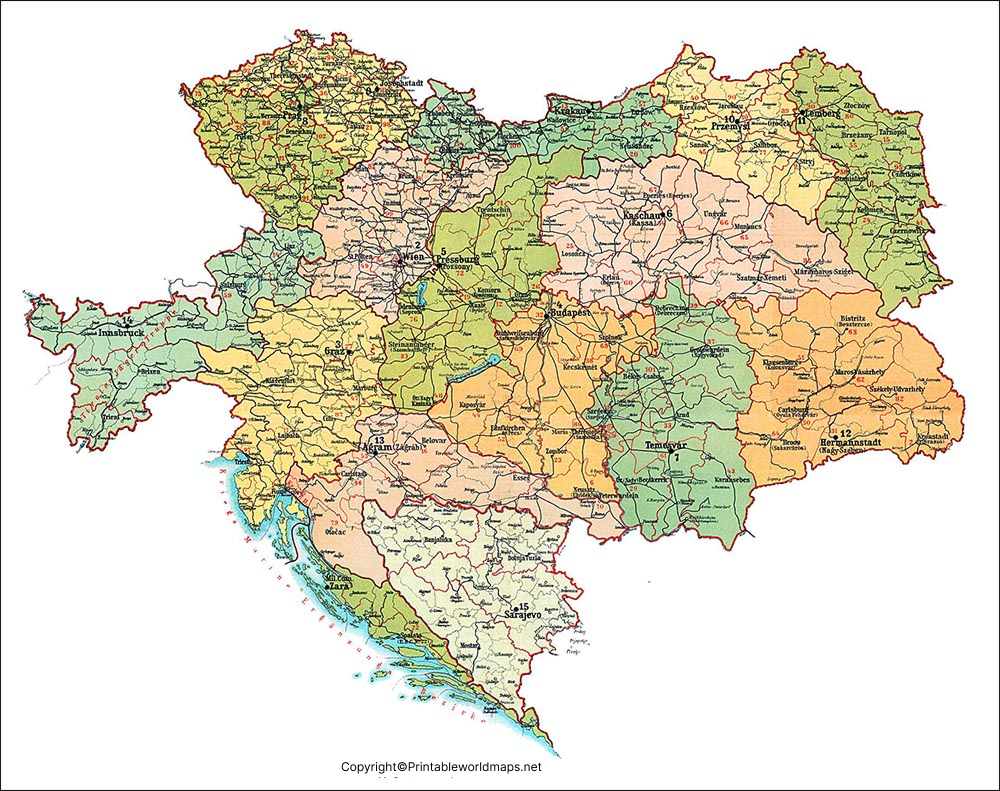
Important cities included:
- Vienna: The imperial capital and principal political center.
- Prague: An important administrative, educational, and cultural center in Bohemia.
- Graz: A major city in Styria and an important regional center.
- Trieste: A strategically important Adriatic port that supported maritime commerce.
- Brno: An important city in Moravia with a growing industrial economy.
- Lviv (historically Lemberg): A major center in Galicia.
- Innsbruck: An important city in the Tyrol region.
- Salzburg: A historic city and regional center.
Place names may appear in different forms depending on the map’s publication date and language. For example, Vienna was known as Wien in German, Prague as Prag in German, and Lviv as Lemberg in historical German-language sources.
These differences are especially useful to understand when studying old maps, historical documents, and family records.
Labeled Austrian Empire with Capital
Vienna was the capital of the Austrian Empire throughout its existence from 1804 to 1867. The city was the seat of the Habsburg monarchy and a major center of European diplomacy, administration, music, and culture.
One of the most significant events associated with Vienna was the Congress of Vienna, held from 1814 to 1815. Representatives of European powers met to negotiate a political settlement following the Napoleonic Wars and reshape the European balance of power.
Vienna’s historic architecture and musical heritage continue to attract visitors today. Its cultural history includes important associations with composers such as Mozart, Beethoven, and Haydn.
It is important to distinguish the Austrian Empire from Austria-Hungary. Following the Compromise of 1867, the Habsburg monarchy became the Austro-Hungarian Dual Monarchy, with Vienna as the capital of the Austrian half and Budapest as the capital of the Hungarian half.
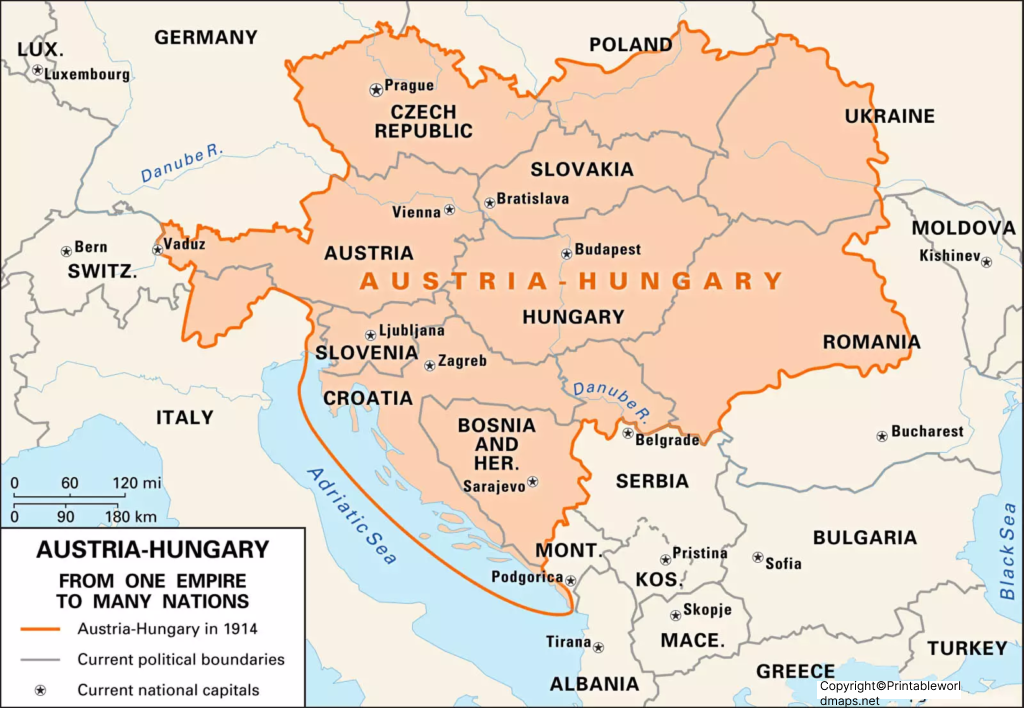
Seven Important Facts About the Austrian Empire
- Founded in 1804: Francis I proclaimed the Austrian Empire during the Napoleonic era.
- Ended in 1867 as a political designation: The Compromise of 1867 established the Austro-Hungarian Dual Monarchy.
- Vienna was the capital: The city served as the monarchy’s principal political center.
- A multinational monarchy: The population included German-speaking, Hungarian, Czech, Polish, Ukrainian, Italian, Romanian, South Slavic, Jewish, and other communities.
- The Danube was important: The river connected important Central and Southeastern European regions and supported transportation and trade.
- Borders changed repeatedly: Wars, diplomacy, and political reforms reshaped the monarchy’s territories.
- Its successor monarchy ended in 1918: Austria-Hungary dissolved at the end of the First World War, and its former territories became part of several independent countries and neighboring states.
How to Read an Austrian Empire Historical Map
When using a historical map, check the following details:
- Date: Confirm the year the map represents.
- Political boundaries: Identify borders that existed during the selected period.
- Place names: Look for historical German names and their modern equivalents.
- Administrative divisions: Distinguish crown lands from present-day nation-states.
- Major rivers: Use the Danube and other rivers as geographical reference points.
- Map legend and scale: Check symbols, boundaries, and distances where provided.
For academic work, compare a general labeled map with a historical atlas or a dated archival map. Historical borders should be verified against sources from the relevant period rather than inferred from current country boundaries.
Frequently Asked Questions
1. What years did the Austrian Empire exist?
The Austrian Empire was proclaimed in 1804 and was reorganized as the Austro-Hungarian Dual Monarchy in 1867.
2. What was the capital of the Austrian Empire?
Vienna, now the capital of Austria, was the imperial capital throughout the Austrian Empire’s existence.
3. Which major cities were part of the Austrian Empire?
Important cities included Vienna, Prague, Graz, Trieste, Brno, Lviv, Innsbruck, and Salzburg. Their political and administrative roles varied over time.
4. Was Hungary part of the Austrian Empire?
Yes. The Kingdom of Hungary was under Habsburg rule, although its constitutional position changed during the nineteenth century. The Compromise of 1867 established Austria-Hungary as a Dual Monarchy.
5. Is the Austrian Empire the same as Austria-Hungary?
No. The Austrian Empire refers to the period from 1804 to 1867. Austria-Hungary existed from 1867 until 1918.
6. Can I download a labeled Austrian Empire map in PDF format?
Yes. The map resources linked above include PDF versions for viewing, printing, and educational use. Check the map’s date and the publisher’s terms before reproducing it.
7. Which modern countries were once part of the Austrian Empire?
Former Habsburg territories now lie within several countries, including Austria, Hungary, the Czech Republic, Slovakia, Slovenia, Croatia, Poland, Ukraine, Romania, and Italy. The exact list depends on the historical year and the territories being considered.
8. Why are historical place names different from modern names?
Historical maps often use the administrative or commonly used language of their time. For example, Lviv was often labeled Lemberg, while Prague was labeled Prag in German-language maps.
Reference links
https://www.britannica.com/place/Austria-Hungary
https://guides.loc.gov/maps-genealogy-eastern-europe/topographic-sets/austria-hungary
https://www.davidrumsey.com/luna/servlet/detail/RUMSEY~8~1~360062~90127169%3AAustrian-Empire-
