

A blank map of Prince Edward Island is a useful resource for students, teachers, geography enthusiasts, and anyone who wants to learn about Canada’s smallest province. These printable outline maps and PDF worksheets can help you practise drawing the island’s shape, identify geographical features, and prepare classroom activities.
You can download the available Prince Edward Island maps in PNG and PDF formats. Choose a simple outline for drawing practice, a printable map for educational activities, or a transparent PNG for compatible digital projects.
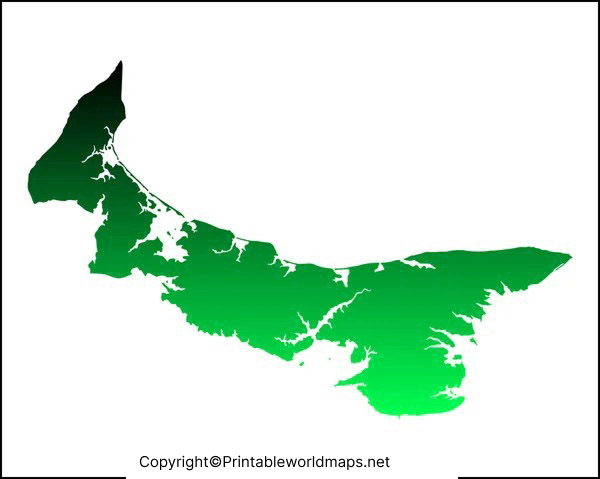
Blank Map of Prince Edward Island – Outline
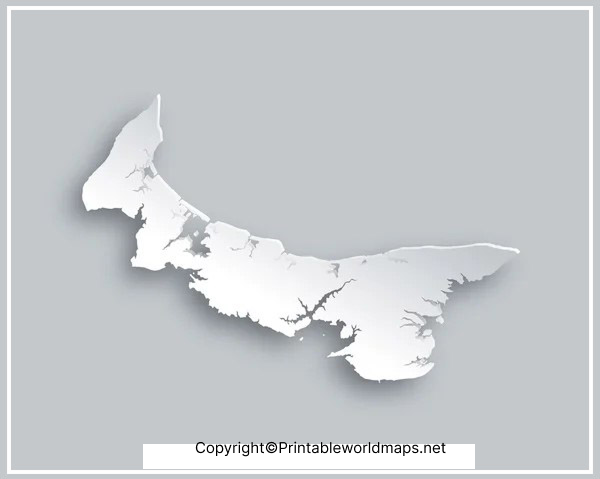
A blank outline map shows the outer shape of Prince Edward Island without requiring learners to rely on a fully labelled reference map. It is useful for practising map drawing, recognising the island’s outline, and creating geography exercises.
Students can use this outline to mark important places, add labels when suitable reference information is available, and compare their work with a completed map.
Prince Edward Island is in eastern Canada, in the Gulf of St. Lawrence. Its coastline includes bays, coves, inlets, and distinctive red sandstone cliffs. These features make the island a useful example for studying coastal geography.
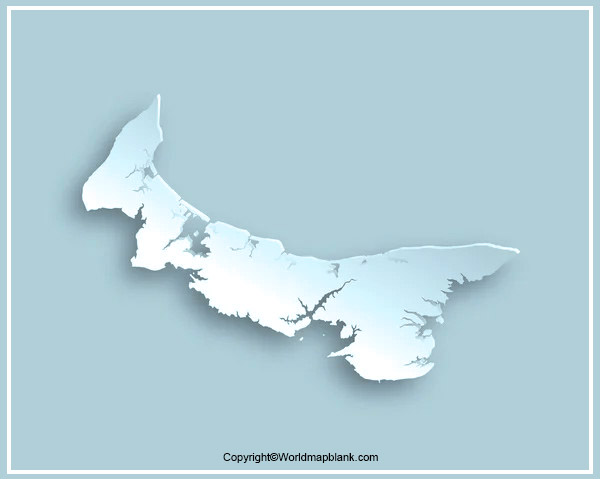
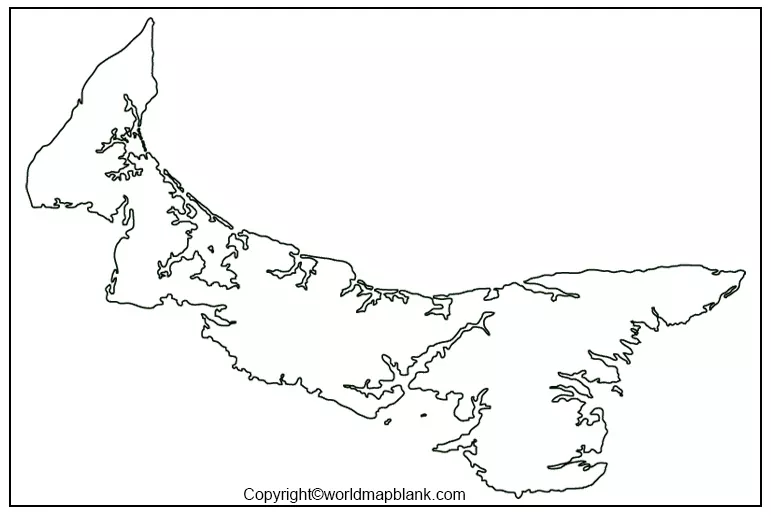
Printable Map of Prince Edward Island
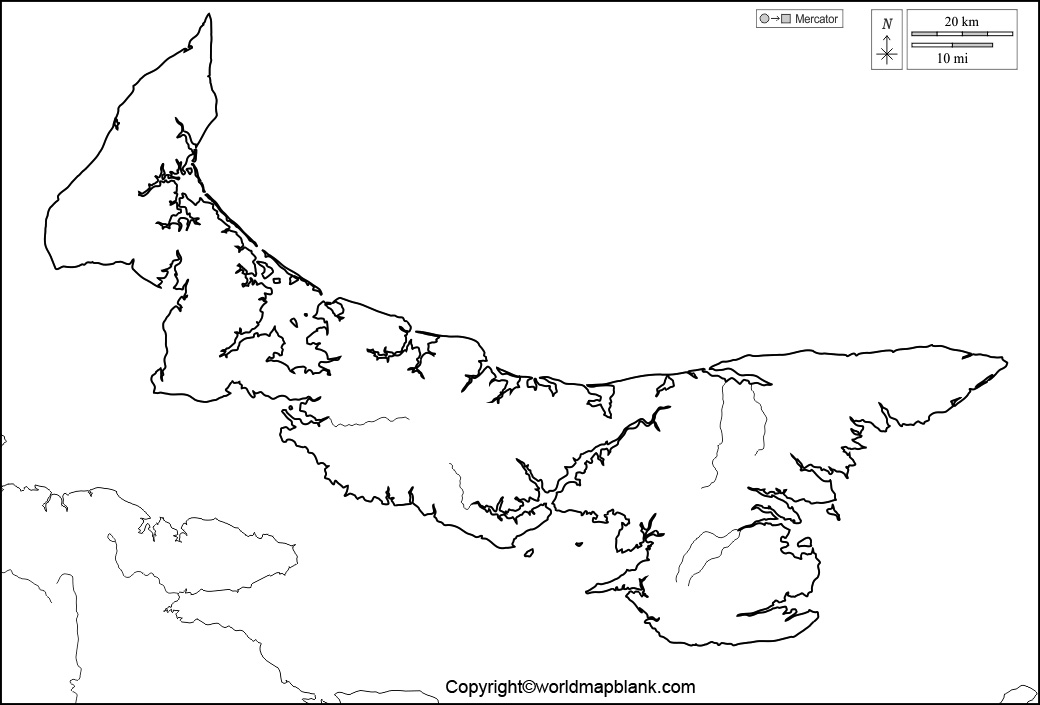
A printable map of Prince Edward Island can support school assignments, geography lessons, home learning, and personal study. Use the image version for quick viewing or select the PDF version when you need a convenient document for printing.
Before printing, check the page orientation and scaling settings in your printer dialogue. Choose a page size that keeps the island’s outline clear and avoids cutting off the edges.
For educational activities, learners can use a suitable reference map to identify Charlottetown, Summerside, the coastline, and other geographical features.
Prince Edward Island Blank Map for Practice Worksheets
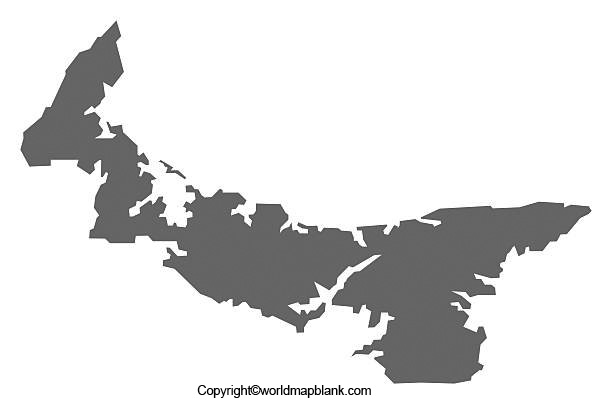
A blank map worksheet provides a practical way to reinforce geographical knowledge. Students can use it to practise recognising the island’s shape, adding labels, and remembering the locations of important communities.
Suggested classroom activities:
- Trace the outer boundary of Prince Edward Island.
- Mark Charlottetown, the provincial capital, using a reliable reference map.
- Label Summerside and other places included in the lesson.
- Identify the Gulf of St. Lawrence and nearby coastal features.
- Compare the completed worksheet with a labelled map and correct any mistakes.
Teachers can adapt these exercises for individual assignments, group activities, revision sessions, and geography quizzes.
This additional printable resource can be used for repeated practice or as a supplementary worksheet. For best results, use a clearly labelled reference map when checking the placement and spelling of geographical names.
Transparent PNG Prince Edward Island
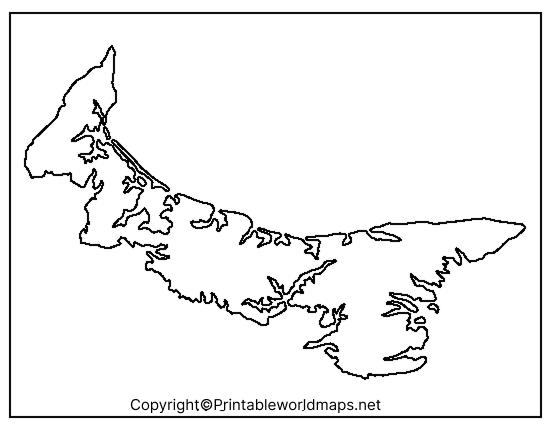
A transparent PNG map can be useful for compatible digital projects, presentations, educational posters, and worksheets. Depending on how the original image was created, its transparent background may allow you to place the map over another background without displaying a solid rectangular image area.
For digital use, check the image in your preferred editor to confirm that transparency is preserved. Converting a PNG to another format or placing it in certain applications may remove transparency.
Use this map as a visual aid, and consult an authoritative geographical reference if your project requires precise boundaries, place names, or measurements.
Important Facts About Prince Edward Island
Prince Edward Island (PEI) is one of Canada’s three Maritime provinces and is part of Atlantic Canada. Its capital is Charlottetown, and the province is known for its coastal scenery, agricultural land, and communities spread across the island.
Here are some useful facts to accompany your blank map:
- Location: Eastern Canada, in the Gulf of St. Lawrence.
- Provincial capital: Charlottetown.
- Land area: Approximately 5,656 square kilometres, according to the Government of Prince Edward Island’s 2025 annual statistical review.
- Coastline: The provincial government describes more than 1,100 kilometres of shoreline.
- Confederation: Prince Edward Island joined Canadian Confederation on July 1, 1873.
- Connection to mainland Canada: The Confederation Bridge connects Prince Edward Island with New Brunswick.
How to Use and Print These Maps
You can use these map resources for different educational and digital purposes.
- For school assignments: Print a blank outline and label the geographical features covered in your lesson.
- For geography practice: Use the worksheets to test your ability to recognise the island and remember key locations.
- For classroom teaching: Include a suitable map in presentations, handouts, and revision activities.
- For digital projects: Use a PNG image in compatible documents or graphics software, checking the image’s transparency where relevant.
- For printing: Open the linked PDF, review the page preview, and choose an appropriate paper size and scaling option.
These resources are intended for general educational use. For navigation, property boundaries, official mapping, or other applications requiring authoritative spatial data, use the relevant official mapping source rather than relying on a general-purpose printable outline.
Frequently Asked Questions
1. Where can I download a blank map of Prince Edward Island?
You can download the blank outline map and its PDF version using the links in the outline-map section above. Additional printable maps and worksheets are also provided on this page.
2. Is a printable Prince Edward Island map available in PDF format?
Yes. PDF links are provided for several map resources, including the outline map, printable map, practice worksheet, and transparent map resource.
3. What is the capital of Prince Edward Island?
Charlottetown is the capital of Prince Edward Island. You can mark it on a blank map using an authoritative reference map.
4. Where is Prince Edward Island located?
Prince Edward Island is in eastern Canada, in the Gulf of St. Lawrence. It is one of the three Maritime provinces, along with New Brunswick and Nova Scotia.
5. How can students use a blank Prince Edward Island map?
Students can practise tracing the island’s outline, identifying the capital, labelling geographical features, and reviewing the locations covered in their geography lessons.
6. What is the difference between a PNG map and a PDF map?
A PNG is an image file that can be viewed or inserted into compatible digital documents. A PDF is a document format that is convenient for viewing and printing while retaining the document’s layout.
7. Can I use a transparent PNG map in a presentation?
Yes, if the PNG file contains transparency and your presentation software supports it. Check the image before use because some editing or conversion processes may remove the transparent background.
8. What is the land area of Prince Edward Island?
The Government of Prince Edward Island reports a land area of 5,656 square kilometres in its 2025 annual statistical review. Figures may vary slightly between sources depending on the measurement and reporting method.
9. When did Prince Edward Island join Canada?
Prince Edward Island joined Canadian Confederation on July 1, 1873.
These printable resources are intended for general learning and visual reference. For navigation, property boundaries, or precise geographic measurements, consult authoritative mapping data from the appropriate government agency.
Reference links
https://www.princeedwardisland.ca/en/information/executive-council-office/island-geography
https://www.princeedwardisland.ca/en/topic/pei-facts
https://www.princeedwardisland.ca/en/information/where-is-prince-edward-island
