

The Nile River Map helps students, teachers, researchers, and geography enthusiasts understand the route of the Nile River across northeastern Africa. This printable map guide includes a labeled Nile River map, a map showing its location in Africa, and PDF versions for studying, classroom activities, and geography projects.
The Nile flows northward through northeastern Africa and empties into the Mediterranean Sea through the Nile Delta in Egypt. The river is widely recognized as one of the world’s longest rivers, although comparisons with the Amazon depend on how their sources and courses are measured. The Nile Basin covers approximately 3.2 million square kilometers, nearly 10% of Africa’s land area.
Nile River Map
Explore the Nile River map to identify its main course, surrounding countries, important tributaries, and the Mediterranean Sea.
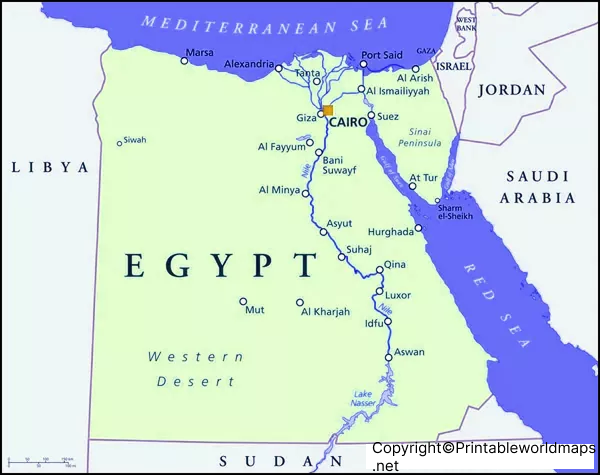
The Nile’s water system connects tropical highlands, lakes, wetlands, savannas, and arid desert regions. Its flow depends on rainfall, upstream lakes, tributaries, evaporation, and water use. The river is particularly important to communities in Sudan and Egypt, where agriculture and settlements depend heavily on freshwater from the Nile.
Nile River Map Labeled
A Nile River Map Labeled makes it easier to identify the river’s major branches, tributaries, lakes, cities, and surrounding geographical features. It is useful for school assignments, map-labeling exercises, and understanding the Nile Basin.
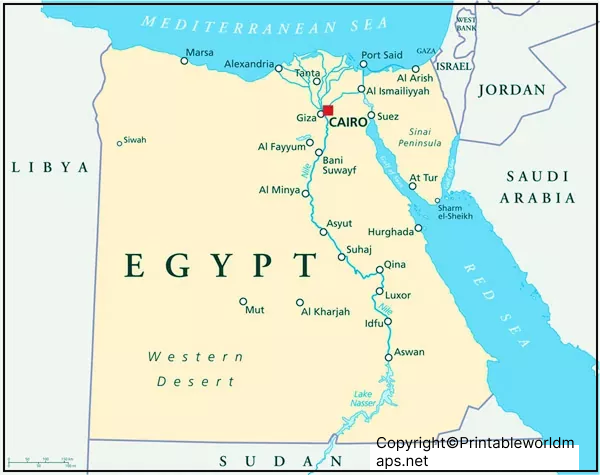
The Nile has two principal branches: the White Nile and the Blue Nile. The White Nile system is associated with the Equatorial Lakes region of East Africa, while the Blue Nile originates at Lake Tana in Ethiopia. These two branches meet at Khartoum, the capital of Sudan, and continue north as the Nile.
The White Nile receives water from a network of rivers and lakes, including the Kagera River system. The Blue Nile carries substantial seasonal flows from the Ethiopian Highlands. Their different rainfall patterns help explain why the Nile’s water supply varies across the basin.
Where is the Nile River on a Map
The Nile River is located in northeastern Africa. On a map of Africa, trace its route northward from the East African lake region, through Sudan, into Egypt, and finally to the Mediterranean Sea.
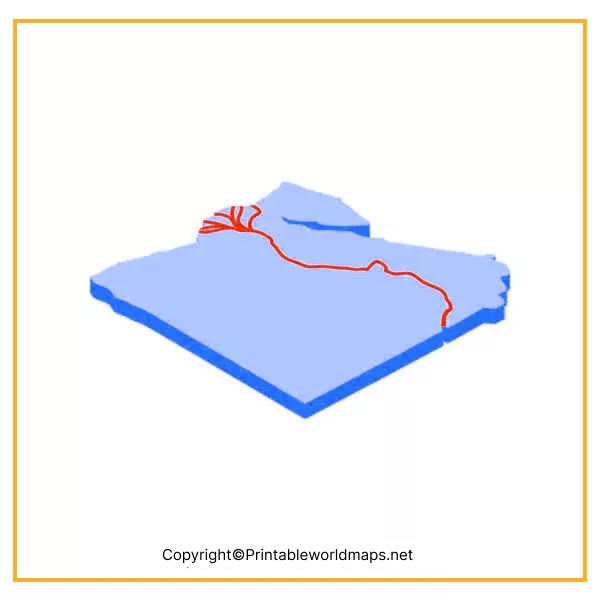
Important tributaries and connected river systems include the White Nile, Blue Nile, Atbara River, Sobat River, and Bahr el Ghazal system. The Atbara River rises in the Ethiopian Highlands and joins the Nile in Sudan. The Sobat contributes water to the White Nile system in South Sudan.
The river’s most distant headwaters are difficult to define because the Nile is formed by an extensive network of streams, lakes, and tributaries. Lake Victoria is an important part of the White Nile system, while the Blue Nile begins at Lake Tana in Ethiopia.
Nile River on Africa map
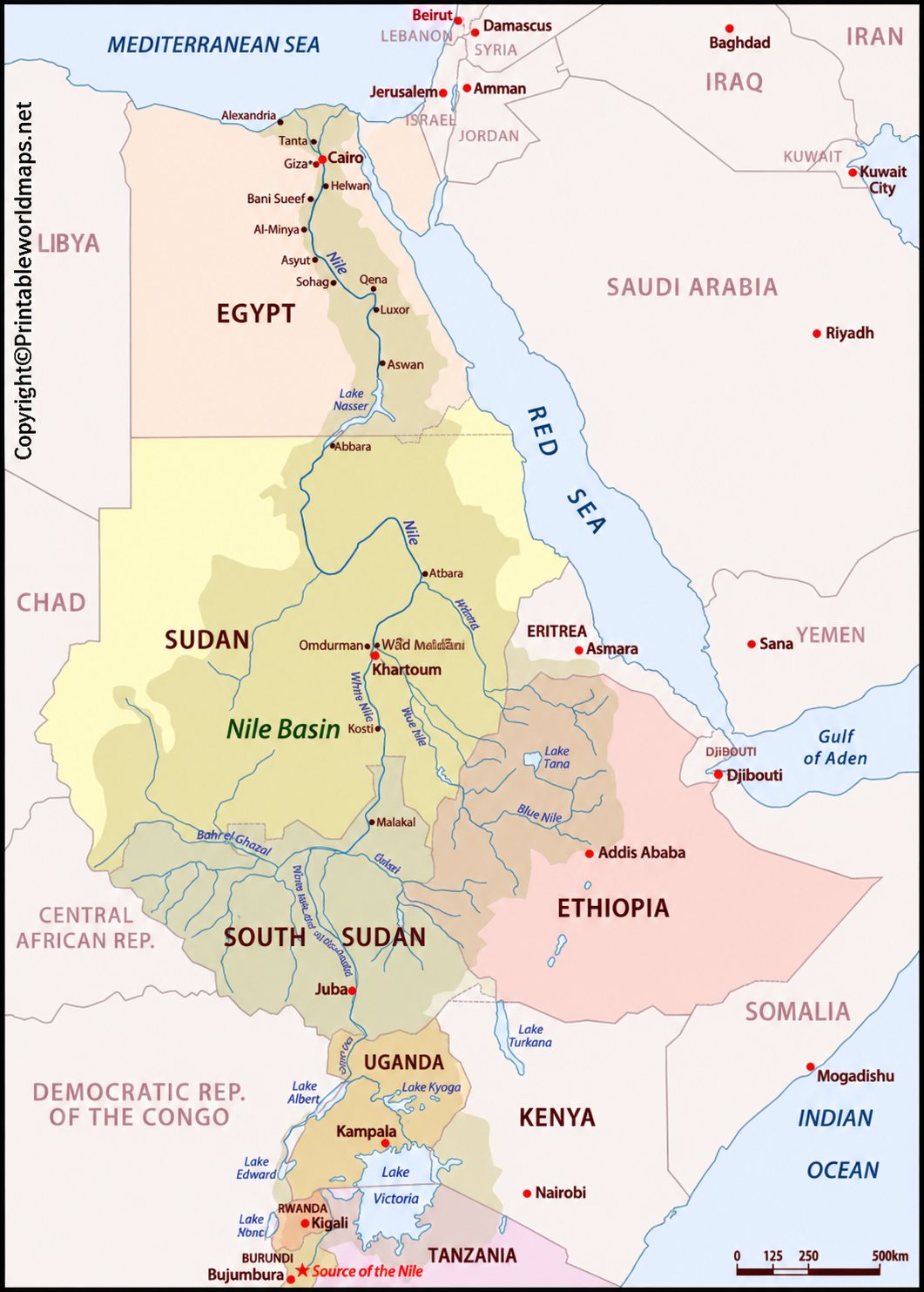
The Nile River on Africa Map shows the river’s northward route and its relationship to the countries, lakes, and landscapes of northeastern and eastern Africa.
The Nile played a central role in the development of ancient Egyptian civilization. Seasonal flooding historically deposited fertile sediment along the river valley and delta, supporting agriculture and settlement. Today, the Nile remains important for irrigation, drinking water, fishing, transportation in some areas, and hydroelectric power.
In Uganda, the Victoria Nile flows out of Lake Victoria toward Lake Kyoga and Lake Albert. Farther downstream, the river system passes through South Sudan, where sections are known as the Bahr al Jabal, before joining other waterways that form the White Nile.
The Nile Basin also connects countries with different climates and water needs. Cooperation over shared water resources, environmental protection, population growth, and agricultural demand remains important for the region’s long-term development.
Countries in the Nile River Basin
The Nile Basin extends across 11 countries: Burundi, the Democratic Republic of the Congo, Egypt, Eritrea, Ethiopia, Kenya, Rwanda, South Sudan, Sudan, Tanzania, and Uganda.
These are countries that share the wider Nile Basin, not countries through which the main Nile channel necessarily flows. Eritrea participates as an observer in the Nile Basin Initiative.
The basin’s large geographical extent means that rainfall and water use in upstream regions can affect water availability downstream. For additional details, consult the Nile Basin Initiative.
Major Tributaries of the Nile River
The main tributaries and connected river systems help explain the Nile’s geography:
- White Nile: A major branch of the Nile system linked to the Equatorial Lakes region.
- Blue Nile: Originates at Lake Tana in Ethiopia and meets the White Nile at Khartoum.
- Atbara River: Rises in Ethiopia and joins the Nile in Sudan.
- Sobat River: Joins the White Nile system in South Sudan.
- Kagera River: Part of the upper river network feeding the Lake Victoria system.
Together, these rivers and lakes form a complex drainage network that supplies water to a large part of northeastern Africa.
7 Amazing Nile River Facts
- A major African river: The Nile flows northward and empties into the Mediterranean Sea.
- A vast basin: Its drainage basin covers approximately 3.2 million square kilometers.
- Two principal branches: The White Nile and Blue Nile meet at Khartoum in Sudan.
- An important Ethiopian source: The Blue Nile originates at Lake Tana.
- A connection to Lake Victoria: The White Nile system is linked to the Equatorial Lakes region.
- A historic agricultural lifeline: Nile waters and fertile river deposits supported ancient Egyptian agriculture.
- A shared international resource: Eleven countries are part of the wider Nile Basin.
River-length figures differ among reference sources because the most distant headwaters and the exact channel measurements are not always defined in the same way.
Why Is the Nile River Important?
The Nile supports human settlements, agriculture, ecosystems, and economic activity across a large part of Africa. In Egypt and Sudan, access to river water is especially important because extensive areas receive little rainfall.
The river and its tributaries also sustain wetlands and habitats for many plants and animals. At the same time, population growth, pollution, changing rainfall patterns, and competing demands for water create challenges for sustainable management.
Understanding the Nile on a map helps explain the relationship between geography, agriculture, population distribution, and water cooperation across national borders.
How to Use the Printable Nile River Map
You can use the printable maps for educational and reference purposes:
- Identify the Nile River’s route from south to north.
- Mark the White Nile, Blue Nile, and Atbara River.
- Locate Lake Victoria, Lake Tana, Khartoum, and the Nile Delta.
- Compare the river’s course with the countries of the Nile Basin.
- Use the labeled map for revision and the unlabeled map for geography practice.
For the clearest printout, choose the PDF version, check the page orientation, and use a suitable paper size. Map labels and small geographical features may be easier to read on larger paper.
Frequently Asked Questions About the Nile River Map
Where is the Nile River located?
The Nile River is in northeastern Africa. It flows north through Sudan and Egypt before emptying into the Mediterranean Sea.
How long is the Nile River?
Its reported length varies by measurement method. Common reference figures are around 6,650–6,695 kilometers, or approximately 4,130–4,160 miles.
Where do the White Nile and Blue Nile meet?
The White Nile and Blue Nile meet at Khartoum, the capital of Sudan.
Where does the Blue Nile begin?
The Blue Nile originates at Lake Tana in the Ethiopian Highlands.
Which countries are part of the Nile Basin?
The wider basin includes Burundi, the Democratic Republic of the Congo, Egypt, Eritrea, Ethiopia, Kenya, Rwanda, South Sudan, Sudan, Tanzania, and Uganda.
Can I download the Nile River map as a PDF?
Yes. Use the PDF links provided in the Nile River Map, Nile River Map Labeled, and Nile River on Africa Map sections.
Why is the Nile River important?
The Nile supplies water for agriculture, households, and ecosystems. It has also played a major role in the history and development of ancient and modern communities along its banks.
Reference links
https://nilebasin.org/about/nile-basin
https://education.nationalgeographic.org/resource/nile-river
https://education.nationalgeographic.org/resource/anatomy-nile
https://www.guinnessworldrecords.com/world-records/longest-river

2 thoughts on “Nile River Map Printable Labeled | Nile River on Africa Map”