

A labeled map of Colorado helps you identify the state’s capital, major cities, county boundaries, rivers, highways, and surrounding states. Colorado is located in the western United States and is known for the Rocky Mountains, high-elevation landscapes, and diverse geography. Its capital and largest city is Denver.
This collection of Colorado maps includes labeled state maps, city maps, capital maps, and printable PDF versions for students, teachers, researchers, and travelers.
Labeled Map of Colorado
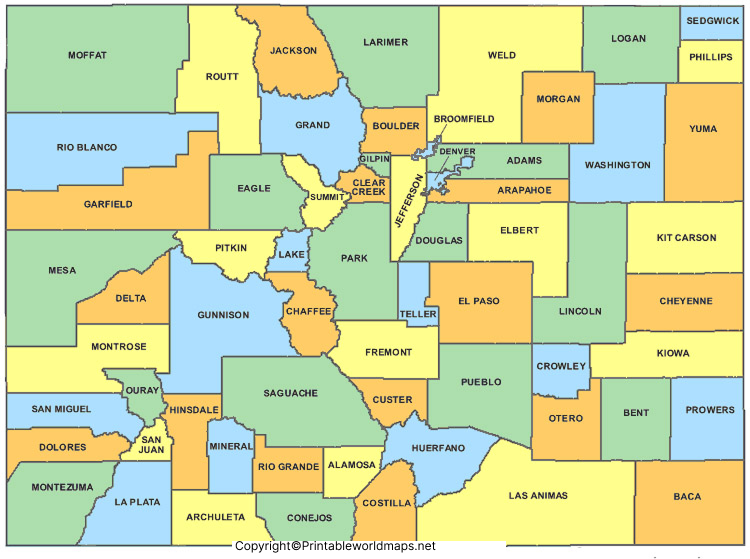
The labeled Colorado state map provides a geographic overview of the state and helps readers understand the location of cities, transportation routes, and physical features.
Colorado shares its borders with Wyoming to the north, Nebraska to the northeast, Kansas to the east, Oklahoma and New Mexico to the south, Utah to the west, and Arizona at the southwestern corner at the Four Corners region.
Colorado became the 38th state of the United States on August 1, 1876. It is commonly known as the Centennial State because it achieved statehood during the 100th anniversary year of American independence.
Labeled Map of Colorado Printable
A printable Colorado map is useful for geography lessons, classroom assignments, travel preparation, and general reference. The PDF version can be printed for offline use, while the image version is convenient for quick viewing on a computer or mobile device.
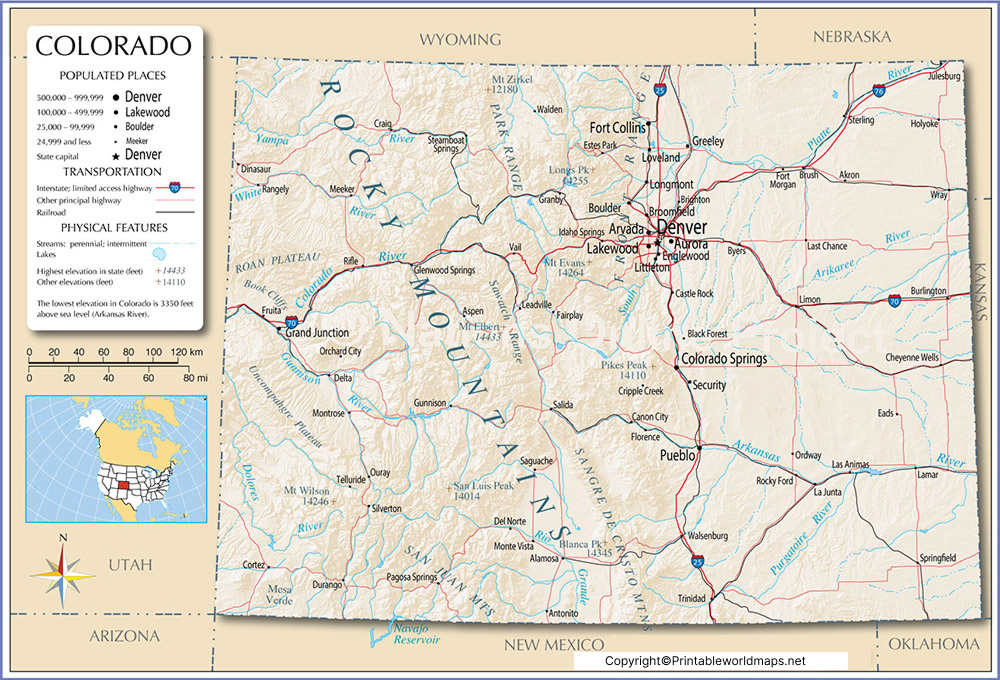
Colorado covers approximately 103,637 square miles of land, according to the U.S. Census Bureau’s geographic data. The state has 64 counties and includes broad plains, mountain ranges, plateaus, and high desert landscapes.
The state’s geography is often described through several major physical regions, including the Great Plains, the Southern Rocky Mountains, the Middle Rocky Mountains, the Colorado Plateau, and the Wyoming Basin.
Colorado is also an important source region for several major river systems. Rivers associated with the state include the Colorado River, Arkansas River, Rio Grande, North Platte River, and South Platte River. These waterways are important for regional ecosystems, agriculture, water supplies, and recreation.
Labeled Map of Colorado with Cities
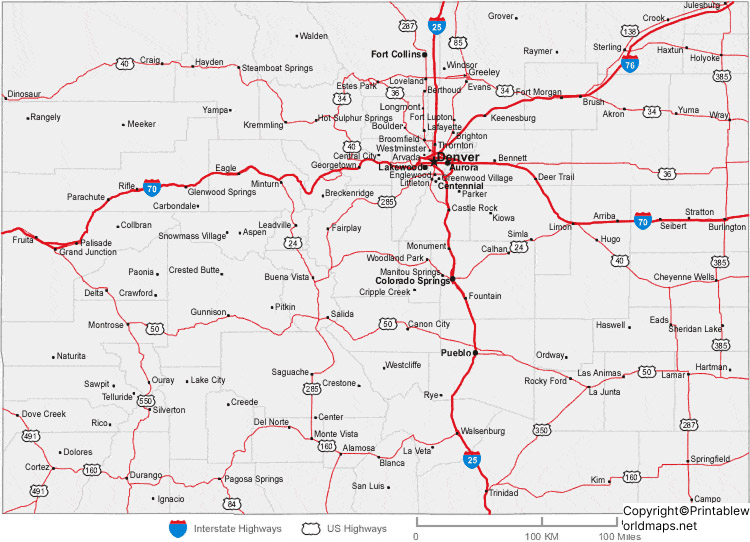
A labeled map of Colorado with cities helps readers locate major urban areas and understand their relative positions throughout the state.
Important Colorado cities and communities include:
- Denver
- Colorado Springs
- Aurora
- Fort Collins
- Lakewood
- Thornton
- Arvada
- Westminster
- Pueblo
- Boulder
- Greeley
- Longmont
- Loveland
- Grand Junction
- Durango
- Montrose
- Castle Rock
- Brighton
- Broomfield
- Centennial
Denver and the surrounding Front Range contain a large concentration of Colorado’s population and urban development. Colorado Springs lies south of Denver, while Fort Collins is located to the north. Grand Junction is an important regional center on the western side of the state.
City populations and municipal boundaries change over time. For current population figures, consult the U.S. Census Bureau rather than relying on an undated city list.
Labeled Colorado Map with Capital
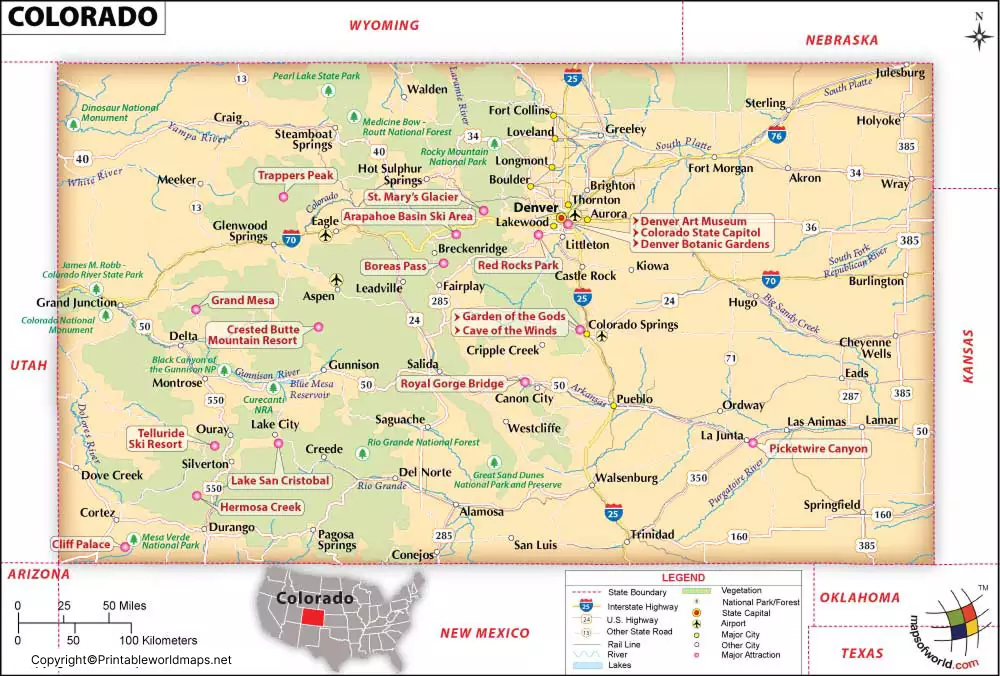
Denver is the capital of Colorado and the seat of the state government. It is situated along the South Platte River near the eastern edge of the Rocky Mountain region, where the Great Plains meet the Front Range.
Denver is also a major center for business, transportation, education, culture, and tourism. Its location makes it a useful reference point when studying Colorado’s cities and regional geography.
Denver became the permanent seat of Colorado’s territorial government in 1867. Colorado later entered the Union as the 38th state in 1876.
A Colorado map with the capital marked is particularly useful for students learning U.S. state capitals, travelers planning routes, and readers comparing the locations of major cities.
Geography and Location of Colorado
Colorado is part of the Mountain West region of the United States. Its landscape ranges from relatively flat eastern plains to the high peaks and valleys of the Rocky Mountains, followed by plateaus and canyon country in the west.
The Continental Divide runs through the Rocky Mountains in Colorado and separates waters that generally flow toward the Pacific Ocean from those that flow toward the Atlantic Ocean and Gulf of Mexico.
The state’s mountainous terrain includes many high-elevation areas, while the eastern portion is characterized by plains and agricultural land. These differences influence transportation, settlement patterns, climate, recreation, and water management.
A physical map of Colorado can help distinguish mountain ranges, major river valleys, plateaus, and plains. A political map is more appropriate for identifying counties, cities, and administrative boundaries.
Counties in Colorado
Colorado has 64 counties. County maps are useful for understanding local government boundaries, regional planning, public services, and geographic subdivisions.
Denver and Broomfield have consolidated city-county governments, which makes their administrative arrangements different from those of most other Colorado cities.
For official county boundaries and geographic information, consult the State of Colorado’s mapping resources or the U.S. Census Bureau.
Colorado Map for Learning and Travel
A labeled Colorado map can support several practical activities:
- Students and teachers: Identify Denver, major cities, neighboring states, rivers, and mountain regions.
- Travelers: Understand the relative locations of destinations before planning a route.
- Researchers: Use geographic maps as a starting point for studying settlement, transportation, and regional patterns.
- Families: Print a state map for geography activities and school projects.
- Map enthusiasts: Compare political maps with physical maps to understand Colorado’s varied terrain.
For navigation, road closures, current boundaries, or travel conditions, use an up-to-date official map or transportation source. A static printable map is intended for general reference and may not show recent changes.
Interesting Facts About Colorado
- State capital: Denver.
- Statehood: Colorado became the 38th U.S. state on August 1, 1876.
- Nickname: The Centennial State.
- Number of counties: 64.
- Major mountain range: The Rocky Mountains.
- Geographic feature: The Continental Divide crosses the state.
- Land area: Approximately 103,637 square miles, according to U.S. Census Bureau geographic data.
- Four Corners: Colorado meets Arizona, New Mexico, and Utah at the Four Corners region.
These facts provide useful context when reading a labeled map of Colorado and comparing the state’s physical and political geography.
Frequently Asked Questions About Colorado Maps
What is the capital of Colorado?
Denver is the capital of Colorado. It is located near the eastern edge of the Rocky Mountains and serves as the seat of the state government.
How many counties are in Colorado?
Colorado has 64 counties. Official county maps are available through state and federal geographic resources.
Which states border Colorado?
Colorado borders Wyoming, Nebraska, Kansas, Oklahoma, New Mexico, Utah, and Arizona.
Can I download a printable map of Colorado?
Yes. The maps provided above include image and PDF versions. Open the relevant PDF link to view or print the map, subject to your browser’s download settings.
What are the major cities shown on a Colorado map?
Major cities include Denver, Colorado Springs, Aurora, Fort Collins, Lakewood, Thornton, Arvada, Pueblo, Boulder, Greeley, and Grand Junction.
What is Colorado’s nickname?
Colorado is known as the Centennial State because it became a state in 1876, the centennial year of the United States Declaration of Independence.
Which major rivers flow through Colorado?
Important rivers associated with Colorado include the Colorado River, Arkansas River, Rio Grande, North Platte River, and South Platte River.
Why is a labeled Colorado map useful?
A labeled map makes it easier to identify cities, state boundaries, the capital, and important physical features. It is useful for education, research, and general geographic reference.
Where can I find official information about Colorado’s geography?
The U.S. Census Bureau provides state geographic and population data. The State of Colorado’s official map viewer provides interactive geographic layers, including county boundaries and other mapping information.
Reference links
1. https://www.census.gov/quickfacts/fact/table/CO/POP715223
2. https://data.census.gov/cedsci/profile/Colorado?g=0400000US08
3. https://gis.colorado.gov/viewer/
4. https://content.leg.colorado.gov/sites/default/files/local_gov_hb_web_0.pdf
