
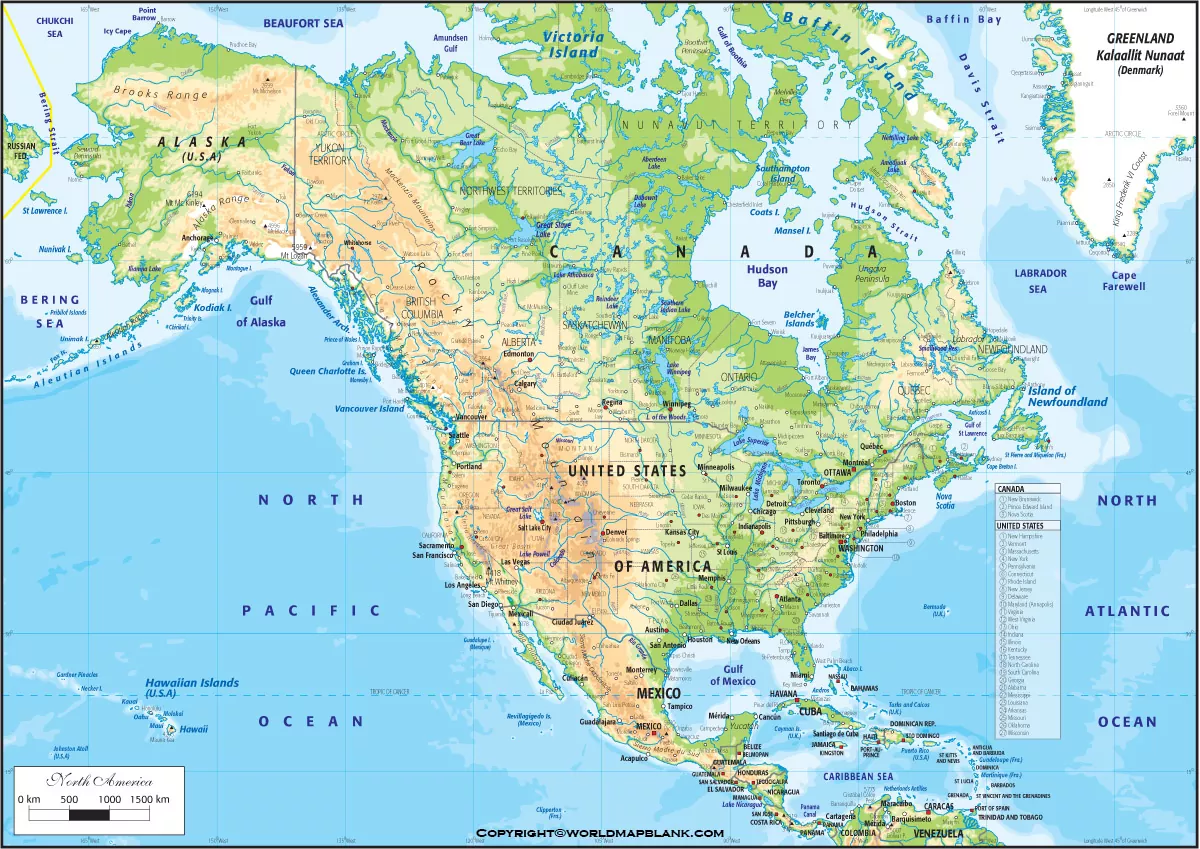

The North America Physical Map helps students, teachers, researchers, and geography enthusiasts explore the continent’s mountains, plains, plateaus, rivers, lakes, and surrounding oceans. These printable maps are useful for geography lessons, school projects, classroom activities, and independent learning.
Explore the physical maps below to identify important natural features and understand how North America’s varied landscape extends from the Arctic region to Central America and the Caribbean. Printable image and PDF versions are provided for convenient study.
North America Physical Map
North America is the world’s third-largest continent by area. Its geography includes towering mountain ranges, extensive plains, ancient rock formations, large freshwater lakes, deserts, forests, and Arctic landscapes.
The continent extends from the Arctic region in the north toward the Isthmus of Panama in the south. Greenland, the Caribbean islands, and Central America are also associated with North America.

The North America Physical Map illustrates the major natural features of this diverse continent. Depending on the map’s labeling and scale, you can use it to locate mountain ranges, rivers, lakes, coastlines, plains, and other geographical features.
Printable North America Physical Map
A printable North America physical map is useful for classroom assignments, geography revision, and map-reading practice. You can view the image digitally or print the PDF for offline use.

Physical maps emphasize natural features rather than political boundaries. Depending on the map design, colors, shading, symbols, and labels may represent elevation, mountain ranges, lowlands, water bodies, and other landscape features.
For the best results, select a print size that keeps labels readable. If you are using the map for a school assignment, add labels for major mountain ranges, rivers, lakes, and oceans where appropriate.
Map of North America Physical

The physical geography of North America can be understood through several major regions. The western part of the continent is dominated by extensive mountain systems, while broad plains occupy much of the interior. The Canadian Shield covers a large area of northeastern and central Canada, and older mountain ranges and coastal plains characterize parts of the east.
The continent is bordered by the Arctic Ocean to the north, the Atlantic Ocean to the east, and the Pacific Ocean to the west. The Caribbean Sea and Gulf of Mexico are important water bodies to the south and southeast.
A physical map is particularly helpful for comparing the continent’s elevated western terrain with its interior plains and eastern highlands. It can also help learners understand how mountain ranges, river basins, and coastlines influence drainage patterns and regional environments.
Physical Map of North America Labeled
A labeled physical map of North America makes it easier to identify natural features and learn their locations. Depending on the labels included, you may be able to locate the Rocky Mountains, Appalachian Mountains, Great Plains, Canadian Shield, Mississippi River, Great Lakes, and surrounding oceans.

Use the map as a reference while studying the relationship between landforms and water systems. For example, mountain ranges influence river drainage, while lowland areas and plains provide pathways for major river systems.
These printable resources can support geography homework, map-labeling exercises, presentations, and revision before examinations. Check the labels and legend on each individual map before using it to answer a specific geographical question.
Major Landforms of North America
North America’s varied landscape includes several important physical regions:
- Rocky Mountains: A major mountain system extending through western North America from Canada into the United States.
- Appalachian Mountains: An older mountain system in eastern North America.
- Great Plains: A broad region of plains extending across central parts of the United States and Canada.
- Canadian Shield: An extensive region of ancient bedrock surrounding Hudson Bay and covering large areas of Canada.
- Coastal plains: Relatively low-lying areas along parts of the Atlantic and Gulf coasts.
- Deserts and plateaus: Arid and elevated landscapes found in parts of the southwestern United States and northern Mexico.
These features help explain the differences in elevation, climate, vegetation, and drainage across the continent.
Major Rivers and Lakes of North America
North America has extensive river networks and freshwater resources. The following features are useful to locate when studying a physical map:
- Mississippi–Missouri river system: A major river network draining a large portion of central North America.
- St. Lawrence River: Connects the Great Lakes drainage system with the Atlantic Ocean.
- Mackenzie River: Drains a large area of northwestern Canada toward the Arctic Ocean.
- Colorado River: Flows through the southwestern United States and into Mexico.
- Great Lakes: A group of five large lakes along the United States–Canada border.
- Lake Winnipeg: A major lake in central Canada.
Not every printable physical map labels all these features. Use a map with suitable labels or compare it with a reliable geographical reference when you need exact locations.
How to Use a North America Physical Map
Follow these steps to make the most of your printable map:
- Identify the surrounding oceans and major seas.
- Locate the Rocky Mountains and Appalachian Mountains.
- Find the Great Plains and Canadian Shield.
- Trace major rivers and locate the Great Lakes.
- Compare mountainous regions with lowlands and coastal plains.
- Use the map legend to interpret colors, elevation shading, symbols, and labels.
- Print the PDF for offline study or use the image for digital assignments.
For additional accuracy, compare the map with a trusted geographical resource such as National Geographic’s physical geography guide.
Interesting Facts About North America’s Physical Geography
- North America is the third-largest continent by area.
- Denali, in Alaska, is the highest mountain peak in North America, rising to approximately 6,190 metres above sea level.
- The Great Lakes form the world’s largest group of freshwater lakes by total surface area.
- The Canadian Shield contains some of Earth’s oldest exposed rocks.
- North America includes environments ranging from Arctic tundra and boreal forests to deserts, grasslands, wetlands, and tropical landscapes.
- The Rocky Mountains form part of the Great Divide, which separates major drainage systems flowing toward different oceans and water bodies.
These facts can help students connect the locations shown on a physical map with the continent’s broader geographical features.
Why Use a Printable North America Physical Map?
A printable physical map provides a convenient visual reference for understanding the continent’s natural landscape. It can help students revise geographical terminology, prepare assignments, practice locating landforms, and compare mountain ranges, rivers, lakes, and plains.
The image format is convenient for quick viewing, while the PDF format is useful for printing and offline reference. For assignments that require precise labels or measurements, consult the map’s legend and verify important details against authoritative geographical sources.
Explore the maps above, choose the format that best suits your needs, and use the labeled features to strengthen your understanding of North American physical geography.
Frequently asked questions (FAQs)
1. What is a North America physical map?
A North America physical map shows natural geographical features such as mountains, plains, plateaus, rivers, lakes, and surrounding oceans.
2. Where can I download a printable North America physical map?
You can download the printable PDF files linked in this article. Choose the map that best fits your study requirements and print it for classroom or personal use.
3. What are the major landforms of North America?
Major landforms include the Rocky Mountains, Appalachian Mountains, Great Plains, Canadian Shield, coastal plains, plateaus, and deserts.
4. What are the major rivers in North America?
Important rivers include the Mississippi–Missouri river system, St. Lawrence River, Mackenzie River, Colorado River, and Yukon River.
5. What oceans surround North America?
North America is bordered by the Arctic Ocean to the north, Atlantic Ocean to the east, and Pacific Ocean to the west. The Caribbean Sea and Gulf of Mexico are also important water bodies in the region.
6. What is the highest mountain in North America?
Denali, located in Alaska, is the highest mountain in North America. Its elevation is approximately 6,190 metres above sea level.
7. What is the difference between a physical map and a political map?
A physical map emphasizes natural features such as elevation, rivers, mountains, and plains. A political map focuses on borders, countries, states, and other administrative divisions.
8. Can I use a physical map of North America for school projects?
Yes. Printable physical maps are useful for geography homework, map-labeling exercises, classroom presentations, and independent study. Check the map’s labels and usage permissions before reproducing it.
Reference links
https://education.nationalgeographic.org/resource/north-america-physical-geography
https://education.nationalgeographic.org/resource/Continent
https://education.nationalgeographic.org/resource/north-america-resources
