

Labeled Map of New Hampshire helps you identify the state’s capital, major cities, counties, rivers, lakes, and surrounding states. This guide includes labeled and printable New Hampshire maps to help students, teachers, travelers, and geography enthusiasts explore the Granite State.
New Hampshire is located in the northeastern United States and is part of the New England region. It borders Québec, Canada, to the north; Maine to the east; Massachusetts to the south; and Vermont to the west. Its capital is Concord, and its largest city by population is Manchester.
Labeled Map of New Hampshire
A labeled map of New Hampshire makes it easier to understand the state’s location, administrative divisions, transportation routes, and physical geography. Depending on the map, you can identify major cities, towns, county boundaries, rivers, lakes, and highways.
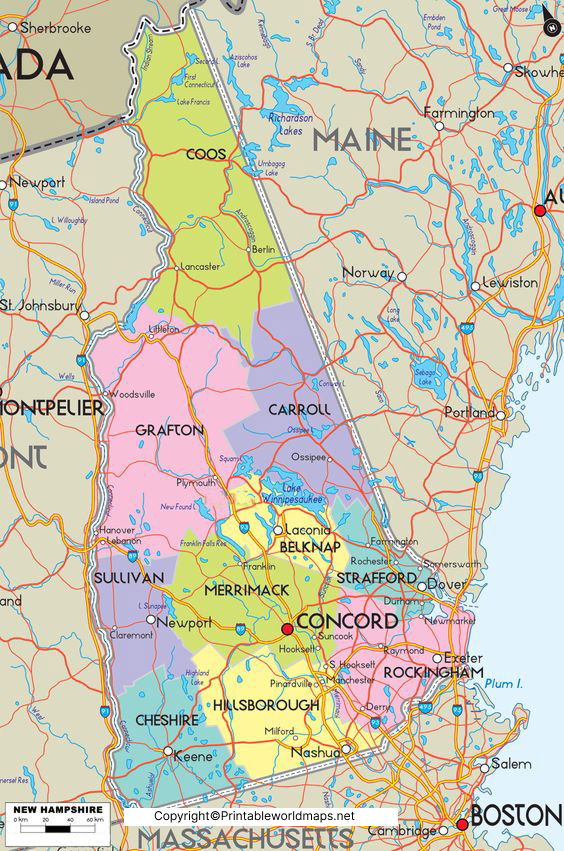
New Hampshire covers approximately 9,349 square miles (24,214 square kilometers) in total area, including land and inland water. Its landscape includes the White Mountains, forests, lakes, river valleys, and a short Atlantic coastline.
The Connecticut River forms much of the state’s western boundary with Vermont. The Merrimack River is another important geographic feature, flowing through central New Hampshire and past communities including Concord and Manchester.
New Hampshire is nicknamed the Granite State, reflecting its granite formations and quarrying history. Its varied landscape makes a labeled map useful for understanding the relationships between its mountains, waterways, settlements, and neighboring regions.
Printable Map of New Hampshire Labeled
A printable map of New Hampshire is useful for classroom activities, geography assignments, travel planning, and personal reference. A labeled version helps readers identify geographic features without needing to consult a separate list of place names.
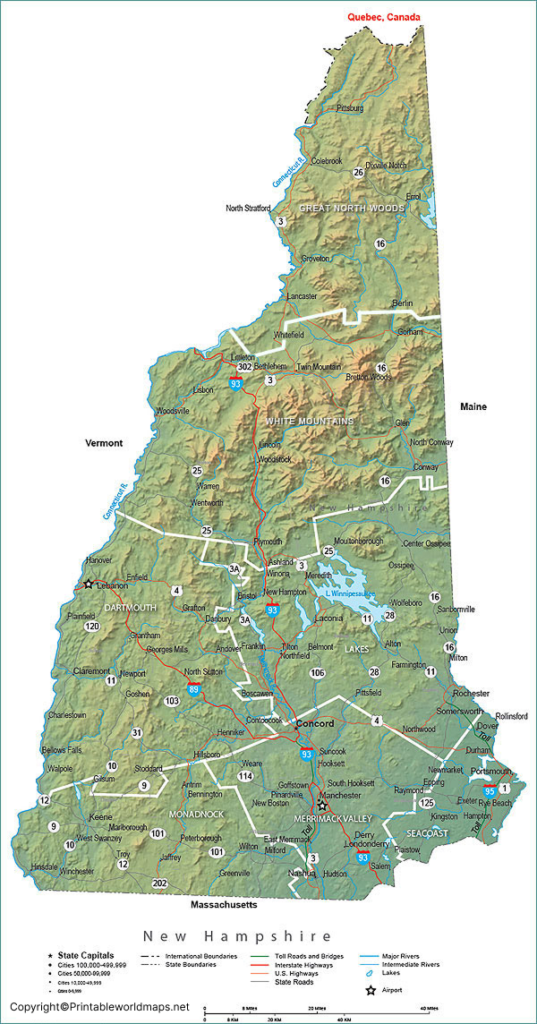
New Hampshire has 10 counties: Belknap, Carroll, Cheshire, Coös, Grafton, Hillsborough, Merrimack, Rockingham, Strafford, and Sullivan.
Counties help organize certain government, court, and administrative functions. However, New Hampshire also has cities, towns, and unincorporated places, so county boundaries do not tell the whole story of local government.
When printing a map, choose a page orientation that matches the map’s shape. Use portrait orientation for a tall, narrow map and landscape orientation for a wider regional map. For school projects, check that place names and boundary lines remain legible at the selected print size.
Labeled Map of New Hampshire with Cities
A labeled map of New Hampshire with cities helps readers locate important population centers and understand where communities are situated across the state.

Some of New Hampshire’s best-known cities include:
- Manchester: The state’s largest city by population and an important commercial and employment center.
- Nashua: A major city in southern New Hampshire, near the Massachusetts border.
- Concord: The state capital and the center of state government.
- Dover: A historic seacoast-region city in Strafford County.
- Rochester: A city in eastern New Hampshire, near the Maine border.
- Portsmouth: A historic coastal city known for its waterfront and maritime heritage.
Derry is also a major population center, although it is classified as a town rather than an incorporated city. This distinction matters when comparing city lists, municipal boundaries, and population statistics.
Manchester and Nashua are particularly useful reference points when studying southern New Hampshire, while Concord provides a central location for understanding the state’s government and transportation connections.
Labeled New Hampshire Map with Capital
Concord is the capital of New Hampshire. Located in Merrimack County along the Merrimack River, it serves as the seat of the state government and is home to the New Hampshire State House.
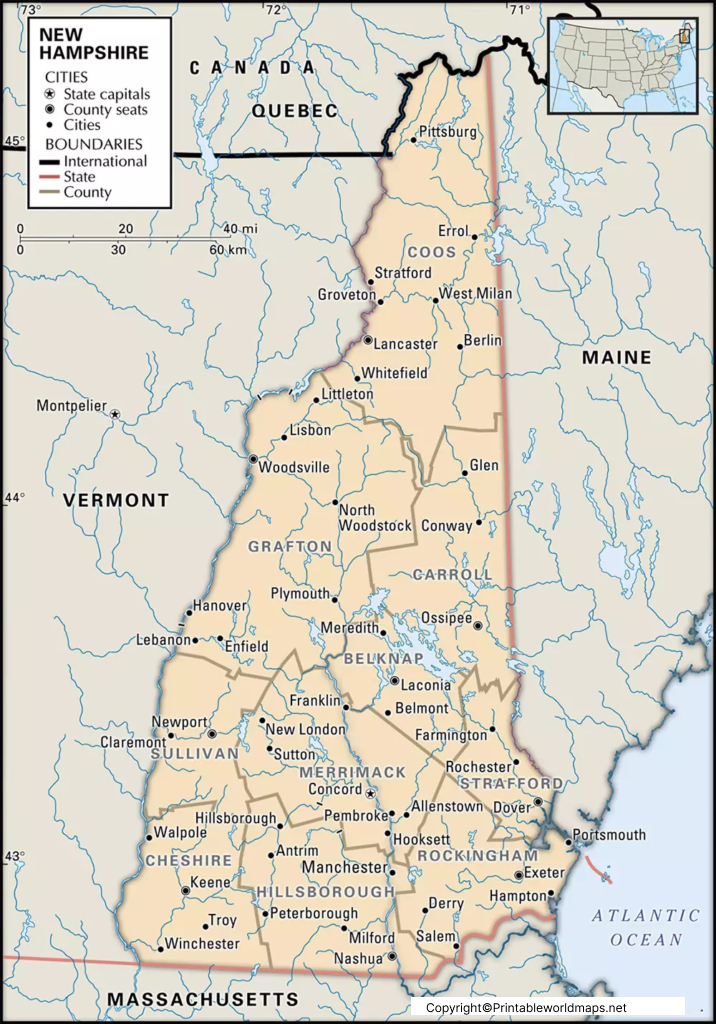
Concord became the permanent state capital in the early nineteenth century. Its central location helped establish it as an important administrative center.
The city has historical connections to granite quarrying, printing, manufacturing, and commerce. Today, state government, healthcare, education, and other service industries contribute to its economy.
A map showing Concord alongside Manchester, Nashua, and other cities helps readers understand the capital’s location in relation to the state’s larger population centers.
New Hampshire’s Location and Neighboring States
New Hampshire is in northern New England, in the northeastern United States. Its location connects inland mountain and forest regions with the Atlantic coast.
Its neighboring regions are:
- Québec, Canada: North of New Hampshire.
- Maine: East of New Hampshire.
- Massachusetts: South of New Hampshire.
- Vermont: West of New Hampshire, with the Connecticut River forming much of the boundary.
The state has a short Atlantic coastline near Portsmouth and the communities of the Seacoast region. Although the coastline is small compared with those of many coastal states, it is an important part of New Hampshire’s geography.
Major Rivers, Lakes, and Mountains in New Hampshire
New Hampshire’s physical geography includes mountain ranges, inland lakes, forests, and rivers. These features influence recreation, settlement patterns, transportation, and local economies.
Major rivers include the Connecticut River, Merrimack River, Pemigewasset River, Androscoggin River, Saco River, and Piscataqua River.
Notable lakes include Lake Winnipesaukee, Squam Lake, Newfound Lake, and Lake Sunapee.
Important mountain areas include the White Mountains, which contain Mount Washington, the highest peak in the northeastern United States.
When using a physical or topographic map, look for elevation shading, mountain symbols, and blue lines or shapes that represent waterways. A road map or city map may emphasize different features, so the best map depends on the information you need.
Quick Facts About New Hampshire
| Fact | Information |
|---|---|
| State capital | Concord |
| Largest city by population | Manchester |
| Region | New England |
| Country | United States |
| State abbreviation | NH |
| Number of counties | 10 |
| Statehood | June 21, 1788 |
| Order of statehood | 9th state |
| Nickname | The Granite State |
| Highest peak | Mount Washington |
| Major river | Merrimack River |
| Neighboring Canadian province | Québec |
The U.S. Census Bureau estimated New Hampshire’s population at 1,415,342 on July 1, 2025. Population figures change over time, so use the latest Census Bureau release when preparing demographic reports or school assignments.
How to Use and Print These New Hampshire Maps
Choose the map that best matches your purpose:
- For students: Use a labeled map to study cities, rivers, state boundaries, and the capital.
- For teachers: Print a map for geography lessons, quizzes, and classroom activities.
- For travelers: Use a city or road map as a geographic reference, and consult a current navigation service for directions.
- For research: Use official county boundaries, Census Bureau data, or state geographic information resources when precise or current information is required.
- For printing: Open the PDF version, select the appropriate paper size, and check the print preview before saving or printing.
A printable map is a convenient reference, but it may not show recent road changes, current travel conditions, or newly updated administrative information. For those purposes, consult an authoritative and current map source.
Official Sources for New Hampshire Geography
For information that goes beyond the printable maps on this page, consult the following authoritative resources:
- The U.S. Census Bureau’s New Hampshire QuickFacts provides population estimates and demographic statistics.
- The New Hampshire Geodata Portal provides geographic datasets and mapping resources.
- The New Hampshire Department of Transportation mapping service provides information about towns, counties, place names, and state boundaries.
- The official New Hampshire facts and history resource provides background on the state’s capital, nickname, and history.
These resources are particularly useful when accuracy matters for educational, planning, or research purposes.
Frequently Asked Questions
1. What is the capital of New Hampshire?
Concord is the capital of New Hampshire. It is located in Merrimack County along the Merrimack River and serves as the seat of the state government.
2. What is the largest city in New Hampshire?
Manchester is New Hampshire’s largest city by population. Nashua is another major population center in the southern part of the state.
3. How many counties are in New Hampshire?
New Hampshire has 10 counties: Belknap, Carroll, Cheshire, Coös, Grafton, Hillsborough, Merrimack, Rockingham, Strafford, and Sullivan.
4. Which states border New Hampshire?
New Hampshire borders Vermont to the west, Massachusetts to the south, and Maine to the east. The Canadian province of Québec lies to the north.
5. Can I print a labeled map of New Hampshire?
Yes. You can open the printable map or PDF links provided in this article and print a copy for personal reference, schoolwork, or educational activities. Check the file’s usage terms if you plan to redistribute or publish the map.
6. What is New Hampshire’s nickname?
New Hampshire is commonly known as the Granite State, a nickname associated with its granite formations and quarrying history.
7. What are the major rivers in New Hampshire?
Major rivers include the Connecticut, Merrimack, Pemigewasset, Androscoggin, Saco, and Piscataqua rivers. They are important features of the state’s physical geography.
8. Where can I find official maps of New Hampshire counties and towns?
The New Hampshire Geodata Portal and the New Hampshire Department of Transportation’s mapping resources provide geographic information about counties, towns, boundaries, and place names.
Reference links
https://www.census.gov/quickfacts/fact/table/NH
https://data.census.gov/profile/New_Hampshire?g=0400000US33
https://www.nhgeodata.unh.edu/
https://maps.dot.nh.gov/arcgis_server/rest/services/Boundaries/NHDOT_BOUNDARIES_Towns/MapServer
https://www.visitnh.gov/press-media/travel-tourism-information/facts-firsts
https://www.concordnh.gov/
