

A Labeled Map of Minnesota helps identify the state’s capital, major cities, counties, neighboring states, Canadian provinces, and important geographic features. Minnesota is located in the north-central United States and borders Canada to the north, North Dakota and South Dakota to the west, Iowa to the south, and Wisconsin and Lake Superior to the east.
Minnesota became the 32nd state of the United States on May 11, 1858. The state covers about 225,181 square kilometers (86,943 square miles) of total area and ranks among the larger U.S. states by area.
Minnesota is widely associated with its many lakes and is known as the “Land of 10,000 Lakes.” Its geography includes forests, prairies, rivers, wetlands, and extensive lake country.
Labeled Map of Minnesota
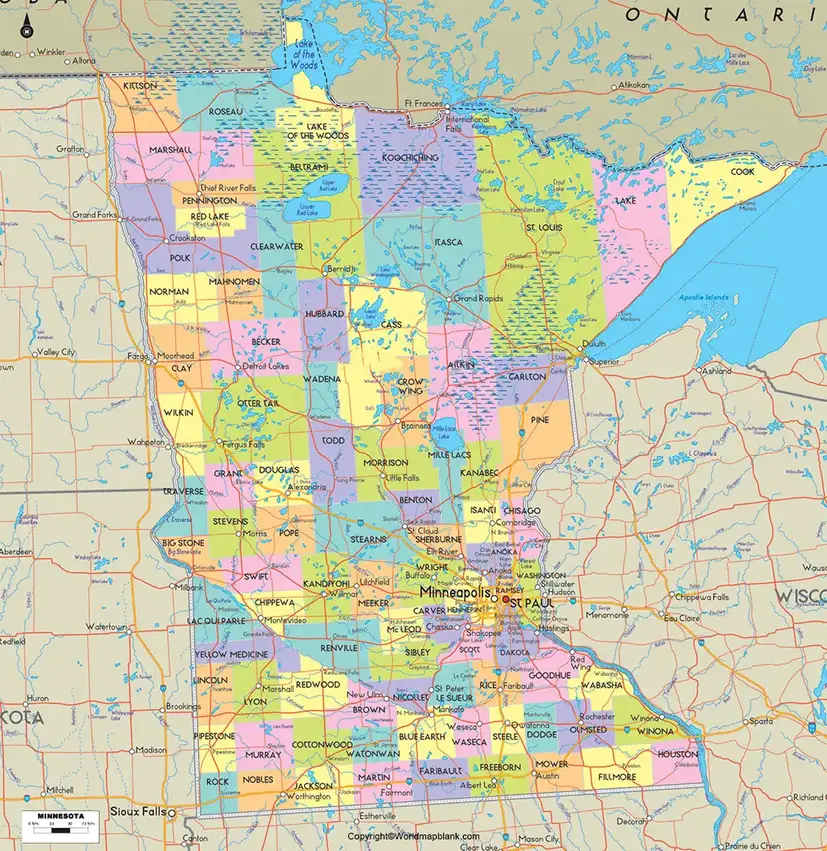
A labeled state map is useful for students, teachers, travelers, researchers, and anyone who wants a quick geographic reference.
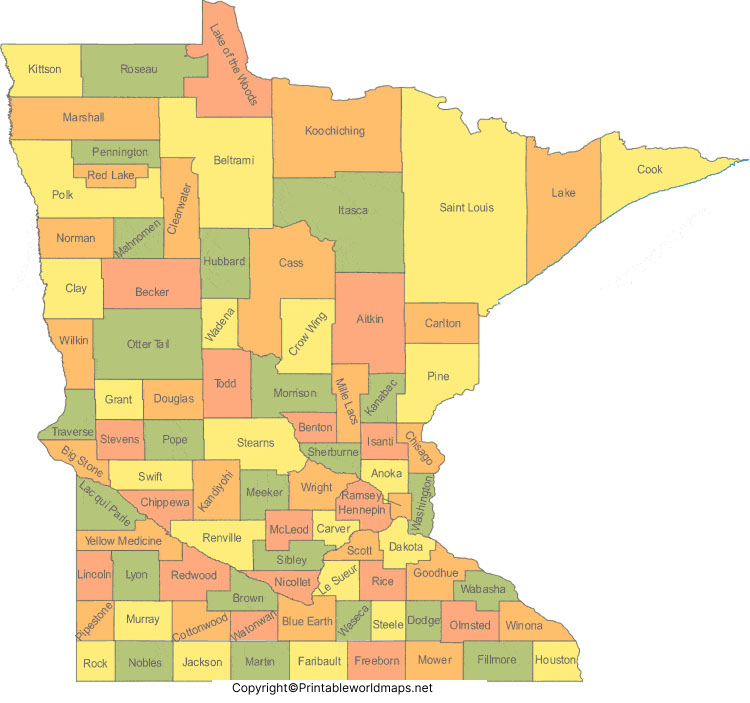
Labeled Map of Minnesota Printable
A Labeled Map of Minnesota printable can be used to identify the state’s location, boundaries, cities, counties, and major geographic features.
Minnesota has 87 counties. The U.S. Census Bureau maintains official geographic data for Minnesota’s counties, including county boundaries and population information.
For an authoritative map reference, Minnesota’s Geospatial Information Office provides statewide map resources covering subjects such as cities, townships, counties, legislative districts, ZIP codes, population, and other geographic boundaries.
Labeled Map of Minnesota with Cities
The Labeled Map of Minnesota with Cities identifies some of the state’s major population centers, including Minneapolis, Saint Paul, Rochester, Bloomington, and Duluth.
According to Minnesota’s latest state population estimates released in 2026, the five largest Minnesota cities by population in 2025 were:
- Minneapolis — 435,246
- Saint Paul — 313,112
- Rochester — 124,953
- Bloomington — 92,613
- Duluth — 88,294
Minneapolis and Saint Paul form the core of the well-known Twin Cities metropolitan area.
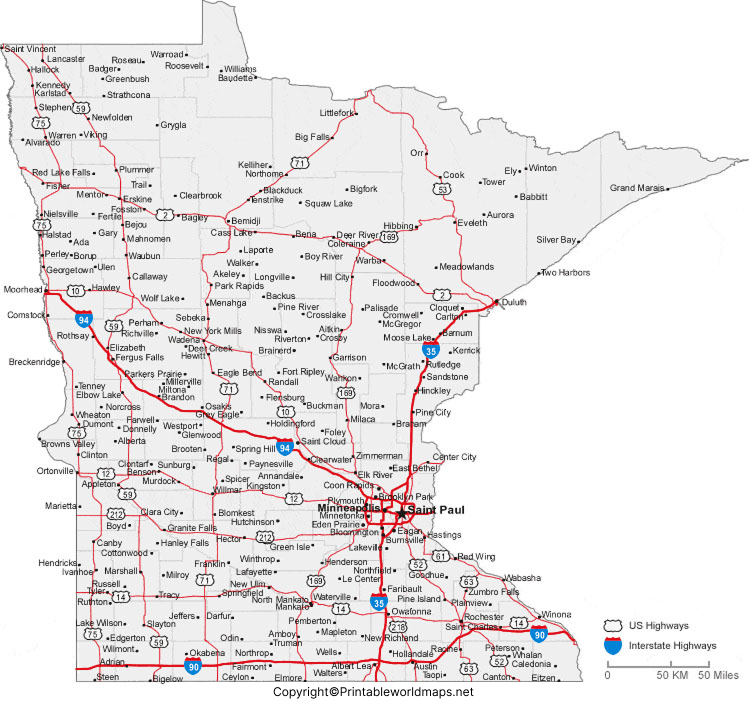
Labeled Minnesota Map with Capital
The capital shown on a Labeled Minnesota Map with Capital is Saint Paul.
Saint Paul is Minnesota’s capital and the state’s second-most populous city. The city is located along the Mississippi River and serves as an important center for government, education, transportation, business, and other institutions.
The U.S. Census Bureau estimates Saint Paul’s population at 306,684 as of July 1, 2025.

Minnesota Population and Area Facts
Minnesota’s population was estimated at 5,830,405 on July 1, 2025, according to the U.S. Census Bureau. The Minnesota State Demographic Center’s 2025 estimate, released in July 2026, gives a somewhat different figure of 5,891,109, reflecting a different state estimation methodology. When presenting a population figure, it is therefore useful to identify the source and estimate date.
Key facts include:
- Capital: Saint Paul
- Largest city: Minneapolis
- Statehood: May 11, 1858
- State number: 32nd
- Counties: 87
- 2025 Census Bureau population estimate: 5,830,405
- Total area: approximately 86,943 square miles
- Major water feature: Lake Superior
- Major river: Mississippi River
- Nickname: Land of 10,000 Lakes
Minnesota Borders and Location
Minnesota occupies a distinctive position in the north-central United States.
The state borders:
- Canada — Manitoba and Ontario to the north
- North Dakota — west
- South Dakota — west
- Iowa — south
- Wisconsin — east
- Lake Superior — east
This location makes Minnesota an important geographic connection between the Upper Midwest, the Great Lakes region, and Canada.
Major Rivers and Lakes in Minnesota
Minnesota’s geography is strongly influenced by its lakes and rivers. The Minnesota Department of Natural Resources identifies extensive water resources across the state.
Major rivers associated with Minnesota include the:
- Mississippi River
- Minnesota River
- Red River
- Rainy River
- St. Croix River
The Minnesota DNR reports approximately 680 miles of the Mississippi River within Minnesota and about 370 miles of the Minnesota River.
Major lakes include:
- Lake Superior
- Red Lake
- Mille Lacs Lake
- Leech Lake
- Lake Winnibigoshish
- Lake Vermilion
- Lake Kabetogama
- Lake Minnetonka
Interesting Facts About Minnesota
Here are several useful facts to add depth and search value to the Labeled Map of Minnesota page:
1. Minnesota Has 87 Counties
Minnesota is divided into 87 counties, providing an important administrative layer for understanding the state’s geography.
2. Saint Paul Is the State Capital
Saint Paul serves as Minnesota’s capital, while Minneapolis is the state’s largest city by population.
3. Minnesota Borders Canada
Minnesota has an international border with the Canadian provinces of Manitoba and Ontario.
4. Lake Superior Is Part of Minnesota’s Eastern Boundary
Lake Superior forms part of Minnesota’s eastern boundary and connects the state geographically with the Great Lakes system.
5. Minnesota Has Extensive Water Resources
The Minnesota DNR reports more than 13 million acres of surface water when lakes, rivers, and wetlands are included.
6. Minnesota Contains Multiple Watershed Regions
Minnesota’s watersheds connect to several major drainage regions, including the Great Lakes, Missouri, Souris-Red-Rainy, and Upper Mississippi regions.
7. The Twin Cities Are Minnesota’s Major Urban Center
Minneapolis and Saint Paul are the central cities of the Twin Cities metropolitan area and are among the state’s largest population centers. Minnesota’s 2025 estimates place Minneapolis and Saint Paul first and second among Minnesota cities by population.
How to Use a Labeled Map of Minnesota
A Labeled Map of Minnesota can be useful for:
- School geography assignments
- Classroom presentations
- State history projects
- Identifying Minnesota cities and counties
- Learning U.S. state geography
- Planning educational trips
- Understanding Minnesota’s borders
- Studying rivers and lakes
- Printable geography worksheets
- General geographic reference
For more detailed geographic information, Minnesota’s official geospatial office provides map resources covering administrative boundaries, cities, counties, townships, population, ZIP codes, and other geographic subjects.
Frequently Asked Questions
What is the capital of Minnesota?
Saint Paul is the capital of Minnesota. It is located along the Mississippi River and is the state’s second-largest city by population.
What is the largest city in Minnesota?
Minneapolis is the largest city in Minnesota by population. Minnesota’s 2025 state estimates put Minneapolis at 435,246 residents.
How many counties are in Minnesota?
Minnesota has 87 counties.
What states border Minnesota?
Minnesota borders North Dakota, South Dakota, Iowa, and Wisconsin. It also borders Canada to the north and has a shoreline on Lake Superior.
What are the major cities shown on a Minnesota map?
Major cities commonly shown on a Minnesota map include Minneapolis, Saint Paul, Rochester, Bloomington, and Duluth.
What is Minnesota known for?
Minnesota is particularly known for its extensive lakes and waterways, forests, prairies, and its location in the Upper Midwest. It is commonly called the “Land of 10,000 Lakes.”
What is Minnesota’s population?
The U.S. Census Bureau estimated Minnesota’s population at 5,830,405 on July 1, 2025. The Minnesota State Demographic Center’s 2025 estimate is 5,891,109, so the source should be specified when publishing a population figure.
Where can I find official Minnesota maps?
The Minnesota Geospatial Information Office provides official map resources covering cities, counties, townships, political boundaries, population, ZIP codes, and other geographic information.
Reference Links
Minnesota State Government — About Minnesota
Minnesota State Demographic Center — Population Estimates
U.S. Census Bureau — Minnesota QuickFacts
Minnesota Geospatial Information Office — Map Gallery
