
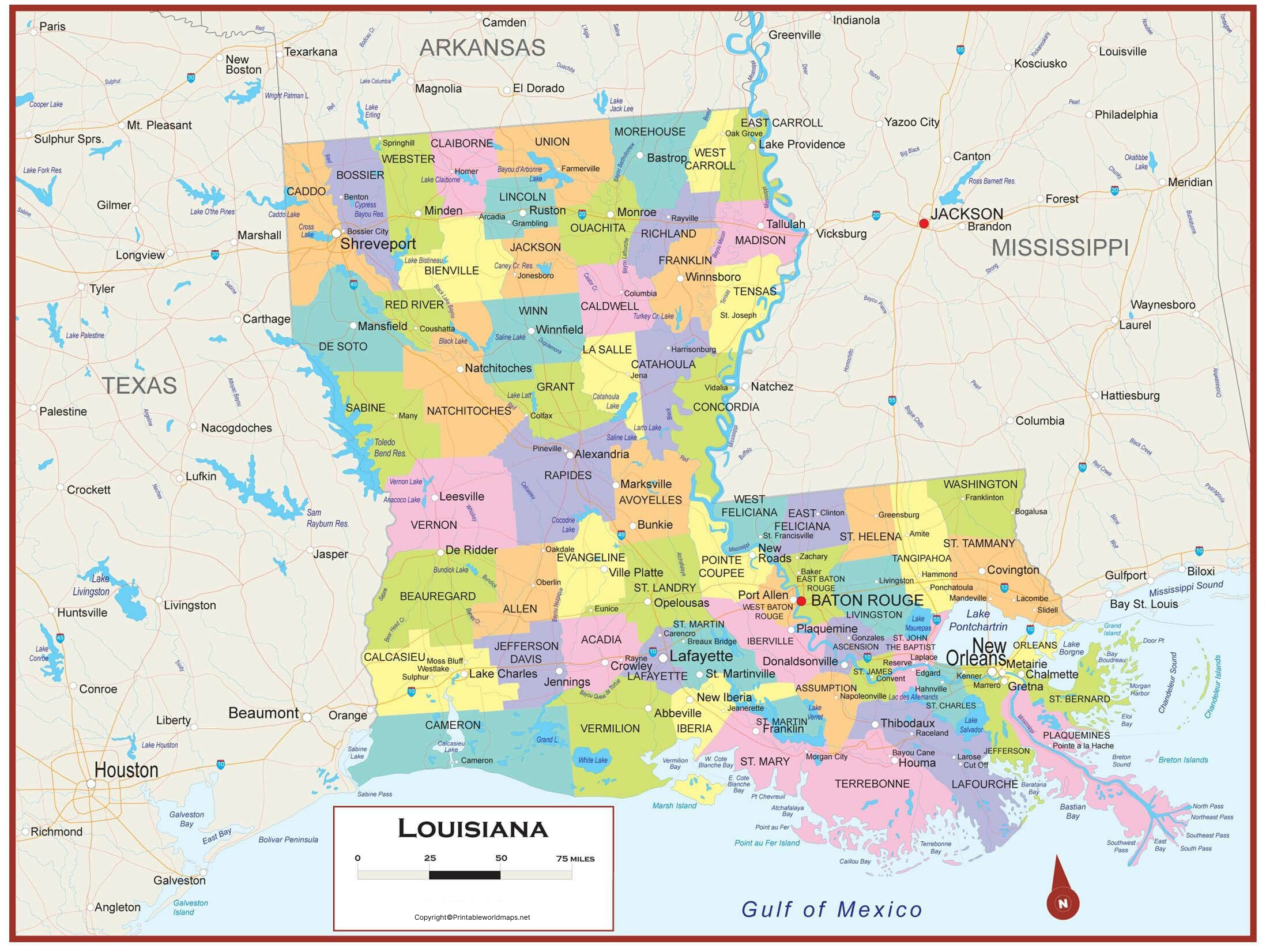

A Labeled Map of Louisiana helps you locate the state capital, major cities, parish boundaries, rivers, and important transportation routes. Louisiana is in the south-central United States, along the Gulf of Mexico, and shares borders with Texas, Arkansas, and Mississippi.
The state is known as the Pelican State and is recognized for its wetlands, Mississippi River Delta, distinctive cultural traditions, and important ports. Whether you are studying US geography, planning a trip, or looking for a printable reference, these labeled Louisiana maps make it easier to understand the state’s geography.
Quick facts about Louisiana
- Capital: Baton Rouge
- State nickname: The Pelican State
- Statehood: April 30, 1812
- Number of parishes: 64
- Estimated population: 4,618,189 in July 2025
- Bordering states: Texas, Arkansas, and Mississippi
- Major river: Mississippi River
- Postal abbreviation: LA
Population source: U.S. Census Bureau, 2025 population estimates.
Labeled Map of Louisiana
A labeled map of Louisiana shows the state’s location, boundaries, capital, major cities, and significant geographic features. Depending on the map, it may also display parish boundaries, highways, lakes, rivers, and other transportation routes.
Baton Rouge is the state capital and an important center for government, education, industry, and commerce. New Orleans, located near the Mississippi River and the Gulf Coast, is another major Louisiana city with significant cultural and economic importance.
Louisiana borders Texas to the west, Arkansas to the north, and Mississippi to the east. Its southern coastline meets the Gulf of Mexico.
Use the map below to identify the state’s location and understand how its cities, waterways, and neighboring states are arranged.
Labeled Map of Louisiana Printable
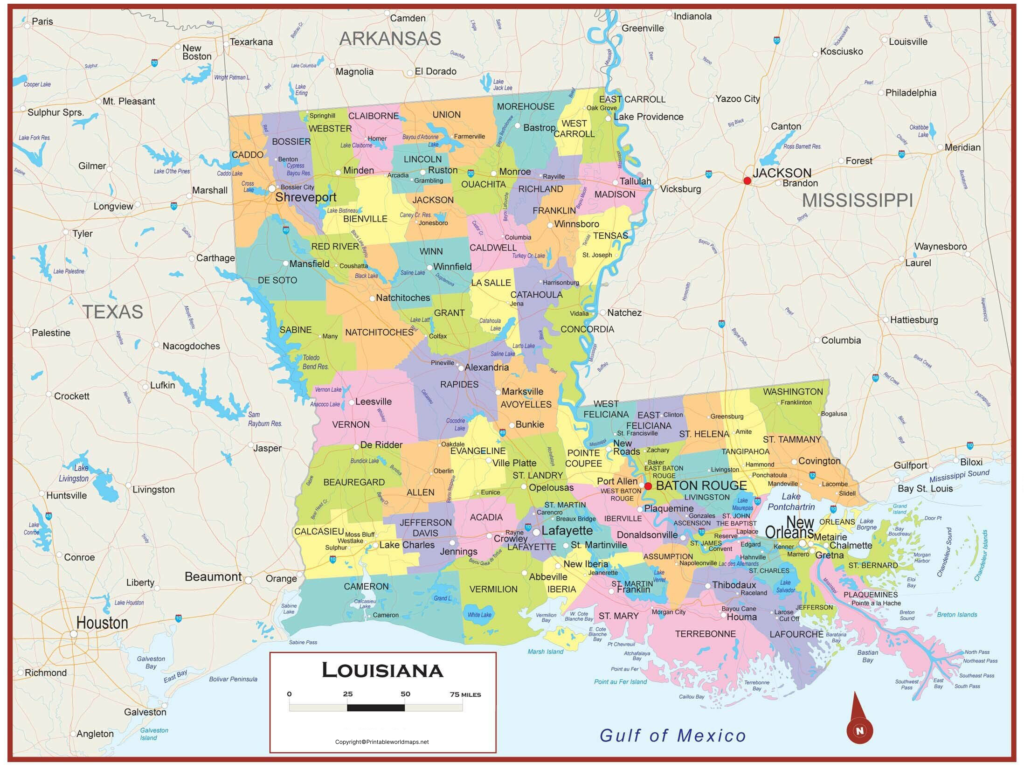
A printable Louisiana map is useful for classroom activities, geography assignments, travel preparation, and general reference. A PDF version is especially convenient because it can be printed or saved for offline use.
Choose a map according to the information you need. A general labeled map is useful for identifying major geographic features, while a map with state boundaries helps you understand Louisiana’s position in relation to neighboring states.
Printing tip: Check the PDF’s page orientation and print preview before printing. Select landscape orientation if it fits the map better, and use the fit-to-page setting to avoid cutting off labels or boundaries.
Labeled Map of Louisiana with Parishes
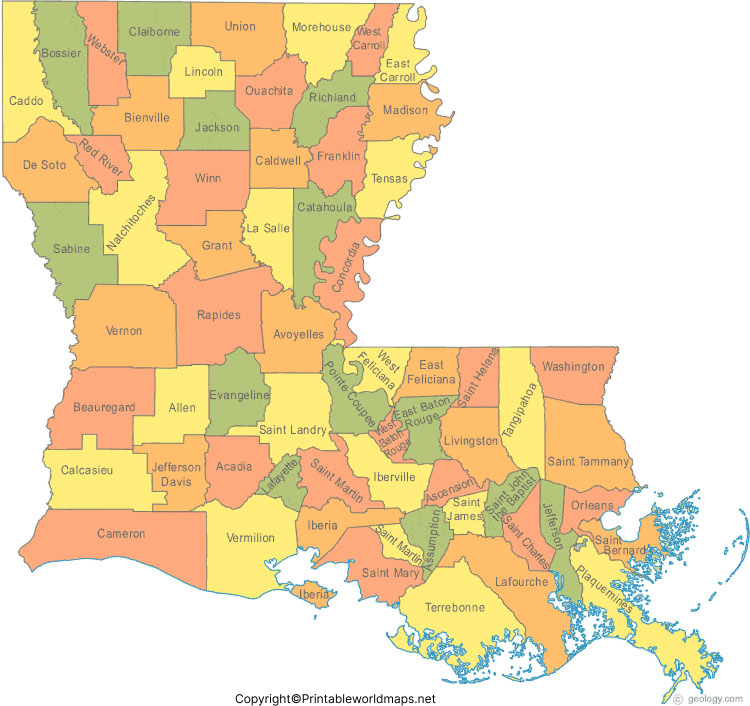
Louisiana is divided into 64 parishes, which serve a similar administrative role to counties in most other US states. This is one of the state’s distinctive geographic and governmental features.
A parish map helps readers identify local administrative boundaries and locate cities, communities, and regional areas. Some parish names include East Baton Rouge, Orleans, Jefferson, Lafayette, Caddo, Calcasieu, and St. Tammany.
East Baton Rouge Parish contains the state capital, Baton Rouge. Orleans Parish corresponds to the consolidated city-parish government of New Orleans.
Parish boundaries are especially useful for understanding local government, researching demographic information, and identifying the jurisdiction associated with a particular location.
Labeled Map of Louisiana with Cities
A Louisiana map with cities helps readers locate major population centers and understand their geographic distribution. The following cities are useful reference points when studying the state.
- New Orleans: A major cultural, tourism, and port city in southeastern Louisiana.
- Baton Rouge: Louisiana’s capital, situated along the Mississippi River.
- Shreveport: A major city in northwestern Louisiana, near the Texas border.
- Lafayette: A regional center in south-central Louisiana, associated with Acadiana and Cajun culture.
- Lake Charles: A southwestern Louisiana city with important industrial and port-related activity.
- Kenner: A city in the New Orleans metropolitan area.
- Bossier City: A northwestern Louisiana city located across the Red River from Shreveport.
These locations provide a useful starting point for exploring Louisiana’s urban geography. A map’s labels and level of detail depend on its scale, so smaller communities may not appear on every map.
For accurate population comparisons, use the latest US Census Bureau estimates rather than older population figures copied from outdated maps or articles.
Labeled Louisiana Map with Capital
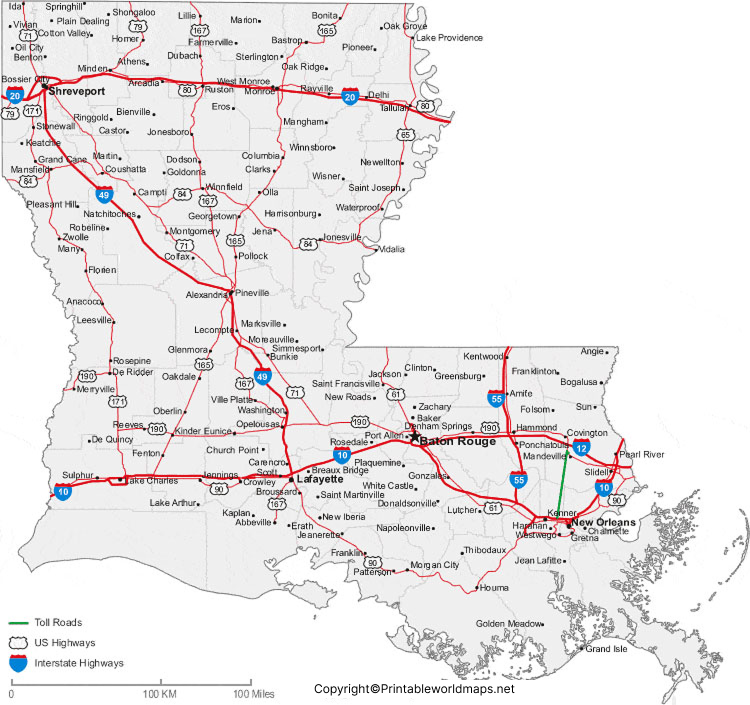
Baton Rouge is the capital of Louisiana. It is located in East Baton Rouge Parish in the southeastern part of the state, along the Mississippi River.
As the state capital, Baton Rouge is home to Louisiana’s principal state government offices, including the Louisiana State Capitol. Its location along the Mississippi River has also contributed to its importance in transportation, trade, and industry.
When using a labeled Louisiana capital map, look for Baton Rouge in the southeastern part of the state, north of the New Orleans area. A map with parish boundaries can help you see its relationship to East Baton Rouge Parish and nearby communities.
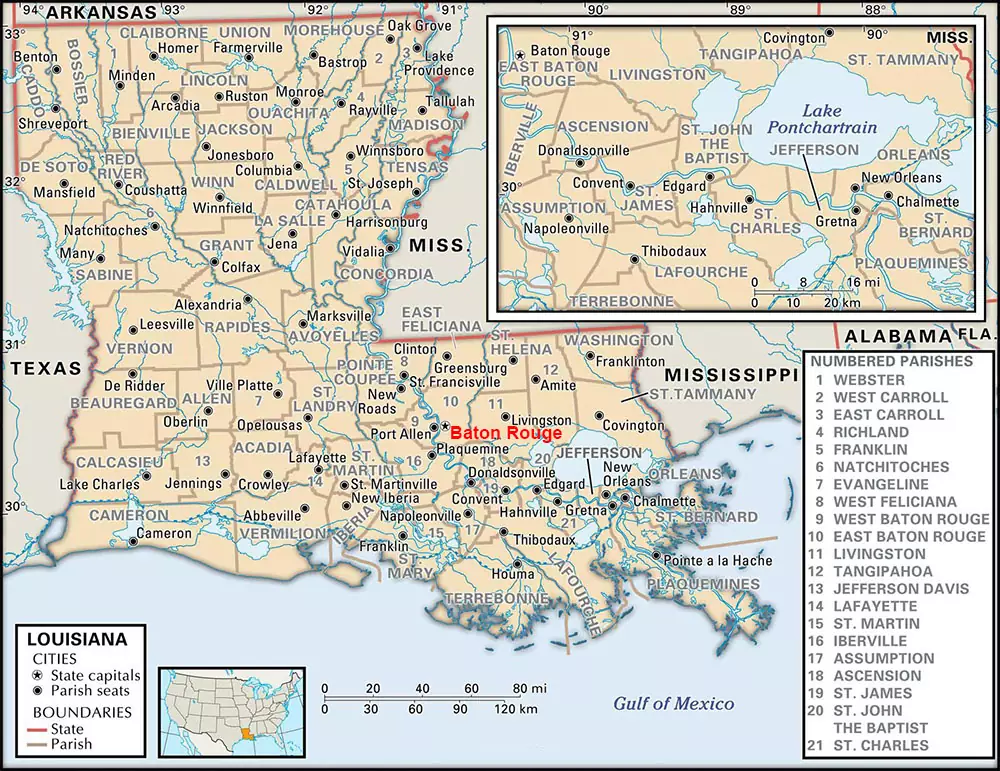
Major Rivers and Geographic Features of Louisiana
Louisiana’s rivers, wetlands, lakes, and coastal areas are important features of its physical geography. A detailed labeled map can help readers identify these features and understand how they relate to cities and state boundaries.
- Mississippi River: Flows through Louisiana and is central to the state’s transportation and port activity.
- Red River: Flows through northwestern and central Louisiana before joining the Mississippi River system.
- Atchafalaya River: Runs through an extensive wetland region and is associated with the Atchafalaya Basin.
- Sabine River: Forms much of the boundary between Louisiana and Texas.
- Ouachita River: Flows through northern Louisiana and joins the Black River.
Other notable features include Lake Pontchartrain, coastal marshes, and the Mississippi River Delta. These areas help explain Louisiana’s distinctive landscape and the importance of flood management and coastal protection.
How to Use a Labeled Louisiana Map
A labeled map can support a range of educational and practical tasks.
- For students: Identify Baton Rouge, neighboring states, major cities, and important rivers.
- For teachers: Use a printable map for geography worksheets and classroom quizzes.
- For travelers: Locate major cities and understand their positions within the state before planning a route.
- For researchers: Use parish boundaries as a starting point for locating official demographic and administrative data.
- For map collectors: Save or print the PDF for offline geographic reference.
For driving directions, road closures, or current travel conditions, use an up-to-date navigation service in addition to a static map.
Interesting Facts About Louisiana
- Louisiana became the 18th US state on April 30, 1812.
- The state has 64 parishes rather than counties.
- Baton Rouge is the state capital, while New Orleans is one of its best-known cultural and economic centers.
- The Mississippi River plays a major role in Louisiana’s shipping and port network.
- Louisiana contains extensive wetlands and coastal environments, including the Atchafalaya Basin.
- The state’s official nickname is the Pelican State.
These facts provide additional context for readers using the map for study, research, or travel planning.
Frequently Asked Questions About the Labeled Map of Louisiana
1. What is the capital of Louisiana?
Baton Rouge is the capital of Louisiana. It is located in East Baton Rouge Parish along the Mississippi River.
2. How many parishes are there in Louisiana?
Louisiana has 64 parishes. They are comparable to counties in most other US states.
3. What is the largest city in Louisiana?
New Orleans is Louisiana’s largest city by population. The US Census Bureau estimated its population at 362,154 on July 1, 2025.
4. Which states border Louisiana?
Louisiana borders Texas to the west, Arkansas to the north, and Mississippi to the east. The Gulf of Mexico lies to the south.
5. Where can I download a printable map of Louisiana?
You can use the printable map and PDF links provided in the sections above. Choose a map that includes the labels and geographic details required for your project.
6. What are the major rivers shown on a Louisiana map?
Major rivers include the Mississippi, Red, Atchafalaya, Sabine, and Ouachita rivers. Their locations are useful for understanding the state’s geography and transportation network.
7. What is Louisiana’s population?
The US Census Bureau estimated Louisiana’s population at 4,618,189 on July 1, 2025. Population estimates change over time, so consult the latest Census Bureau figures for updated statistics.
Reference links
https://www.census.gov/quickfacts/LA
https://www.census.gov/quickfacts/table/PST045215/2255000/accessible
